

Just over three months after being unceremoniously relegated to end-of-life maintenance mode and sent out to pasture, Destiny 2 has pulled off one of the most astonishing comebacks in modern video game history. In a stunning reversal that has sent shockwaves through the industry, Bungie announced yesterday that the sci-fi live-service titan is officially being rescued from its mothballed state. Studio leadership has declared that the franchise is once again "foundational" to its long-term future, complete with plans to un-vault massive amounts of paid historical content that had previously been excised from the game.
For a community that spent months staring down the barrel of a permanent blackout, the news was met with an intoxicating mixture of absolute euphoria, vindication, and lingering disbelief. But beneath the celebratory haze of content creators popping champagne and veteran players dusting off their digital armor lies a complex web of corporate miscalculations, unprecedented fan activism, and difficult questions regarding the game’s future.
Main Facts: The Resurrection of a Live-Service Giant
The core facts of yesterday’s announcement mark a staggering about-face for developer Bungie and parent company Sony:
- The End-of-Life Reversal: Destiny 2, which was officially transitioning into a static, un-updated state as of June, has been pulled out of its sunset phase.
- The Return of Vaulted Content: As an initial gesture of good faith to disgruntled players, Bungie has confirmed that development has already begun to restore previously removed content—including major campaigns, planets, and raids that players had originally paid for before falling victim to the Destiny Content Vault (DCV) initiative.
- A Shift in Corporate Priority: Studio leadership has explicitly pivoted away from phasing out the franchise, affirming that Destiny remains a foundational pillar for Bungie’s commercial and creative roadmap moving forward.
- The Catalyst: The dramatic U-turn follows a relentless, three-month grassroots and social media campaign spearheaded by the player base and prominent community content creators, directly targeting Sony’s corporate oversight and demanding a future for the franchise.
Chronology: From the Brink of Death to the Halls of Victory
To understand the magnitude of yesterday’s announcement, one must look back at the volatile timeline that brought Destiny 2 to the edge of the abyss and miraculously dragged it back.
Phase 1: The Execution (Early 2024 – June 2024)
Cracked by internal turmoil, sweeping layoffs that purged vast amounts of institutional knowledge, and declining player sentiment, Bungie and its parent company, Sony, quietly set the wheels in motion to wind down Destiny 2. The messaging to the player base was clear: the live-service updates were coming to an end. The game was to be placed on life support, allowing the studio to pivot its finite resources toward fresh horizons, most notably its upcoming extraction shooter, Marathon.
Phase 2: The Insurgency (June – September 2024)
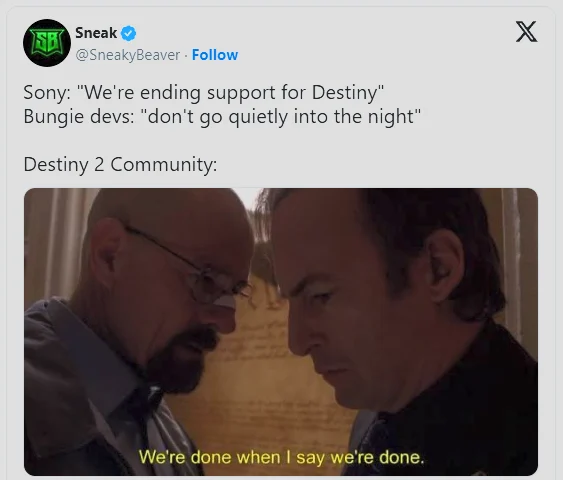
Rather than going quietly into the night, the Destiny community mobilized. Remembering the famous Dylan Thomas phrase—"Do not go gentle into that good night," which had been cryptically referenced by Bungie principal communications manager dmg04 around the time of the initial shutdown announcement—players launched a relentless counter-offensive.
For nearly a hundred days, Sony’s social media channels, live corporate showcases, and public-facing corporate accounts were inundated with a single, deafening demand: We Want Destiny 3. A Change.org petition demanding Sony spearhead a true sequel skyrocketed past 400,000 signatories. Bizarrely, even external communities, such as fans of Digital Extremes’ Warframe, stepped in to lend moral solidarity. Throughout this period, Destiny 2’s concurrent player numbers remained roughly six times higher than those of Bungie’s heavily pushed new darling, Marathon.
Phase 3: The Breakthrough (Yesterday)
Realizing the PR nightmare and commercial fallout of alienating one of gaming’s most fiercely loyal multi-million-player communities, leadership blinked. Bungie dropped its bombshell announcement: Destiny 2 is back, the vaulting process is being rolled back, and the franchise’s heart is beating once more.
Supporting Data and Community Metrics
The sheer weight of the player resistance is quantified by numbers that corporate executives simply could not ignore.
- 400,000+ Signatures: The community-led Change.org petition calling on Sony to develop Destiny 3 crossed a monumental threshold, proving the global demand for the intellectual property remained remarkably high.
- Player Retention vs. Marathon: Despite official support winding down, Destiny 2’s daily active user metrics and concurrent player numbers continued to dwarf those of Bungie’s nascent projects, making the decision to euthanize the cash cow look increasingly indefensible from a spreadsheet perspective.
- Cross-Platform Solidarity: The movement transcended standard YouTube echo chambers, bleeding into Reddit, X (formerly Twitter), and competing game spaces, creating a unified wall of resistance that made corporate isolation impossible.
Official Responses: Victory Laps Meet Measured Skepticism
The gaming internet erupted into celebratory chaos following the news, with content creators leading the charge in triumphant fashion.
The Voices of Triumph
Prominent lore historian My Name Is Byf released a video titled "We did NOT go quietly. We Won", directly drawing parallels to the defiant community pushback. Content creator Mactics opted for a succinct, joyous "DESTINY IS BACK… WE DID IT!", while industry insider and creator Aztecross—who had spent weeks hinting behind closed doors that a seismic shift was coming—posted a celebratory video addressed directly to the player base.
Perhaps the most visceral reaction came from creator Llama, whose live-streamed reaction captured him receiving the news in real time. Transitioning from utter shock to hysterical laughter and visible tears, his video encapsulated what the game meant to those who built their livelihoods around its universe.
The Voices of Caution
However, not everyone donned party hats. A distinct undercurrent of skepticism rippled across the community, particularly on Reddit’s r/DestinyTheGame, where threads titled "Please keep expectations in check" warned players not to blindly trust corporate messaging after years of broken promises and content removal.
Prominent veteran figures echoed these reservations. Datto took to social media to clarify his stance: "to anyone wondering: i am not unretiring from destiny. happy for y’all though! but i am gonna keep trying to do something new." When pressed further, he noted he had no plans to return specifically for sunset content.
Similarly, veteran creator Gladd sounded a sharp note of caution regarding the cyclical nature of hype:
"Here we go. Now everyone’s hopes are up. Most likely more unfulfilled promises. The ‘I-told-you-so’ people are gonna spam ‘We Won!’ And the folks with a single personality trait are gonna be let down… again. This seems like another repeated cycle."
Implications: Can Bungie Actually Pull This Off?
While the immediate emotional response is pure ecstasy, the long-term logistical reality of this decision is dizzying. Bungie faces an uphill battle fraught with monumental hurdles.
The Technical and Financial Dilemma
The fundamental dilemma that drove Bungie to implement the Content Vault in the first place has not magically vanished. Destiny 2 is a bloated, aging monolith of code. How does a studio create enough fresh, high-quality content to satisfy a ravenous endgame player base without driving production costs through the roof and making file sizes unmanageable for modern hardware?
Compounding this problem is the devastating human cost of previous corporate restructuring. With a massive percentage of the studio laid off over the past two years, an irreplaceable amount of institutional knowledge walked out the door. The developers who originally built these systems may no longer be at Bungie, leaving the current skeleton crew to untangle a complex web of legacy code in order to un-vault paid expansions.
The Sony Factor and C-Suite Fragility
From a broader industry perspective, this incident offers a rare glimpse into the fragile psychology of modern AAA corporate executives. Major hardware manufacturers and publishing conglomerates rarely bow to social media pressure. Canceling a live-service cash cow only to reverse course three months later is practically unprecedented.
It is clear that Sony’s C-suite—already battered by controversies surrounding physical media, shifting platform strategies, and marketplace saturation—did not anticipate the ferocious, unyielding scale of the Guardian pushback. They severely underestimated the value of brand equity tied to a ten-year-old franchise.
Conclusion: A Victory for the Guardians
We will likely never know the exact internal calculations that transpired behind closed doors in Seattle and Tokyo. Whether the decision was driven by stark financial projections, panicked damage control, or genuine realization of value, one truth remains absolute: the community did have an impact.
For a franchise fundamentally built around immortal warriors fighting against insurmountable, extinction-level odds, the community’s refusal to let Destiny 2 fade quietly into the dark is the most fitting lore-accurate victory imaginable. Whether Bungie can actually deliver on this miraculous second chance, however, remains the ultimate raid boss yet to be beaten.

