


As the superhero film landscape continues to shift and evolve, DC Studios is taking a bold, unyielding step into the macabre. Scheduled for release on October 23, Clayface promises to completely redefine what audiences expect from a comic book adaptation. Rather than offering a standard cape-and-cowl blockbuster, director James Watkins and his creative team have crafted a relentless, R-rated villain origin story rooted deeply in classic body horror.
Centering on the tragic and terrifying transformation of Matt Hagen—an up-and-coming Hollywood actor pushed to the brink—the film leans heavily into practical effects, psychological torment, and visceral terror. For fans eagerly awaiting the next chapter in the DC universe, Clayface is poised to deliver an experience far removed from anything the genre has seen in years.
Main Facts: A Grisly Descent Into Madness
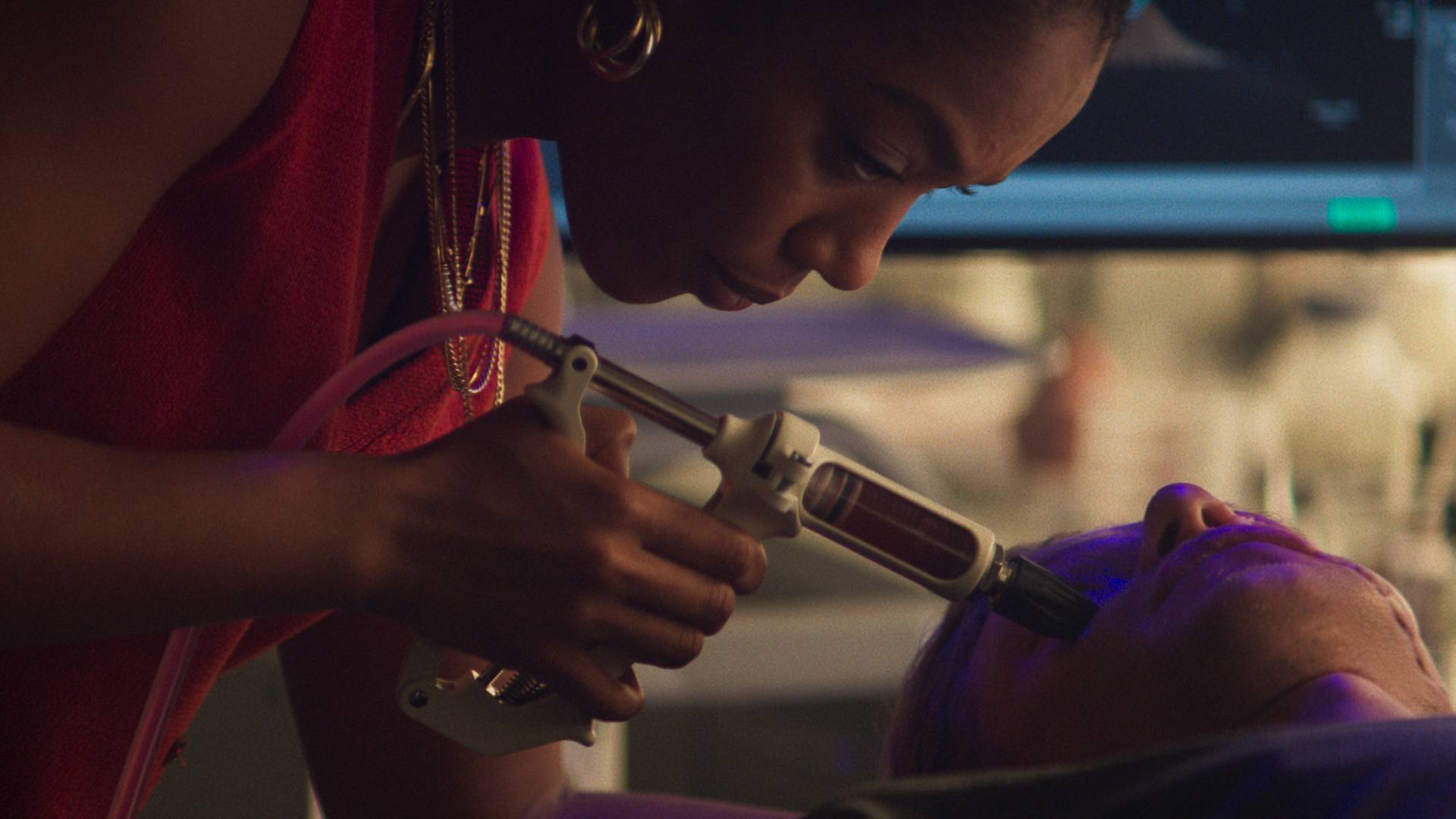
At its core, Clayface is a character-driven psychological tragedy masquerading as a monster movie. The narrative follows Matt Hagen, an ambitious young actor whose life is derailed after he is horrifically disfigured in an attack by a ruthless mobster. Desperate to reclaim his career, his appearance, and his life, Hagen undergoes an experimental medical treatment administered by Dr. Caitlyn Corr.
While the procedure initially works, granting him unprecedented shapeshifting abilities, it comes with a horrific price. Hagen’s biology becomes completely unstable; whenever he experiences intense emotions, he loses absolute control over his own physical form, leading to grotesque mutations.
- Release Date: October 23
- Key Cast: Tom Rhys Harries as Matt Hagen/Clayface; Naomi Ackie as Dr. Caitlyn Corr; Max Minghella as GCPD cop John Borrelli.
- Director: James Watkins
- Cinematographer: Rob Hardy
- Tone & Rating: R-rated; heavy emphasis on practical body horror, psychological dread, and the grimy, neon-lit aesthetics of Gotham City.
Chronology: Crafting a Modern Monster Movie
The journey to bring Clayface to the big screen as a pure horror film was an intentional choice by director James Watkins, who sought to capture the unpredictable thrills of a traditional horror experience.
Seeking Inspiration from Masters of Horror
When conceptualizing the film’s visual identity and tone, Watkins looked backward to move forward, drawing heavy inspiration from the golden era of practical effects and psychological horror. During interviews in London, the director cited legendary filmmakers and milestones of the genre as his primary blueprints.
"In terms of movies, I guess I’d probably look back to the films that I really liked when I was growing up and drew inspiration from those," Watkins explained. He specifically pointed to the pioneering body horror of David Cronenberg, calling out films like Videodrome and The Fly as massive touchstones. Alongside those, he referenced John Carpenter’s The Thing and An American Werewolf in London.
"Brilliant films that have the body horror, but they have a kind of humanity to them," Watkins noted. "They have a human story that grounds it, that makes you connect with the characters, and that’s why I think those films are so good."
Bringing Practical Effects to Life
Rather than relying solely on computer-generated imagery to render Hagen’s terrifying transformations, the production prioritized tactile, practical filmmaking. Lead actor Tom Rhys Harries spent hours in the makeup chair, wearing extensive facial prosthetics that fundamentally dictated his physical performance on set.
Harries recalls having to completely recalibrate his acting style to compensate for the heavy layers of artificial skin. "We had conversations with James Watkins on set where I’d have prosthetics that were covering the majority of my face," Harries said. "If I was to smile through these prosthetics, I learned fairly quickly that if I was hitting like a 20% smile, it wouldn’t read as 20%, it would read at like two. So, I had to really push it."
This commitment to physical performance extended to the film’s cinematography. Working alongside director of photography Rob Hardy, the crew managed to balance the visceral, vibrant color palette required for modern cinema with the dark, dingy, claustrophobic essence traditionally associated with Gotham City.
Supporting Data & Behind-the-Scenes Production
The production scale of Clayface relied heavily on practical stunts, specialized set design, and intense physical commitment from its lead actors. Nothing highlights this more than one of the movie’s most talked-about and gruesome sequences: a scene set inside an airplane bathroom during a violent flight.
The Airplane Bathroom Sequence
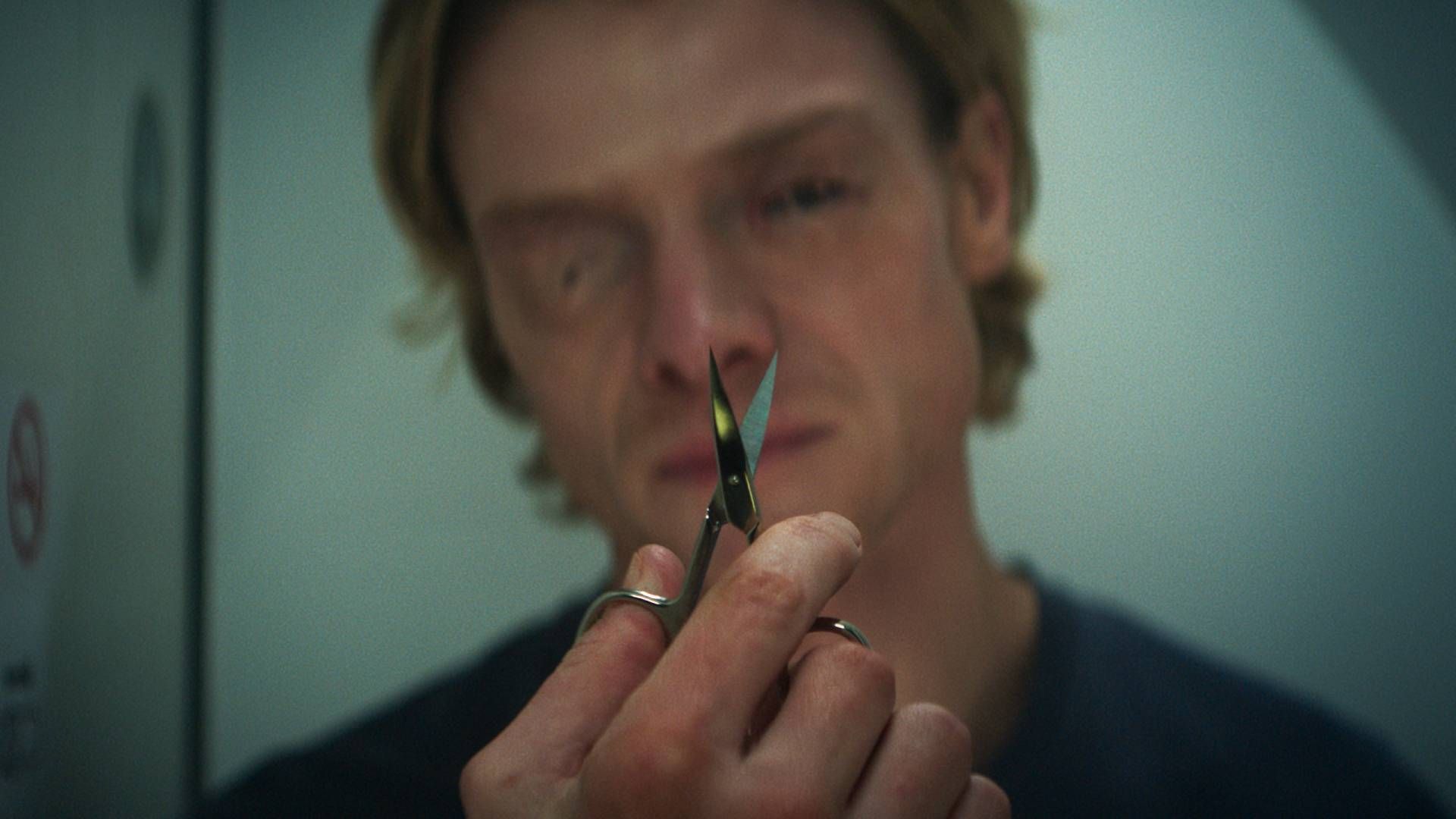
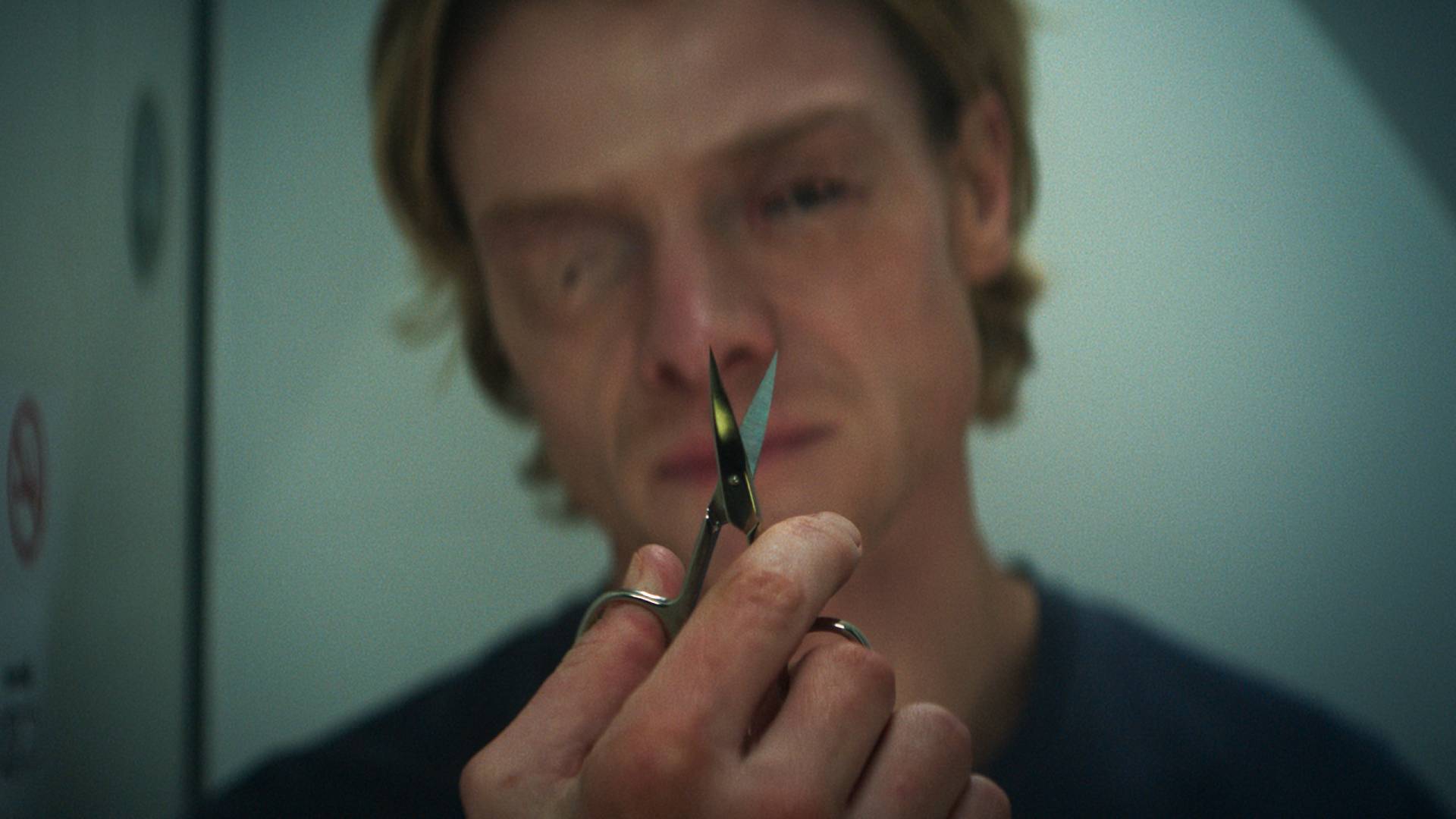
In the scene, a desperate Matt Hagen attempts to cut his own eyelids open with a pair of scissors while turbulence violently rocks the aircraft cabin. It is a sequence engineered to make audiences squirm, and achieving it required extensive technical coordination.
The crew built a partial plane cabin attached to air bellows to simulate realistic, chaotic movement. For the bathroom scenes, a separate set was mounted on a gimbal—a mechanical device capable of full rotation.
Furthermore, the prop department provided Harries with a literal arsenal of specialized scissors for the sequence. "He had, actually, four pairs of scissors," Watkins revealed. "There was a sharp pair, there was a dull pair, there was a rubber pair, and I think there was a pair that had the tip missing in case we needed to add it."
Despite having safe alternatives, Harries opted for realism. "He just sort of started getting stuck in with the sharp pair, and I was like, ‘Are we safe? Are we safe?’ And he’s like, ‘No, no, I got it, I got it,’" Watkins recalled.
The psychological impact of the scene bled onto the set immediately. Crew members monitoring the "video village"—the collection of monitors used by various departments to track takes—reportedly groaned out loud in horror. "I remember being at the monitors and people going, ‘Oh my god,’ and so I knew at that moment that we were tapping into something," Watkins said.
Official Responses and Cast Reactions
The communal, visceral reaction of watching a horror film with an audience is something the cast and crew believe will be one of Clayface‘s strongest selling points.
Max Minghella, who portrays GCPD officer John Borrelli in the film, emphasized the joy of the shared cinematic experience. "That’s sort of the most fun part, is the communal experience of seeing this film in a cinema with a big crowd and getting to scream and giggle and have that whole thing together," Minghella stated.
For Naomi Ackie, who plays the morally ambiguous Dr. Caitlyn Corr, stepping back to witness the final product was an electrifying experience. Ackie noted she was "buzzing" to see how all the chaotic narrative threads and visual components came together.
Tom Rhys Harries shared similar sentiments regarding the film’s brisk and unforgiving pace, praising the collaboration between Watkins and editor John Harris. Reflecting on an early private screening in Soho with just three people in the theater, Harries expressed immense pride: "I’m not an objective judge of it, so I’m looking at it from a fairly technical standpoint, but I’m really proud of all the different departments and what we’ve got, and I’m so excited for people to see it."
Implications: A New Era for DC Studios
The release of Clayface carries significant weight for the future direction of DC Studios. By greenlighting an R-rated, director-driven body horror project centered on a lesser-known Batman rogue, DC is signaling a clear willingness to diversify its cinematic portfolio.
For years, comic book adaptations have largely adhered to four-quadrant, PG-13 formulas designed to appeal to the widest possible demographic. However, the immense success of similarly gritty, character-focused genre experiments has proven that moviegoers are hungry for riskier, more specialized storytelling. Clayface proves that DC Studios is willing to embrace genre-specific filmmaking—treating a comic book property not just as a superhero spectacle, but as a vehicle for pure, unadulterated psychological horror.
If Clayface succeeds in theaters this October, it could pave the way for more unexpected, niche villains to receive standalone horror or thriller adaptations, permanently expanding the boundaries of what a comic book movie can be.

