

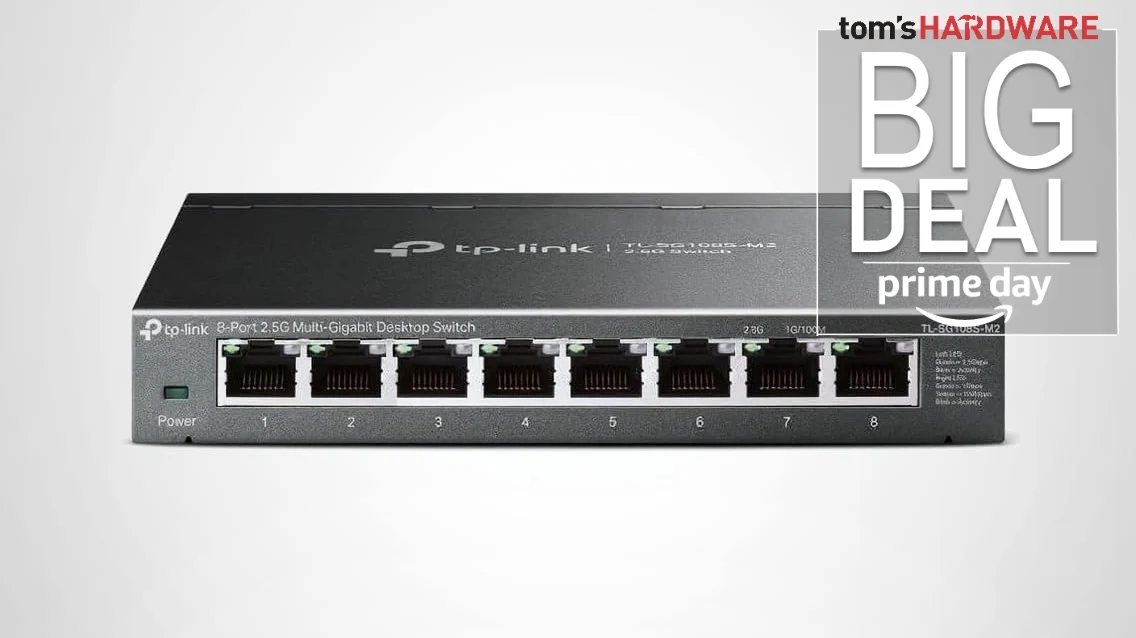
NEW YORK, NY – [Date of Publication] – In a move set to electrify home network enthusiasts and small business owners alike, TP-Link, a global leader in networking devices, has slashed the price of its highly anticipated TL-SG108S-M2 unmanaged 8-port 2.5 Gigabit Ethernet (GbE) switch to an astonishing $49.99 during a special Prime Day event on Amazon. Originally retailing at an MSRP of $79.99, this substantial discount represents a significant opportunity for consumers to upgrade their network infrastructure without breaking the bank, offering premium performance that was once relegated to much higher price points.
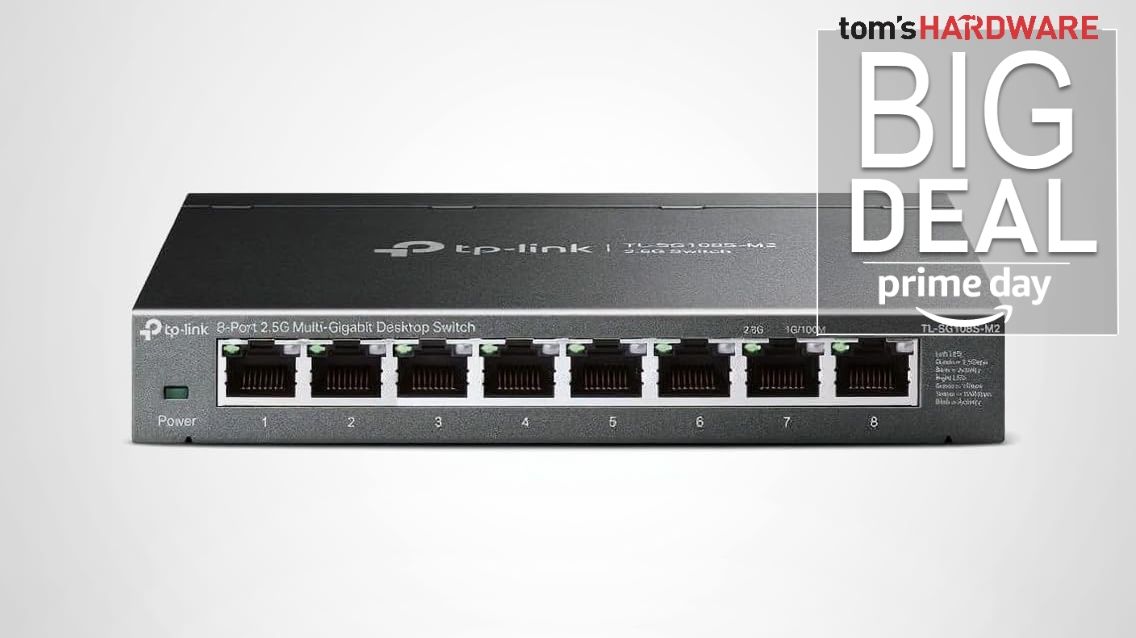
The TL-SG108S-M2 is more than just another network switch; it is a gateway to a significantly faster, more responsive, and future-proof digital environment. With eight ports capable of delivering speeds up to 2.5 Gbps, and a robust 40 Gbps switching capacity, this compact, silent, and durable device is poised to become an indispensable component for anyone looking to maximize their internet connection, accelerate file transfers, and enhance overall network efficiency in both home and small office settings. The allure of an 8-port 2.5 GbE switch falling below the $50 mark is a compelling testament to the evolving accessibility of high-speed networking technologies, signaling a new era for mainstream connectivity.
Main Facts: A Game-Changer for Modern Networks
The core appeal of the TP-Link TL-SG108S-M2 lies in its potent combination of performance, simplicity, and now, unparalleled affordability. At its heart, this is an unmanaged switch, meaning it requires no complex configuration or software installation—it’s truly plug-and-play. This characteristic makes it ideal for users who desire immediate network expansion and speed upgrades without the steep learning curve often associated with more advanced managed solutions.
The device boasts eight 2.5 Gigabit Ethernet ports, a crucial specification in today’s bandwidth-hungry world. While 1 Gigabit Ethernet (1 GbE) has been the standard for over a decade, the advent of faster internet service providers (ISPs) offering multi-gigabit speeds (like 2.5 Gbps, 5 Gbps, or even 10 Gbps fiber) and the proliferation of Wi-Fi 6/6E routers capable of exceeding 1 Gbps wireless throughput, has created a significant bottleneck within many home and small office networks. The TL-SG108S-M2 directly addresses this by allowing compatible devices to communicate at 2.5 times the speed of traditional Gigabit Ethernet.
Furthermore, its impressive 40 Gbps switching capacity ensures that all eight ports can operate at full 2.5 Gbps speeds simultaneously in full-duplex mode without any internal bottlenecks. This non-blocking architecture is vital for maintaining peak performance even under heavy network load, ensuring smooth data flow for applications ranging from high-resolution video streaming and online gaming to large file transfers to and from Network Attached Storage (NAS) devices.
The physical design of the TL-SG108S-M2 also contributes to its practical appeal. Housed in a sturdy, all-metal casing, it promises durability and efficient heat dissipation. Crucially, it employs passive cooling, meaning it contains no fans, thus generating zero operational noise. This silent operation is a significant advantage for home offices, bedrooms, or any environment where acoustic pollution is a concern. Its compact dimensions (6.22 x 3.98 x 1 inches) allow for flexible placement, whether tucked away on a desk, behind a monitor, or mounted discreetly on a wall using its integrated mounting points.
The Prime Day price of $49.99 transforms the TL-SG108S-M2 from a compelling option into an almost irresistible proposition. As the author notes, this price point undercuts even a 6-port competitor previously purchased for $10 more, highlighting the exceptional value TP-Link is offering. This aggressive pricing strategy positions the TL-SG108S-M2 as a benchmark for affordable multi-gigabit networking, making high-speed connectivity accessible to a broader audience than ever before.
The Rise of 2.5 Gigabit Ethernet: A Chronology of Network Evolution
Understanding the significance of the TL-SG108S-M2 requires a brief look at the evolution of local area networks (LANs) and the increasing demand for bandwidth.
Early Days: From Dial-Up to Fast Ethernet (10/100 Mbps)
For many years, home and small office networks were relatively rudimentary. The internet itself was often accessed via dial-up modems, followed by early broadband connections like DSL and cable, which offered speeds measured in kilobits or low megabits per second. Internal networks primarily facilitated basic file sharing and printer access. The dominant standard for wired connections during this era was Fast Ethernet, supporting speeds of 10 Mbps or 100 Mbps. These speeds were more than adequate for the applications of the time, where streaming video was nascent and large file transfers were infrequent. Routers and switches were simple devices, often with just a handful of 10/100 Mbps ports, reflecting the limited demands placed upon them.
The Gigabit Leap: 1 Gbps Becomes Standard
The early 2000s marked a pivotal shift with the widespread adoption of Gigabit Ethernet (1 GbE). As broadband internet speeds increased and digital media consumption grew (MP3s, standard definition video), the 100 Mbps ceiling became a noticeable bottleneck. Gigabit Ethernet, offering ten times the speed at 1000 Mbps (1 Gbps), quickly became the new standard for wired connections on motherboards, network interface cards (NICs), and networking equipment. This leap provided ample bandwidth for most home users and small businesses for well over a decade, enabling faster internal file transfers, smoother local media streaming, and robust support for the then-emerging high-definition content. It became the bedrock of modern networking, allowing for efficient data exchange within a local network and seamless access to faster internet connections.
The Bottleneck Emerges: Why 1 Gbps Isn’t Enough Anymore
However, technological progress rarely stands still. In recent years, 1 GbE has increasingly shown its age, creating new bottlenecks:
- Faster Internet Service: Fiber optic internet connections and advanced cable modems now routinely offer speeds exceeding 1 Gbps, with 2 Gbps, 5 Gbps, and even 10 Gbps plans becoming more common. A 1 GbE router or switch cannot fully utilize these faster internet connections, effectively capping the maximum speed available to wired devices.
- Increased Internal Network Traffic: The digital lifestyle has intensified. Users now stream 4K and 8K video, play bandwidth-intensive online games, utilize cloud storage services, and increasingly rely on Network Attached Storage (NAS) devices for centralized backups and media servers. Transferring multi-gigabyte files (e.g., video projects, large game installs, RAW photos) between devices on a 1 GbE network can be a painfully slow process.
- Wi-Fi 6/6E and Beyond: Modern Wi-Fi standards like Wi-Fi 6 (802.11ax) and Wi-Fi 6E are capable of aggregate wireless throughputs far exceeding 1 Gbps. To ensure that these high-speed wireless networks can fully deliver their potential to wired backbones (like connecting an access point to the main router), multi-gigabit wired connections are essential. A Wi-Fi 6E access point connected to a 1 GbE switch will be artificially constrained.
- Multi-Device Households: The average household now has numerous connected devices, many of which are simultaneously demanding bandwidth. This cumulative demand can quickly saturate a 1 GbE network, leading to lag, buffering, and slow response times.
The 2.5 GbE Solution: A Cost-Effective Mid-Point
This is where 2.5 Gigabit Ethernet (2.5 GbE) emerges as a pragmatic and highly effective solution. While 10 GbE offers ultimate performance, the cost of 10 GbE switches, network cards, and often, the need for more expensive cabling (like Cat6a or Cat7 for longer runs) has kept it largely out of reach for the average consumer or small business.
2.5 GbE strikes a perfect balance. It provides a significant performance uplift over 1 GbE (2.5x faster) at a much more accessible price point than 10 GbE. Crucially, 2.5 GbE can run over existing Cat5e cabling for typical home and small office distances, eliminating the need for costly and disruptive re-cabling projects. This "sweet spot" positioning makes it the ideal upgrade path for the vast majority of users who are feeling the limitations of 1 GbE but don’t require or can’t afford full 10 GbE infrastructure. The TP-Link TL-SG108S-M2, with its 8 ports and sub-$50 price tag, perfectly embodies this strategic evolution, making the transition to faster networks both simple and affordable.
Unpacking the TL-SG108S-M2: Supporting Data and Technical Insights
The TP-Link TL-SG108S-M2 is not just a product; it’s a statement about the direction of consumer and small business networking. Its technical specifications and design choices are meticulously crafted to meet contemporary demands.
Core Specifications and Performance
- 8-Port Configuration: The provision of eight ports is highly practical. For a home, this means connecting a router, a primary desktop PC, a NAS, a gaming console, a smart TV, and still having ports available for future expansion or temporary connections. In a small office, it can link several workstations, a server, a network printer, and an access point.
- Unmanaged Operation: The term "unmanaged" is a key feature, not a limitation for its target audience. It means the switch operates without requiring any user configuration. You simply plug in your Ethernet cables, and the switch intelligently handles traffic forwarding. This contrasts with "managed" switches, which offer advanced features like VLANs, QoS, and port mirroring but require networking expertise to set up and maintain. For most home users and small businesses, the simplicity of an unmanaged switch is a significant advantage.
- Multi-Speed Compatibility: The TL-SG108S-M2 is designed for seamless integration into existing networks. Its ports auto-negotiate, meaning they can detect and operate at 100 Mbps, 1 Gbps, or 2.5 Gbps, ensuring compatibility with older devices while providing maximum speed for newer ones. This backward compatibility prevents the need for an entire network overhaul.
- 40 Gbps Switching Capacity: This metric is crucial. It represents the total amount of data the switch can process simultaneously across all its ports. For an 8-port 2.5 GbE switch, each port supports 2.5 Gbps in each direction (send and receive), totaling 5 Gbps per port in full-duplex. With 8 ports, 8 ports * 5 Gbps/port = 40 Gbps. This confirms that the switch has a non-blocking architecture, meaning it can handle maximum theoretical traffic on all ports concurrently without slowing down. This is vital for demanding applications where multiple devices are transferring data at high speeds.
Design and Durability
The construction of the TL-SG108S-M2 speaks to its professional intent:
- All-Metal Casing: Beyond aesthetics, an all-metal enclosure offers superior durability compared to plastic alternatives. It provides robust protection against physical damage and contributes significantly to thermal management. Metal is an excellent conductor of heat, aiding in the dissipation of warmth generated by the internal electronics.
- Passive Cooling: The absence of active cooling components (fans) is a deliberate design choice that enhances user experience. Fans introduce noise, draw power, and are potential points of failure due to dust accumulation. Passive cooling, relying solely on the metal casing and internal heatsinks to dissipate heat, ensures completely silent operation, making the switch suitable for any environment, from a quiet home office to a living room media center. It also reduces maintenance requirements.
- Compact Form Factor and Mounting Options: Measuring just 6.22 x 3.98 x 1 inches, the switch is remarkably small. This allows for discreet placement, whether it’s tucked away on a shelf, behind a monitor, or integrated into an entertainment unit. The inclusion of mounting points on the bottom provides additional flexibility, allowing users to secure the switch to a wall or under a desk, minimizing clutter and optimizing space.
Practical Applications for Home and Small Office
The versatility of the TL-SG108S-M2 makes it a valuable asset across various scenarios:
- Home Users:
- High-Speed Internet Distribution: Connect your multi-gigabit capable router to the switch, then distribute the full speed to wired devices like a gaming PC, smart TV, or Wi-Fi 6/6E access point.
- Gaming PCs: Wired connections offer the lowest latency and highest stability, critical for competitive online gaming. 2.5 GbE ensures your gaming rig isn’t bottlenecked by the network when downloading large game updates or streaming high-quality content.
- 4K/8K Media Streaming: Devices like NVIDIA Shields, Apple TVs, or dedicated media servers can benefit from 2.5 GbE when streaming uncompressed or high-bitrate 4K/8K content from a local NAS.
- Network Attached Storage (NAS): This is arguably one of the biggest beneficiaries. A NAS often serves as a central hub for backups, media libraries, and shared files. Upgrading the NAS connection to 2.5 GbE (if the NAS supports it) drastically reduces transfer times for large files, making backups quicker and accessing media smoother.
- Wi-Fi 6/6E Access Points: To fully leverage the multi-gigabit potential of modern wireless access points, they need a multi-gigabit wired uplink. The TL-SG108S-M2 provides the necessary 2.5 GbE connection.
- Small Office/Home Office (SOHO):
- Workstations: Professionals working with large files (graphic design, video editing, CAD, software development) will experience significantly faster file saves and loads from network drives or servers.
- Shared Network Printers: While printers themselves aren’t high-bandwidth devices, connecting them to a robust switch ensures reliable access for multiple users.
- Small Servers/File Servers: For small businesses utilizing local servers for applications or file storage, a 2.5 GbE connection improves server responsiveness and data access for connected clients.
- VoIP Systems: While not requiring massive bandwidth, a stable and high-capacity network backbone ensures voice quality and reliability for IP-based phone systems.
The Cat5e Advantage
A particularly attractive aspect of 2.5 GbE is its compatibility with existing Cat5e Ethernet cabling. Unlike 10 GbE, which often requires Cat6a or better for optimal performance over longer distances, 2.5 GbE can reliably operate at its full speed over standard Cat5e cables for runs up to approximately 100 meters (328 feet). This eliminates a major barrier to adoption—the costly and labor-intensive process of replacing existing network infrastructure. For most homes and small offices already wired with Cat5e, upgrading to 2.5 GbE is as simple as swapping out their 1 GbE switch for the TL-SG108S-M2 and ensuring their endpoints (PCs, NAS) have 2.5 GbE compatible NICs.
Official Responses and Market Context
The launch and aggressive pricing of the TP-Link TL-SG108S-M2 are not isolated events but rather strategic moves within a dynamic market.
TP-Link’s Vision for Consumer Networking
TP-Link has long been a dominant force in the consumer networking market, known for its extensive range of routers, switches, and Wi-Fi extenders. Their success is built on a strategy of delivering reliable, feature-rich products at competitive price points. The TL-SG108S-M2 aligns perfectly with this vision, showcasing TP-Link’s commitment to:
- Mainstreaming Advanced Technology: By offering an 8-port 2.5 GbE switch at such an accessible price, TP-Link is actively working to bring multi-gigabit networking out of the niche enthusiast market and into the homes and small businesses of everyday users.
- Simplicity and Ease of Use: The unmanaged nature of the switch reinforces TP-Link’s focus on user-friendliness. They understand that not every consumer wants or needs the complexity of enterprise-grade equipment, preferring reliable "set and forget" solutions.
- Quality and Reliability: The all-metal, passively cooled design speaks to TP-Link’s emphasis on building durable products that can withstand continuous operation without performance degradation or noise.
This product, and its pricing, can be seen as TP-Link’s proactive response to the growing demand for faster internal networks driven by advancements in internet services and Wi-Fi technology. They are positioning themselves to be at the forefront of the next wave of network upgrades.
Amazon’s Role in Driving Adoption
Amazon’s Prime Day event serves as a powerful catalyst for consumer adoption of new technologies. These events are characterized by aggressive discounts that often make previously premium products accessible to a broader audience. For TP-Link, leveraging Prime Day for the TL-SG108S-M2 allows them to:
- Generate High Sales Volume: The discounted price, coupled with Amazon’s massive reach, ensures a significant influx of sales, helping to establish the product firmly in the market.
- Increase Brand Visibility: Prime Day is a high-traffic shopping event, providing TP-Link with extensive exposure for their latest networking solutions.
- Gauge Market Demand: Sales data from such events can provide invaluable insights into consumer appetite for multi-gigabit networking, influencing future product development and pricing strategies.
Amazon’s platform facilitates dynamic pricing, allowing manufacturers to react swiftly to market conditions and competitive pressures, ultimately benefiting consumers with better deals.
Competitive Landscape and Value Proposition
The networking hardware market is intensely competitive, with numerous brands vying for consumer attention. The author’s personal anecdote—purchasing a 6-port 2.5 GbE switch from UGREEN for $59.97—underscores the TL-SG108S-M2’s exceptional value. For $10 less, TP-Link offers two additional ports and the backing of a globally recognized brand with a strong reputation for support and reliability.
This pricing strategy puts significant pressure on competitors, particularly smaller or newer brands, to match or exceed TP-Link’s offering. The "game-changer" aspect lies in establishing a new price-to-performance benchmark for 2.5 GbE switches. Consumers no longer have to compromise on port count or brand reliability to access multi-gigabit speeds. This shift will likely accelerate the decline in prices for other 2.5 GbE switches across the market, making the technology even more ubiquitous.
Implications for Consumers and the Future of Networking
The arrival of the TP-Link TL-SG108S-M2 at such an attractive price has far-reaching implications for individual users and the broader networking industry.
Empowering the Modern Digital Lifestyle
For consumers, the primary implication is the ability to unlock the full potential of their digital ecosystem. No longer will a 1 GbE bottleneck hinder the performance of a high-speed fiber internet connection, a cutting-edge Wi-Fi 6E router, or a fast NAS. Users can expect:
- Blazing-Fast File Transfers: Moving large video files, game installations, or extensive photo libraries between devices will become a matter of seconds, not minutes.
- Seamless 4K/8K Streaming: Buffering and stuttering will be significantly reduced, especially when multiple high-bitrate streams are active simultaneously.
- Responsive Online Gaming: Lower latency and higher sustained bandwidth contribute to a smoother, more enjoyable online gaming experience.
- Efficient Backups: Critical data backups to a NAS will complete much faster, encouraging more frequent and reliable data protection.
- Optimized Wi-Fi: By ensuring Wi-Fi 6/6E access points have a multi-gigabit backbone, wireless devices can achieve their theoretical maximum speeds, improving overall Wi-Fi performance throughout the home or office.
This upgrade significantly enhances the quality of life for anyone engaged in bandwidth-intensive activities, providing a tangible improvement in daily digital interactions.
The Democratization of High-Speed Connectivity
The most profound implication is the democratization of high-speed networking. Historically, multi-gigabit Ethernet was an expensive proposition, primarily reserved for enterprise environments or high-end prosumers. The TL-SG108S-M2’s sub-$50 price point shatters this barrier, making advanced networking accessible to:
- Budget-Conscious Consumers: Those who previously couldn’t justify the cost of multi-gigabit upgrades can now participate.
- Small Businesses and Startups: These entities can now build robust, high-performance networks without requiring significant capital expenditure on networking infrastructure.
- Home Lab Enthusiasts: The switch provides an affordable foundation for building more complex and faster home lab setups.
- Mainstream Users: Even average users who simply want to future-proof their networks are now empowered to do so with minimal investment.
This accessibility will accelerate the adoption curve of 2.5 GbE, making it a common feature in homes and small offices much sooner than if prices remained high.
The Shifting Paradigm: Beyond 1 Gigabit
This aggressive pricing signals a significant shift in the networking industry. It suggests that 1 Gigabit Ethernet, while still functional for many basic tasks, is slowly but surely moving towards obsolescence as the default standard. Just as 100 Mbps gave way to 1 Gbps, 1 Gbps is now yielding to 2.5 Gbps as the new baseline for performance-oriented wired connections.
This transition is crucial because it paves the way for even faster technologies. As 2.5 GbE becomes common and manufacturing processes become even more efficient, the cost of 5 GbE and eventually 10 GbE solutions will likely follow a similar downward trajectory. The TL-SG108S-M2 is not just an upgrade; it’s an accelerator for the entire multi-gigabit ecosystem, priming consumers and manufacturers for the next generation of networking speeds. It sets a new expectation for what affordable, high-performance networking should be.
Seizing the Opportunity
For interested consumers, the message is clear: the Amazon Prime Day sale on the TL-SG108S-M2 is a limited-time opportunity. Deals of this magnitude on essential networking hardware are rare and typically do not last long. Those considering an upgrade should act swiftly to secure this exceptional value. Before purchasing, it is advisable to quickly verify that existing devices (like your PC’s network card, NAS, or router) either already support 2.5 GbE or can be affordably upgraded with compatible network interface cards to fully capitalize on the switch’s capabilities. The TP-Link TL-SG108S-M2 at $49.99 is more than a good deal; it’s a strategic investment in the future of your digital connectivity.

