


As the global gaming community prepares for the highly anticipated NieR:Orchestra Concert 12026 [ YoRHa ] tour—a massive multi-city event spanning from August 2026 through March 2027—the spotlight turns once again to the ethereal, haunting, and fundamentally unique voice that defined the series: Emi Evans.
A Tokyo-based vocalist, lyricist, and one-half of the ambient duo freesscape, Evans has become synonymous with the NieR franchise. Her work, particularly her mastery of "Chaos Language," has elevated the soundtracks of NieR Replicant and NieR:Automata from mere background music to cornerstone elements of the games’ emotional architecture. In a recent conversation, Evans reflected on her unlikely career trajectory, the evolution of her vocal style, and the creative alchemy behind some of the most celebrated soundtracks in gaming history.
1. The Accidental Journey: From Indie Ambience to Gaming Icon
The trajectory of Emi Evans’ career is a testament to the power of serendipity. Before she was lending her voice to the sweeping orchestral scores of Yoko Taro’s masterpieces, Evans was carving out a niche in the Tokyo ambient music scene. Her entry into the video game industry was not the result of a calculated audition process, but rather a classic "friend of a friend" connection.
Her first foray into the medium was on the Etrian Odyssey Super Arrange albums. This initial step was facilitated by a chance introduction to composer Norihiko Hibino. After passing along a demo CD of her work with freesscape, the stars aligned, and she was invited to contribute. This pivotal moment laid the foundation for her later, more expansive work.

The NieR Connection
Her involvement with the NieR franchise follows a similarly organic path. While attending a party, Evans was struck by the music played by a DJ—music that resonated with the ambient, electronic sensibilities of her own duo. She handed the DJ her demo, scribbled with her contact information. As fate would have it, that DJ was a close acquaintance of Keiichi Okabe, the legendary composer behind the NieR series.
When Okabe began seeking a vocalist for a new project, he was presented with Evans’ demo. Though his initial search for a specific type of English singer did not immediately lead to her, he kept her in mind. When the NieR project entered full development, he reached out. The rest, as they say, is gaming history.
2. Defining Chaos Language: The Linguistic Philosophy
Perhaps the most significant contribution Evans has made to the NieR aesthetic is the creation of "Chaos Language." The concept originated from the mind of creative director Yoko Taro, who sought a vocal style that sounded like a human tongue but possessed no fixed, translatable meaning. The goal was to provide an emotional anchor for the music without tethering the player to specific words that might clash with the game’s narrative or the voice acting.
Linguistic Evolution
Evans describes the process of creating these languages as an act of "imagined drift." For the songs on NieR Replicant, Okabe would assign her a specific real-world language as a starting point. Evans would then research that language—listening to Gaelic or other obscure dialects—to capture its cadence, rhythm, and phonetic "flavor." She would then invent lyrics that mimicked how that language might sound if it had evolved or drifted for thousands of years in isolation.
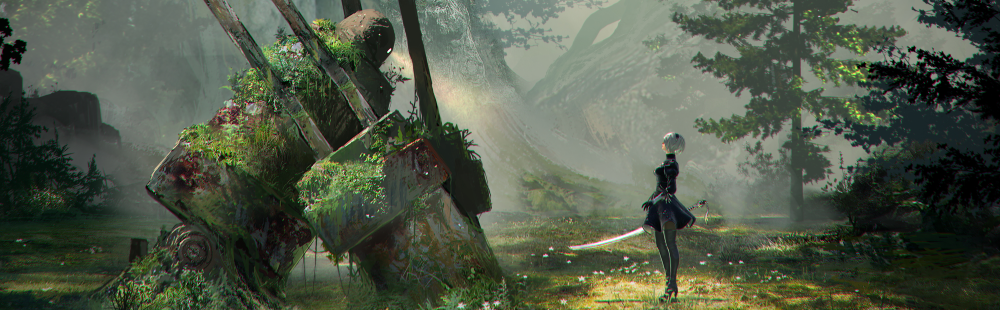
This approach reached a zenith in NieR:Automata. By the time work began on the sequel, Evans felt a newfound sense of confidence. "With NieR Replicant, it was my very first time to sing in my own made-up languages," she notes. "But thanks to all the positive feedback… when working on Automata, I had no worries to hold me back." She expanded her repertoire, incorporating influences from Bulgarian and the nearly extinct Chamicuro language, pushing the boundaries of what a "fictional" language could convey.
3. The Emotional Architecture of Kaine
For many fans, the track "Kaine / Salvation – Escape" remains the emotional apex of the original NieR. The song is a complex blend of vulnerability and raw aggression, mirroring the titular character’s turbulent life.
Evans’ approach to recording this piece was deeply informed by the character’s personality. "I was told a bit about Kaine’s feisty character in the studio," she explains. "When I recorded, I had this in mind and tried to sing with beauty and attitude!" By grounding the performance in the narrative context of the character, Evans transformed a song written in a constructed language into a visceral expression of grief, defiance, and survival.
4. Multilingual Performance: The Brain’s Divergent Paths
One of the most fascinating aspects of Evans’ career is how she navigates three distinct modes of songwriting: English, Japanese, and Chaos Language. She notes that these processes require entirely different cognitive "gears."

- English: As a native speaker, Evans finds the process of writing in English surprisingly laborious. Because she strives for poetic quality, she often collaborates with her father, a natural poet, to capture the specific emotional nuances she wishes to express.
- Japanese: Despite living in Tokyo, Evans relies on her close friend and fellow singer SAK to craft Japanese lyrics. This collaborative process ensures that the nuances of the language are handled with native-level precision.
- Chaos Language: Paradoxically, this is the easiest for Evans to recall. Because it is a phonetic construction of her own design, it flows with a natural intuition that the more rigid structures of standard languages lack. She describes it as being "in her element."
5. Beyond NieR: A Diverse Portfolio
While NieR remains her most visible work, Evans has consistently lent her talents to other innovative projects. Her collaboration with composer Lena Raine on Chicory: A Colorful Tale provides a stark contrast to the sweeping intensity of NieR. For the track "The Mountain Top," Evans was presented with pre-existing lyrics. She chose to rely entirely on her instincts, resulting in unexpected, complex harmonies that define the track’s ethereal atmosphere.
Similarly, her work on the Labyrinth of Refrain and Labyrinth of Galleria series with composer Tenpei Sato highlights her ability to adapt to different studio environments. Whether she is being directed through complex, layered choral arrangements or given the freedom to improvise, her vocal signature remains a unifying thread across disparate genres.
6. Implications for the Future: A Potential New NieR
When asked about how she would approach a potential new NieR title, Evans maintains a philosophy of perpetual discovery. Her creative process is not one of repetition, but of exploration. "I would try to create lyrics based on languages I’d never used before," she says. "It’s always such fun and so inspiring for me to immerse myself in completely new sounds."
This commitment to novelty is perhaps why the NieR soundscape remains so fresh. Even after years of contributions, Evans views every new project as an opportunity to dig deeper into the world’s linguistic and musical potential.
7. Official Perspectives and Legacy
The partnership between Evans and the Scarlet Moon agency has been a pillar of her career. Under the guidance of Jayson Napolitano, Evans has been able to bridge the gap between high-profile AAA titles and the vibrant, experimental world of indie games. The recent addition of J’Nique Nicole to the Scarlet Moon roster—a vocalist with her own strong NieR ties—signifies a continued commitment to fostering a community of artists who understand the unique demands of the medium.
A Note on the Daily Ritual
Beyond the grand scope of concert tours and global soundtracks, Evans’ life remains grounded in simple, human rituals. When asked about her coffee preferences—a lighthearted but telling detail—she describes a process that mirrors her music: precise, deliberate, and focused on quality. "Freshly ground and hot with no sugar and a splash of cream, please! And I also need a bite of chocolate to make my coffee time complete!"
As the NieR:Orchestra Concert 12026 approaches, audiences are not just attending a musical performance; they are witnessing the culmination of nearly two decades of artistic evolution. Emi Evans has proven that the human voice, even when stripped of the meaning provided by conventional language, possesses the singular power to connect, to heal, and to define the spirit of an entire generation of gaming. Whether she is singing in Gaelic-inspired phonemes or collaborating on an indie project, her work serves as a reminder that the most profound expressions are often those that defy easy explanation.

