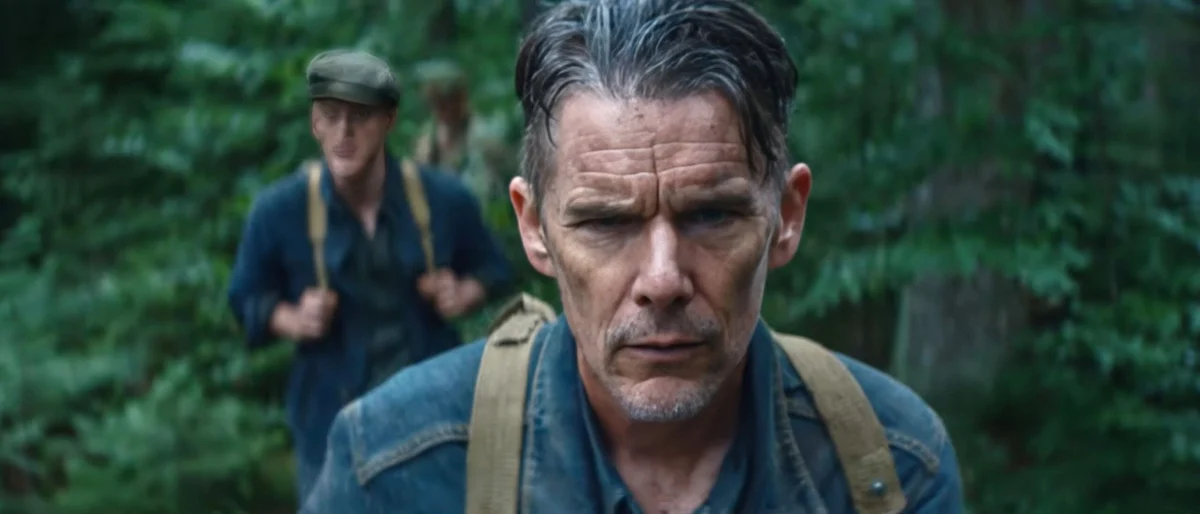
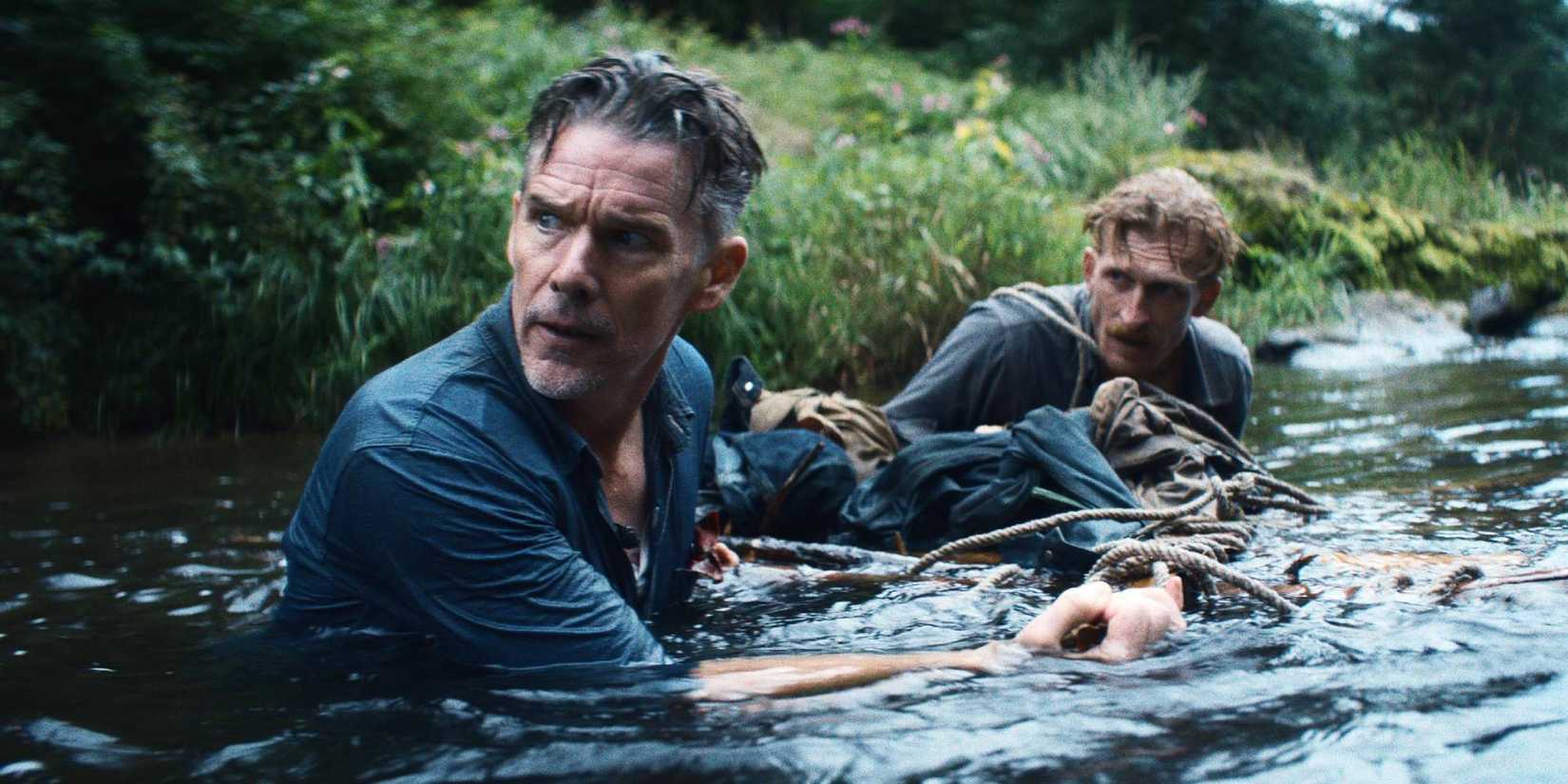
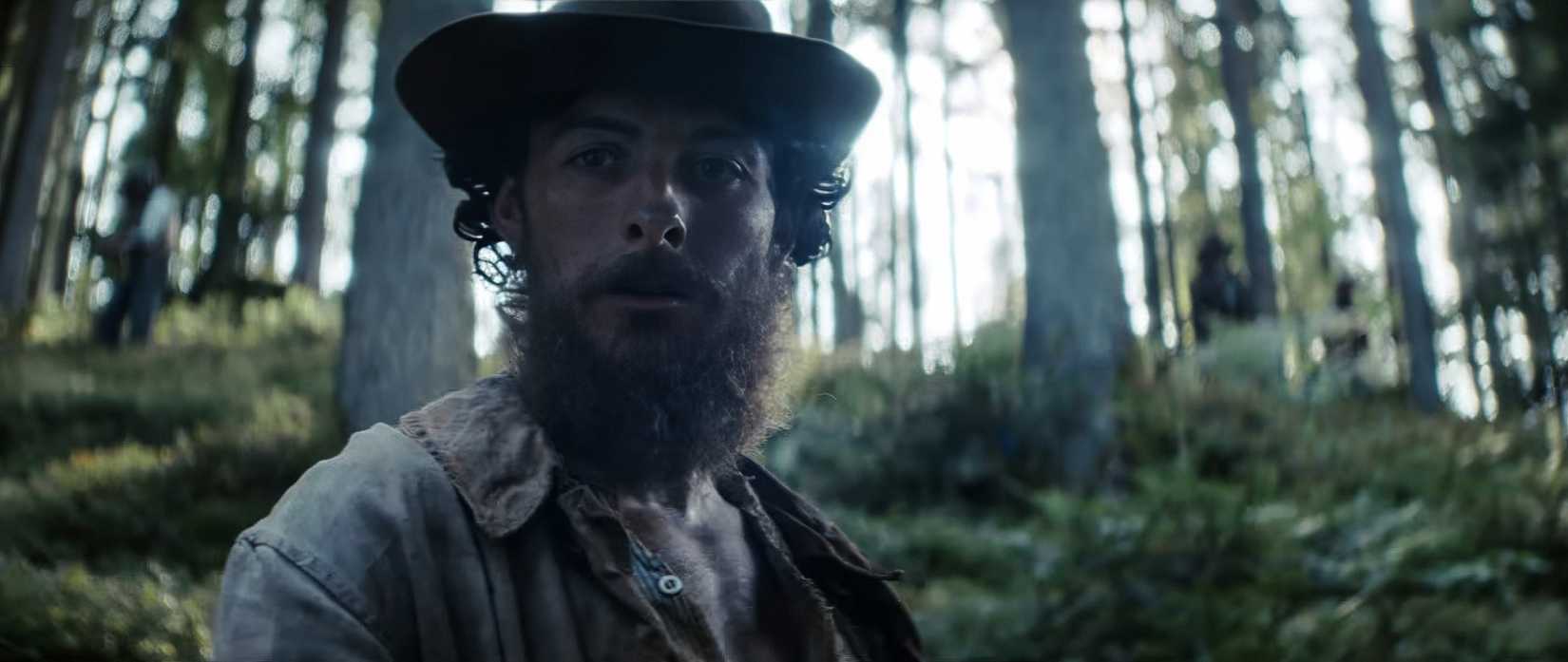
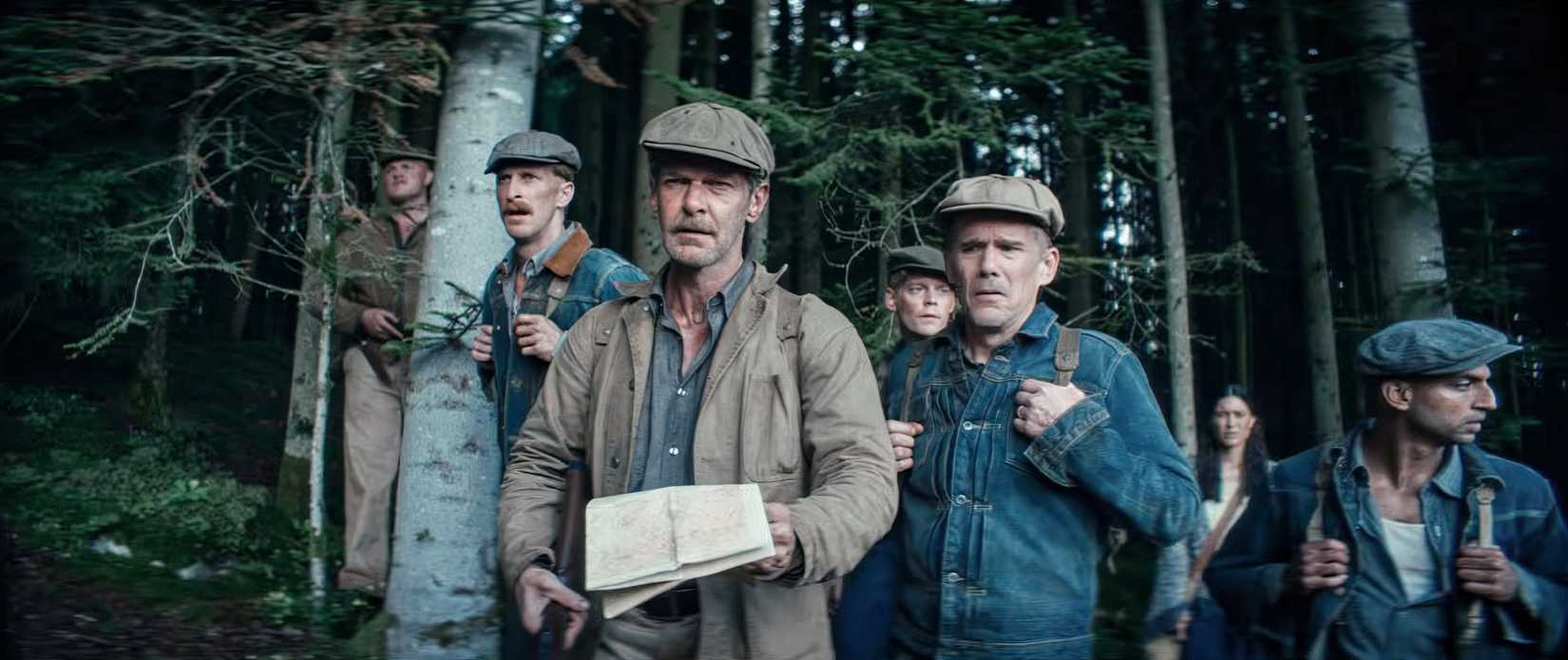
In director Padraic McKinley’s visceral historical drama The Weight, Ethan Hawke stars as Samuel Murphy, a down-on-his-luck single father navigating the unforgiving terrain of 1930s Oregon. Separated from his young daughter, Murphy is cast into a brutal work camp where survival is an hourly struggle. He forms a precarious alliance with a manipulative warden, portrayed by Russell Crowe, who dangles the carrot of an early release. The catch? Murphy must smuggle several bags of gold bars out of a heavily guarded mine before President Franklin D. Roosevelt’s New Deal administrators can seize them, delivering the payload to a clandestine drop-off point.
The cinematic journey features a tight-knit ensemble cast including two distrusting gold miners and an Indigenous runaway, played by Julia Jones, who joins the crew mid-escape. The production itself mirrored the narrative’s grueling nature: shot largely on location deep within the dense forests of the Bavarian region in Germany, the cast and crew contended with treacherous terrain, physical injuries, and isolation from modern conveniences. The film’s crown jewel—and its most harrowing set piece—is a heart-stopping crossing across a dangerously flimsy rope bridge, a sequence that pays explicit homage to classic cinema landmarks like William Friedkin’s Sorcerer and Indiana Jones and the Temple of Doom.
Chronology
Pre-Production and Location Scouting
The Search for the Wilds: Director Padraic McKinley and his production team faced the monumental task of transforming European landscapes into a believable, rugged stand-in for 1930s Oregon.
Engineering Peril: Production designer Cora Pratz was tasked with constructing a functional, safe rope bridge that retained the optical illusion of extreme danger. The bridge needed to sway dramatically, feature gaps wider than a human foot, and anchor safely while appearing entirely naturalistic.
Principal Photography in Germany
Deep Woods Isolation: The production moved deep into the Bavarian wilderness, effectively cutting the cast off from cell service and modern distractions to foster authentic immersion into the Great Depression era.
The Injury: Just twenty-four hours before filming the sequence’s most intense moments, Ethan Hawke suffered a minor hamstring tear due to "a variety of dumb reasons." Despite the physical setback, Hawke pressed forward, suspended over a simulated drop to catch and heave heavy, faux-gold bricks.
The Bridge Sequence Optimization: Because one side of the bridge was anchored securely to the ground while the other remained free-swinging, McKinley was restricted to shooting in only one direction. The crew executed the sequence using clever camera blocking, requiring actors to toss the gold one way, swapping backgrounds slightly, and having Hawke turn around to film the reverse perspective.
Post-Production and Release
Practical Magic: Eschewing heavy reliance on CGI, McKinley utilized traditional filmmaking techniques, incorporating only three visual effects shots for the iconic bridge sequence, drawing direct inspiration from multi-location classics like Indiana Jones and the Temple of Doom.
Theatrical Launch:The Weight officially opened in theaters on September 20, 2026, drawing critical acclaim for its gritty atmosphere, committed performances, and harrowing survivalist tension.
Supporting Data
Release Date: September 20, 2026.
Setting: 1930s Oregon (filmed primarily on location in Bavaria, Germany).
Key Cast Members:
Ethan Hawke as Samuel Murphy
Russell Crowe as the Work Camp Warden
Julia Jones as the Indigenous Runaway
Production Team:
Directed by Padraic McKinley
Production Design by Cora Pratz
Visual Effects Count: Only three digital VFX shots were utilized for the central rope bridge sequence, emphasizing the production’s commitment to practical stunts and physical immersion.
Cinematic Inspirations: William Friedkin’s Sorcerer (1977) and Steven Spielberg’s Indiana Jones and the Temple of Doom (1984).
Official Responses and Behind-the-Scenes Insights
The physical tolls of filming The Weight became a central theme for the cast and crew during promotional interviews. Rather than relying solely on green screens or controlled studio environments, the production leaned heavily into authentic physical exhaustion.
Ethan Hawke recounted the reality of working on the set to Polygon, highlighting the cumulative physical toll of the shoot:
"The day before he filmed The Weight‘s most intense scene, Ethan Hawke gave himself a minor injury. For a variety of dumb reasons, I pulled my hamstring… When you’re falling all over the ropes over a couple days, it really starts to hurt a lot. But I loved doing it because I believed in the movie and we had this great group of people around and our director was incredible."
Hawke also noted how the relentless nature of the environment bled into their performances:
"Pretty much every scene in this movie was stressful and difficult. Every day presented some kind of riddle that was much more difficult than I had imagined… Even if it’s just hiking a mountain. To get a shot where you can’t see anything means we have to be in the middle of nowhere. A lot of that was really fun. I look back so fondly on the talks we all had when we were getting ready to do shoots and walking through the woods. It’s fun in hindsight, but in the moment, there was the fear that something would go terribly wrong."
Co-star Julia Jones echoed these sentiments, pointing out the psychological and physical blurring between the actors’ reality and their characters’ struggles:
"As we filmed we’d get banged up… So the further we got into production, it did feel like we were getting deeper and deeper into the woods, but also, you have a sprained ankle now because of the jump you took yesterday. The irony of it is, that’s helpful as an actor, given the script."
Director Padraic McKinley detailed the logistical hurdles of crafting a cinematic masterpiece using practical ingenuity rather than digital trickery. Discussing the construction of the infamous bridge, McKinley explained:
"Our production designer, Cora Pratz, was able to build this bridge that was stable and safe, but really swung, and you could go over, no problem. All the gaps in it were bigger than your foot. So if you didn’t watch your step, you were falling through."
Addressing the logistical challenges of shooting on the swinging structure, McKinley added:
"We shot one group of people throwing the gold bricks this way, and then we switched out the backgrounds a little and shot the other people… Ethan basically just turned around. It wasn’t without its own set of treachery, but it wasn’t quite as bad as it looks—a little bit of movie magic."
To capture the vast, disorienting wilderness of the Pacific Northwest within European borders, McKinley turned to cinematic history for guidance:
"We took much more of a cue from the Sorcerers of the world… We looked at Indiana Jones, where they shot it in three different countries, three different locations. We borrowed from the best, and we took some angles that they used in Indiana Jones and the Temple of Doom. There’s three VFX shots in it. The rest is all practical."
Implications
The release and production model of The Weight carry notable implications for the current landscape of dramatic and action-thriller cinema. In an era where blockbusters and mid-budget dramas alike frequently default to Volume stages and extensive computer-generated imagery, The Weight demonstrates the enduring power of physical, location-based filmmaking.
By immersing its actors in genuine isolation, forcing them to navigate actual uneven terrain, and relying on practical stunt work—such as the meticulously engineered swinging rope bridge—the production achieved a raw, tangible authenticity that resonates directly on screen. The physical fatigue, minor injuries, and psychological strain experienced by Hawke, Jones, and the supporting ensemble were not hidden away or masked by digital corrections; instead, they were harnessed as active catalysts for performance depth.
Furthermore, the film’s deliberate nods to gritty, high-stakes classics of the 1970s and 1980s (Sorcerer and Indiana Jones) signal a growing appetite among filmmakers and audiences for tactile, high-tension storytelling that values human vulnerability over digital spectacle. As The Weight plays in theaters, it stands as a testament to the fact that when artists willingly push past their physical limits in service of their craft, the resulting visceral impact cannot easily be replicated by algorithms or green screens.