

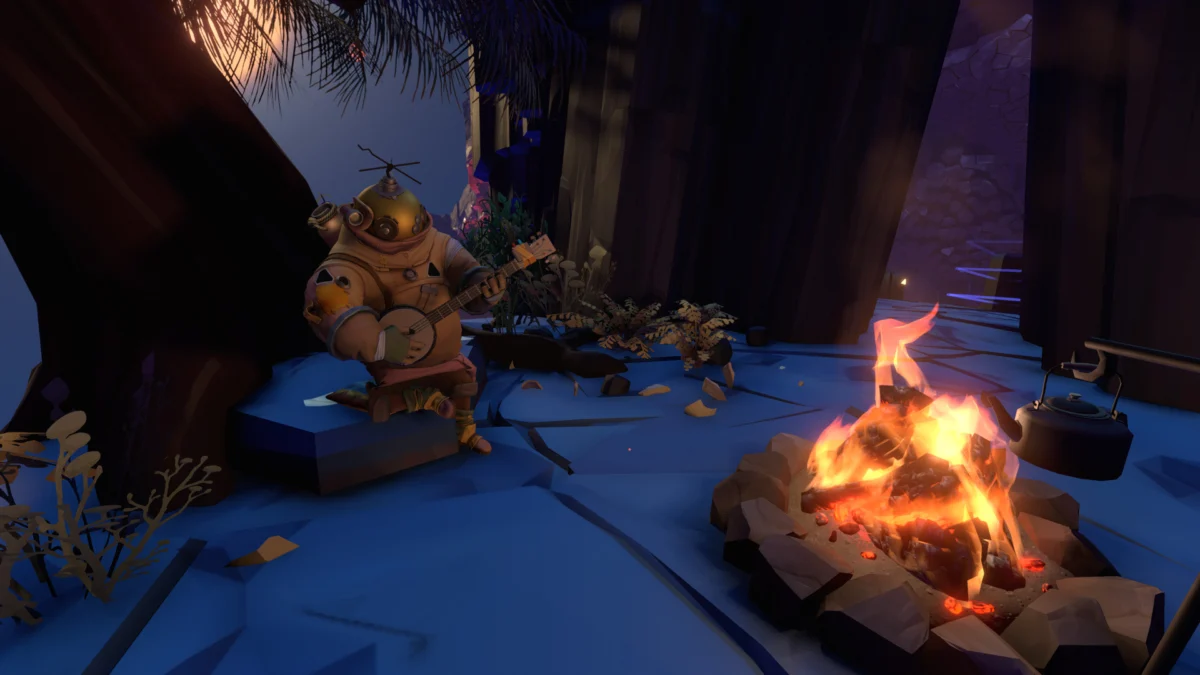
Since its initial release in 2019, Mobius Digital’s Outer Wilds has carved out a unique space in the pantheon of contemporary gaming. It is a title that defies easy categorization, straddling the lines between space exploration, puzzle-solving, and existential philosophy. While many games focus on power fantasies and progression, Outer Wilds focuses on the acquisition of knowledge—a currency more valuable than any upgrade or weapon. As we reflect on its enduring legacy, it becomes clear that this is not merely a game, but a profound experience that every gamer should encounter at least once.
The Core Concept: Knowledge as the Only Upgrade
At its heart, Outer Wilds is a game about a solar system trapped in a 22-minute time loop. You play as the newest recruit of Outer Wilds Ventures, a fledgling space program operating out of a rustic, wood-paneled space station. Your mission is simple: fly into the unknown, explore the planetary bodies surrounding your home world, Timber Hearth, and uncover the history of the Nomai, an ancient, advanced civilization that once inhabited this system.
However, the sun at the center of the system is destined to go supernova, destroying everything in its path. When the sun explodes, you are pulled back to the moment you first woke up, retaining only the knowledge you gained during your previous run. This loop is the game’s primary mechanic. There are no traditional upgrades—no better engines, no stronger shields. The only thing that evolves is the player’s understanding of the world. By treating knowledge as the only true progress, Mobius Digital created a game that respects the player’s intelligence and rewards curiosity above all else.
Chronology of a Cult Phenomenon
- 2012–2015: Development Origins: Outer Wilds began as Alex Beachum’s master’s thesis at the University of Southern California’s Interactive Media & Games Division. It caught the attention of developer Masi Oka, who helped form Mobius Digital to bring the project to a wider audience.
- 2015: Fig Crowdfunding: The game launched a successful Fig crowdfunding campaign, signaling significant interest from the indie gaming community.
- May 2019: Initial Launch: The game was released on PC (via the Epic Games Store) and Xbox One, followed by a PlayStation 4 release shortly after.
- 2020–2021: Critical Acclaim and Awards: During this period, the game swept numerous awards, including the BAFTA Games Award for Best Game and the Seumas McNally Grand Prize at the IGF Awards.
- September 2021: "Echoes of the Eye": The release of the highly anticipated expansion added a significant, standalone mystery to the existing game, further cementing its status as an essential title.
A Solar System of Dynamic Hazards
One of the most striking aspects of Outer Wilds is its commitment to simulation. The solar system is a clockwork machine. The planets are not static backgrounds; they are dynamic, shifting, and often lethal environments.
For instance, the planet Brittle Hollow is constantly crumbling into a black hole at its core. Giant’s Deep is a water-covered planet featuring massive cyclones that toss islands into space. Ash Twin and Ember Twin are binary planets connected by sand, with one slowly burying the other as the loop progresses. These hazards are not just obstacles; they are part of the narrative. Learning how these systems interact—and how to survive within them—is the fundamental thrill of the game.
The Philosophy of Failure
Many modern games are designed to prevent player failure through checkpoints and hand-holding. Outer Wilds does the exact opposite. Death is not a "Game Over" screen; it is a vital part of the loop. Each time you perish—whether by being crushed by falling debris, suffocating in the vacuum of space, or being swallowed by an anglerfish—you are provided with a new opportunity to approach a problem from a different angle.
This cycle of failure and discovery mimics the scientific method. You formulate a hypothesis ("I can reach that structure if I jump at this specific time"), you test it, you fail, you analyze the results, and you try again. This creates a sense of agency that few other titles can match. You aren’t following a quest marker; you are following your own intuition.
Official Reception and Critical Consensus
Upon its release, Outer Wilds was met with universal acclaim. Critics praised its narrative structure, which is told entirely through environmental cues and ancient text logs. The "non-linear" nature of the investigation means that two players can experience the game in entirely different orders, yet both will reach a cohesive and emotionally resonant conclusion.

In his review, various gaming outlets highlighted the game’s "indescribable" quality, noting that to spoil even the smallest detail would be a disservice to the player. The game’s soundtrack, composed by Andrew Prahlow, also received significant praise for its use of banjo and woodwind instruments, which perfectly capture the "campfire in space" aesthetic that permeates the title.
The Implications for Game Design
Outer Wilds proves that there is a massive appetite for games that trust the player. In an era where AAA titles often feel bloated with repetitive side quests and map markers, Outer Wilds offers a tightly focused, dense experience that respects the player’s time.
The game’s success has implications for the future of indie development:
- Narrative Integration: It shows that lore does not need to be forced through cutscenes; it can be woven into the fabric of the world itself.
- Player Agency: By removing the "power curve," it demonstrates that intrinsic motivation (the desire to learn) is a more powerful driver than extrinsic rewards (XP and gold).
- Experimental Mechanics: It serves as a blueprint for how to use time loops not as a gimmick, but as a central narrative and mechanical pillar.
A Challenge to the Player
If you are a gamer who enjoys being told exactly where to go and what to do, Outer Wilds will initially feel like a challenge. It is a game that requires patience. There are moments of genuine frustration where you may feel stuck, staring at a puzzle you don’t yet have the tools to solve. But those moments are deliberate. They are the friction that makes the spark of discovery feel so bright.
When you finally realize how the pieces fit together—when the mystery of the Nomai and the purpose of the Eye of the Universe finally clicks—the emotional payoff is profound. It is a rare game that leaves the player staring at the screen during the credits, contemplating their own place in the universe.
Final Verdict: Why You Should Play It Today
Even years after its launch, Outer Wilds remains a mandatory experience. It is the perfect antidote to the "sameness" of the modern gaming landscape. Whether you are looking for a game to lose yourself in during a holiday break or simply want to experience one of the most innovative designs in history, this is your sign to pick it up.
You don’t need to be a fan of space sims or puzzle games to appreciate what Mobius Digital has achieved. You only need to be curious. If you go into Outer Wilds with an open mind, you might just find that it changes the way you look at gaming—and perhaps, in a small way, how you look at the world around you.
Do not look up spoilers. Do not look up guides. Simply launch the ship, ignite the thrusters, and let the mystery pull you in. The solar system is waiting for you, and the loop is ready to begin again.

