

In the rapidly evolving landscape of mobile gaming, where hyper-casual titles and recurring revenue models often dominate the storefronts, the arrival of Lucas Angelo’s Game Collection Vol. 1 serves as a jarring, necessary reminder of the medium’s potential for avant-garde expression. Solo Brazilian developer Lucas Angelo has spent the better part of three years (2024–2026) crafting a series of experiences that defy traditional classification. Now, these six distinct projects have been unified into a single mobile anthology, inviting players to confront the most uncomfortable of human questions: What are the final thoughts of a person buried alive?
The Main Facts: A Curated Anthology of the Surreal
Lucas Angelo’s Game Collection Vol. 1 is not a collection of games in the conventional sense—at least, not if one expects tutorials, scoreboards, or traditional gameplay loops. Instead, Angelo describes these six titles as "art pieces," utilizing the mobile platform as a canvas for interactive philosophy.
The collection acts as a thematic exploration of existentialism, horror, and surrealism. By bundling works created between 2024 and 2026, the developer offers a retrospective of a specific creative period characterized by a distinct, dark aesthetic. The games transition fluidly between genres—ranging from arena-based action and zero-player simulations to psychological puzzle-solving and surrealist visual novels—all unified by a pervasive sense of dread and introspection.
Chronology: The Evolution of a Vision
The development of the Vol. 1 anthology represents a focused effort to archive a period of intense creative output. By examining the titles in the order they were conceived and refined, we can observe the developer’s shift from mechanics-driven gameplay to more abstract, narrative-heavy experiments.
BLOOD LOSS (The Genesis of Combat)
The collection opens with BLOOD LOSS, a visceral arena-action title set against the backdrop of an apocalyptic desert. The player controls a blind soldier who utilizes blood manipulation as their primary tool for survival. Mechanically, the game forces players to manage their own life force while simultaneously harvesting it from enemies. It is a harsh, immediate experience that sets the tone for the entire collection: life is finite, and survival is inherently violent.
TIDAL HELL (The Shift to Zero-Player Simulation)
Moving away from direct action, TIDAL HELL introduces the player to the role of an architect of conflict rather than a participant. As a zero-player game, the player’s agency is relegated to the pre-battle phase—designing weaponry and deploying units. The experience is then purely observational, as the player watches the automated chaos unfold. This transition marks the collection’s first foray into the "spectator" model of gaming, where the outcome is divorced from player input.
CASTRATION (Reality and Behavioral Complexity)
The midpoint of the collection is occupied by CASTRATION, an ambitious title set within a reality-bending prison. Here, Angelo introduces complex behavioral systems for the game’s denizens, forcing the player to navigate environments where the laws of physics and logic are fluid. By utilizing unconventional control schemes, the developer ensures that the player feels as disoriented as the protagonist, effectively blurring the lines between dream states and objective reality.
FULL METAL SYNCOPE (Visual Novels and Surrealism)
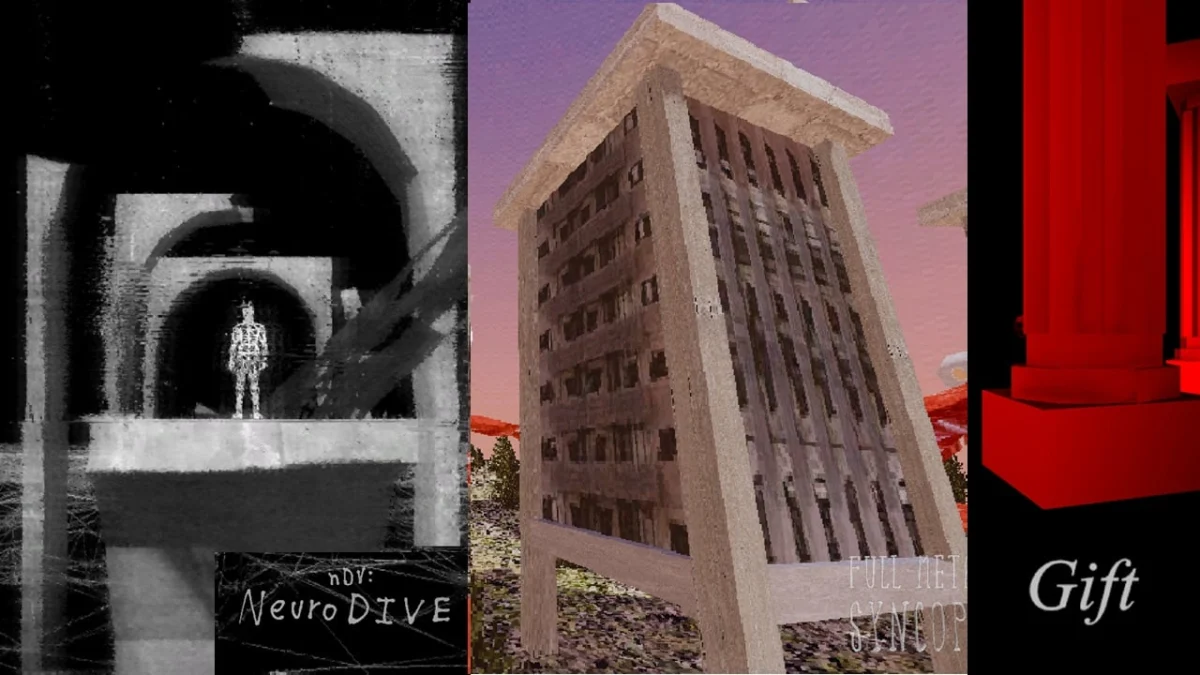
As the collection progresses, FULL METAL SYNCOPE integrates first-person shooting (FPS) with the slow-burn narrative structure of a visual novel. Set on a series of floating islands, the player is tasked with exploring a surrealist landscape, engaging in dialogue, and interacting with the local inhabitants. This title acts as the bridge between the high-octane combat of the early entries and the deeply introspective nature of the final two games.
GIFT (The Philosophy of Rebirth)
GIFT serves as the emotional core of the anthology. Departing from external conflict, the game focuses on a post-death state. Players explore monochromatic, fragmented memories, reconstructing the identity of a soul navigating doubt and fear. It is a stark departure from the action-oriented entries, acting as a meditation on the permanence of loss and the possibility of rebirth.
nDV Neuro DIVE (The Final Reconstruction)
The final entry, nDV Neuro DIVE, is explicitly framed as a spiritual successor to GIFT. Presented as "reverse hashing reconstruction software," the game forces players to decrypt corrupted data. It is a meta-commentary on the collection itself—the act of digging through old files to find meaning. By engaging with encrypted, corrupted memory segments, the player completes the cycle of the anthology, turning the act of "playing" into an act of archaeological data retrieval.
Supporting Data: Why This Anthology Matters
The significance of this collection lies in its departure from the "Games as a Service" (GaaS) model. In a market where developers are pressured to keep players engaged for years through daily rewards and endless content updates, Lucas Angelo has chosen the opposite path: a closed, finite experience that invites a single, deep playthrough.
Market data from the indie sector suggests that while these titles lack the viral potential of mainstream mobile games, they occupy a crucial niche. Players are increasingly seeking "experience-based" games that offer emotional resonance over mechanical progression. Lucas Angelo’s Game Collection Vol. 1 provides a high-density, low-time-commitment alternative to the "endless runner" fatigue currently plaguing the mobile gaming market.
Official Responses and Developer Philosophy
In discussions surrounding the collection, Angelo has maintained that the games should not be evaluated by the traditional metrics of "fun."
"If you are looking for entertainment in the traditional sense, you might be disappointed," Angelo remarked in recent developer notes. "These are not games designed to keep you addicted. They are designed to keep you thinking. The question of what it feels like to be buried alive—the isolation, the sensory deprivation, the desperate search for meaning in the dark—is the thread that ties all six projects together. I wanted to see if the limitations of mobile hardware could actually enhance the feeling of claustrophobia."
By positioning the collection as an art installation, Angelo has effectively shielded the project from the critique of "lack of polish" often leveled at indie developers. By framing the "glitches" and "corrupted data" in nDV Neuro DIVE as intentional design choices, the developer turns potential technical flaws into narrative features.
Implications for the Future of Mobile Gaming
The release of Lucas Angelo’s Game Collection Vol. 1 signals a potential shift in how indie developers approach the mobile platform. For years, mobile has been dismissed as a secondary platform for "serious" gaming. However, by embracing the mobile device as an intimate, handheld medium, Angelo demonstrates that it is uniquely suited for psychological horror and avant-garde storytelling.
Accessibility as an Aesthetic Choice
The decision to bundle these games on the Google Play Store makes them accessible to a global audience, bypassing the elitism of PC-only art games. If successful, this anthology could pave the way for other developers to curate their own "creative retrospectives," treating their body of work as a cohesive whole rather than a series of disparate downloads.
The Rise of the "Experimental Anthology"
We are likely to see a trend in the coming years where developers group their smaller, experimental projects into singular, premium-priced bundles. This addresses the "discoverability" problem on mobile storefronts, where individual small-scale games are often buried under a deluge of mass-market titles. By creating an "anthology," the developer creates a brand, making it easier for niche audiences to find and support their work.
Conclusion
Lucas Angelo’s Game Collection Vol. 1 is a somber, demanding, and deeply original piece of work. It refuses to hold the player’s hand, nor does it seek to offer the cheap dopamine hits of contemporary mobile gaming. Instead, it offers six snapshots of a developer exploring the limits of their own creativity.
Whether it is the frantic blood-letting of BLOOD LOSS or the quiet, haunting decryption of nDV Neuro DIVE, the collection asks the player to participate in the act of creation. It is a rare example of a developer trusting their audience enough to present them with something difficult, something strange, and ultimately, something human. For those who find the typical mobile gaming landscape stale, Angelo’s collection is an essential, if unsettling, destination.
Lucas Angelo’s Game Collection Vol. 1 is currently available for download on the Google Play Store. As the industry continues to debate the intersection of art and interactivity, this collection stands as a testament to the fact that, even on the smallest of screens, the most profound questions can be asked.

