

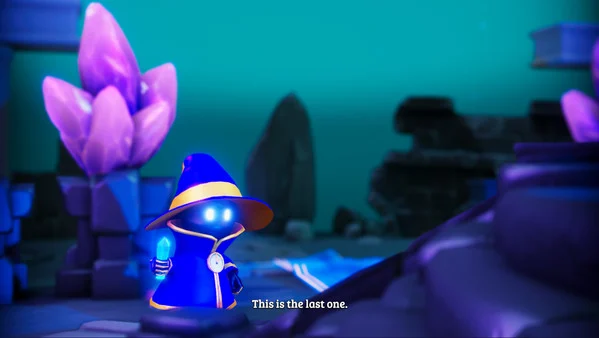
In the rapidly evolving landscape of independent gaming, few titles manage to capture the delicate balance between whimsical charm and intellectual rigor. As we look toward the start of 2022, a new contender from developer MorpheusZ promises to challenge our perception of causality and coordination. Time Master, a 3D puzzle-platformer set for release on January 18, 2022, invites players to step into the magical, albeit slightly clumsy, boots of Zeno, a wizard on a desperate quest to rectify a catastrophic magical accident.
The Core Concept: A Wizard’s Regret
The premise of Time Master is as emotionally grounded as it is mechanically complex. Players are introduced to Zeno, a practitioner of the arcane arts whose pursuit of power has led to an unintended, heartbreaking consequence: the accidental banishment of his sister, Sophia, to the enigmatic Prison Vortex.
While the aesthetic presentation—vibrant, stylized, and undeniably "cute"—suggests a lighthearted romp, the core gameplay loop demands a high degree of cognitive dexterity. The game functions as a series of Trials of Time, ancient obstacles that no mortal has successfully navigated. To survive these trials and ultimately save Sophia, Zeno must leverage the most volatile element of his arsenal: time itself.
The Mechanics of Chronological Cooperation
The defining "hook" of Time Master lies in its innovative approach to time manipulation. Unlike traditional puzzle games where a player simply restarts a level upon failure, Time Master introduces a collaborative mechanic where the player works alongside their own past actions.
Working With Your Past Self
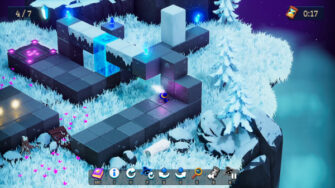
The gameplay revolves around recording actions in a timeline and then "looping" those actions. Players must perform a task—such as standing on a pressure plate to open a gate—and then rewind time to perform a subsequent task—such as running through the now-open gate—while their "past self" continues to hold the plate. This mechanic creates a complex puzzle environment where players must account for their previous movements, ensuring that their current actions do not collide with or negate the progress made by their past selves.
This asynchronous multiplayer-with-oneself approach transforms the level design from a standard platforming challenge into a strategic, multi-layered choreography. As players progress through the Trials, the sequences become increasingly intricate, requiring precise timing and forward-thinking logic.
A Narrative-Driven Odyssey
Beyond the mechanics, MorpheusZ has prioritized the narrative heart of the game. Time Master is not merely a collection of isolated puzzles; it is a fully realized quest. The game features fully-voiced cinematics that bridge the gap between the challenging puzzle rooms, providing context for Zeno’s journey and depth to his motivation.

The story is punctuated by the presence of Lucix, the antagonist whose influence complicates Zeno’s quest. Throughout the campaign, players will uncover the history of the Ancients, the architects of the Trials, while managing the pressure of a ticking clock. The game encourages replayability; players can opt to finish puzzles in standard chronological order or return to previously conquered trials to shave off seconds, perfecting their runs and demonstrating true mastery over the temporal mechanics.
Development and Philosophy: The MorpheusZ Approach
MorpheusZ, the sole developer behind the project, has entered the industry with a clear, focused mandate. The studio’s philosophy centers on creating experiences that are accessible to casual players while maintaining enough mechanical depth to satisfy hardcore puzzle enthusiasts.
Time Master serves as the studio’s debut title, a significant undertaking for a solo developer. By focusing on a single, high-quality mechanic—time manipulation—and building a narrative-rich world around it, the developer has managed to create a cohesive vision that avoids the common pitfalls of "feature creep." The game is built on the foundation of rewarding patience, careful planning, and iterative learning.
The Implications for the Indie Puzzle Genre
The release of Time Master comes at a time when the puzzle-platformer genre is seeing a resurgence in popularity. Games like Portal and The Talos Principle established the gold standard for spatial logic, but Time Master differentiates itself by focusing on the collaborative aspect of time-loops.
Challenging the Status Quo
By tasking the player with managing multiple versions of the same character, the game pushes the boundaries of how we perceive success in a single-player environment. It forces the player to stop thinking in a linear, "here and now" fashion and instead adopt a holistic view of the level. This has broader implications for game design; it suggests a move toward "systemic gameplay," where the rules of the world are consistent and the player’s ability to manipulate those rules is the primary vector for progress.
Accessibility and Depth
The accessibility of the art style—which features a warm, inviting color palette and a protagonist designed to be endearing—is a strategic choice. It lowers the barrier to entry for casual players, while the increasing complexity of the puzzles ensures that the "skill ceiling" remains high. This duality is critical for the success of independent titles in a saturated market, as it allows the game to appeal to a wider demographic of players.
Official Responses and Anticipation
Since the announcement and the subsequent release of the demo, the response from the gaming community has been largely positive. The demo, which allows players to experience a subset of the early Trials, has been praised for its intuitive controls and the "aha!" moments that define the best puzzle games.
In official statements, the developer has emphasized that Time Master is designed to be a learning experience. "We want players to feel the satisfaction of a plan coming together," a representative for MorpheusZ noted. "The game isn’t just about finishing the level; it’s about the journey of learning how to master the time you have."
Looking Ahead: January 18, 2022
As the release date of January 18, 2022, approaches, the community’s focus has shifted to the potential for post-launch support and the depth of the final product. With the game now available for wishlisting on Steam, the initial interest is high. For those who enjoy testing their limits, the game offers a "perfecting" mechanic, which is likely to foster a competitive speedrunning community.
The journey of Zeno and the quest to save Sophia represents a bold step for a solo developer. Time Master is more than just a 3D platformer; it is an exercise in logic, patience, and the art of correcting one’s mistakes. Whether the player is a newcomer to the genre or a seasoned veteran of spatial puzzles, the game provides a compelling reason to step back, rewind, and try again.
Conclusion
Time Master stands as a testament to the power of focused game design. By marrying a charming aesthetic with a complex, innovative time-manipulation system, MorpheusZ has crafted a title that is as rewarding as it is challenging. As we anticipate its arrival on the Steam platform, the narrative of Zeno’s redemption serves as a poignant backdrop to a mechanical tour-de-force.
For those looking to engage with a title that respects their intelligence while providing a whimsical atmosphere, Time Master is set to be one of the first major indie highlights of the year. The Trials of Time await, and it will be up to the players to prove that they, too, can master the clock. Remember, in the world of Zeno, your greatest asset—and your greatest obstacle—is simply your past self. Prepare your strategies, clear your schedule for January, and get ready to rewrite the flow of time itself.

