

By: Editorial Staff
Published: Gaming Industry Updates & Analysis
Main Facts: The Next Generation of Policing in Leonida
As the global gaming community counts down the days to the release of Grand Theft Auto 6, Rockstar Games has begun peeling back the curtain on the technological and mechanical leaps powering its virtual recreation of modern-day Florida—dubbed Leonida. Among the most anticipated overhauls is the completely revamped law enforcement architecture. Gone are the days of the simplistic, arcade-style police responses seen in GTA 5. In Grand Theft Auto 6, Rockstar is introducing a dynamic, multi-layered system that marries an expanded six-star Wanted Level hierarchy with an entirely new investigative mechanic known as the "Heat" system.
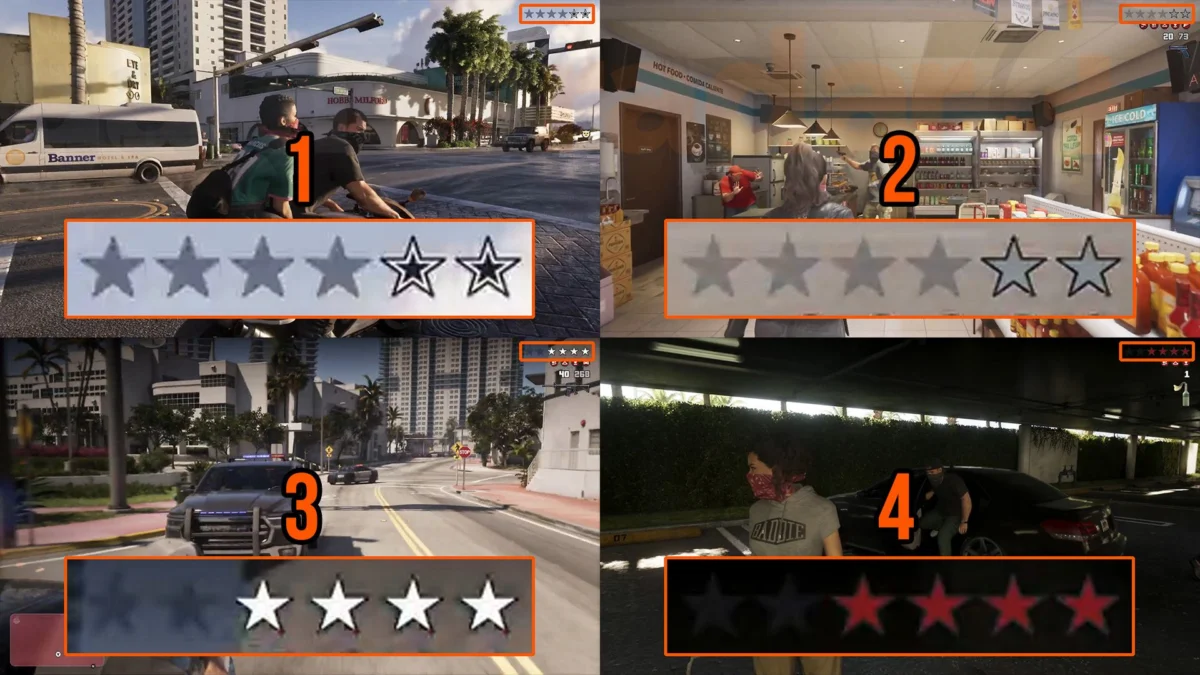
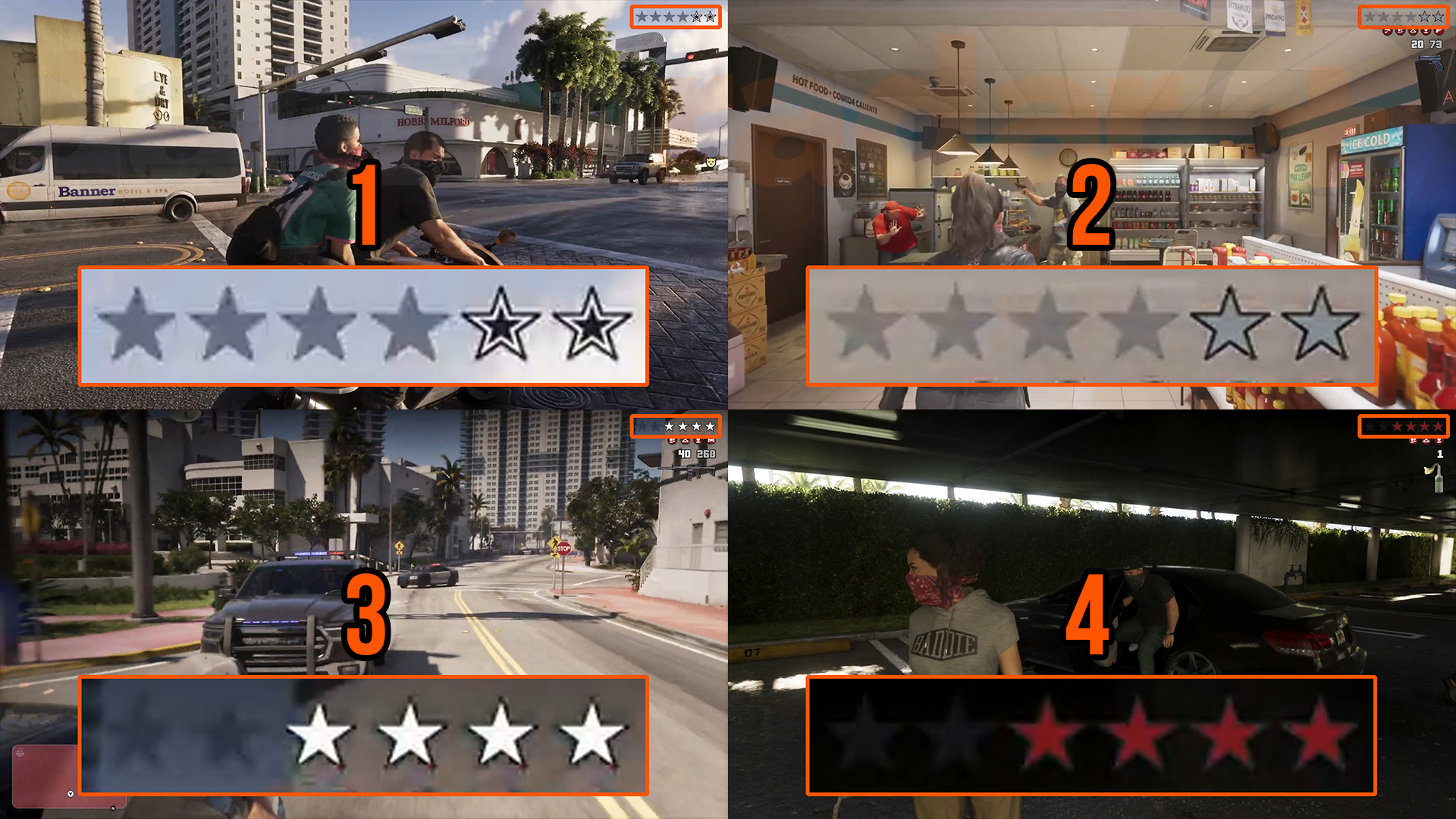
Rather than treating police presence as a binary state of being chased or being anonymous, GTA 6 treats criminal activity as an ongoing investigation. The classic star meter has been expanded back to a maximum of six stars, bringing back the high-stakes, military-grade escalation fans have missed, while introducing nuanced visual indicators. These dynamic stars alter their appearance depending on the gravity of the situation—distinguishing between local law enforcement casually investigating a minor disturbance and a coordinated, federal-level manhunt utilizing the player’s personal details, vehicle descriptions, and known associates.
Compounding this is the Heat system. Displayed via intuitive red icons in the upper-right corner of the screen, the Heat mechanic tracks the specific types of evidence the police possess against protagonists Jason and Lucia. Whether the authorities are tracking you via eyewitness accounts, security camera footage, vehicle recognition, or lingering physical descriptions, the game explicitly tells players why the police are hunting them. Surviving the law in Leonida will no longer be a simple matter of out-driving a cruiser around a corner; it will require meticulous tactical planning, situational awareness, and an understanding of forensic evasion.

Chronology: The Evolution of the Wanted System from GTA III to GTA 6
To fully appreciate the magnitude of the changes coming in GTA 6, it is crucial to examine the historical progression of the franchise’s law enforcement mechanics over the last two decades.
- 2001 (Grand Theft Auto III): Rockstar introduced the foundational Wanted Meter using up to six stars. At low levels, local beat cops and standard squad cars pursued the player on foot or via cruiser. As stars escalated, the FIB (Rockstar’s parody of the FBI) and the military deployed tanks, heavy armor, and roadblocks. Evasion relied entirely on line-of-sight and finding a designated "Spray ‘n’ Pay" garage to instantly repaint the vehicle.
- 2008 (Grand Theft Auto IV): This entry introduced the revolutionary "search bubble" mechanic. When players broke line-of-sight with the police, a flashing red and blue radius appeared on the radar. Players had to physically escape this circle and remain hidden inside it until the police gave up the search. While groundbreaking for its time, it remained relatively rudimentary regarding forensic tracking.
- 2013 (Grand Theft Auto V): Streamlining the experience for a broader audience, Rockstar reduced the maximum Wanted Level to five stars. Police vision cones were introduced on the minimap, allowing players to sneak past law enforcement if they stayed out of specific viewing angles. However, evading the police often felt predictable, leading to familiar cheese strategies like hiding in subway tunnels or flying helicopters out of sight.
- 2025 and Beyond (Grand Theft Auto 6): Rockstar breaks the mold entirely by resurrecting the six-star scale while integrating contextual visual states for stars and introducing the reactive Heat system. Police intelligence is no longer tethered purely to a proximity radar; it is driven by real-time intelligence gathering, civilian witnesses, digital surveillance, and environmental clues left behind at crime scenes.
Supporting Data: Breaking Down the Mechanics of the Heat System
Detailed previews and media analysis from industry insiders have shed light on the mechanics governing the Heat system and the expanded Wanted Levels. While exact UI terminology continues to be analyzed from promotional footage and extended gameplay showcases, the structural framework of player accountability is becoming remarkably clear.
The Six-Star Status Evolution
The return of the six-star Wanted Level brings back maximum-threat responses, but the journey to six stars is no longer linear.
- 1-2 Stars (Investigation & Harassment): Police are dispatched to verify reports. Stars appear muted or outlined differently, indicating that officers are searching for a suspect matching a general description rather than actively shooting on sight.
- 3-4 Stars (Active Manhunt): Law enforcement has identified the player or their vehicle. Coordinated roadblocks, spike strips, and canine units are deployed. The minimap frequently experiences electronic interference, pulsing with red and blue emergency lighting that obscures the player’s radar tracking of nearby units.
- 5-6 Stars (Federal Escalation): Complete military and specialized tactical response. The state of Leonida treats the protagonists as high-value domestic terror targets, deploying armored vehicles, heavy air support, and aggressive containment strategies.
Heat System Markers and Evasion Tactics
The Heat system utilizes discrete icons to inform players of their investigative exposure. Understanding these markers dictates how a player must respond to a crime gone wrong:

- Eyewitness and Informant Heat: Triggered when civilians or bystanders call emergency services with accurate descriptions. Can be mitigated by wearing face coverings or masks before committing a crime.
- Vehicle Heat: Tied directly to the specific car or motorcycle being driven. As demonstrated in gameplay deep-dives, stepping out of a hot vehicle instantly drops the vehicle-specific heat marker, though officers may still pursue the occupant on foot if personal identification has been established.
- Surveillance and Camera Heat: Leonida’s urban centers are heavily monitored by closed-circuit security cameras. Players must factor camera locations into heist planning, utilizing stealth takedowns or long-range weaponry to disable recording hardware before executing illegal operations.
- Accomplice Heat: A unique mechanic reflecting the dual-protagonist nature of Jason and Lucia. When both characters are linked to a crime, this marker remains active until they physically separate. However, Rockstar has balanced this to prevent players from easily sacrificing their partner: if one character is apprehended by the police while separated, the player still faces a "Busted" state, enforcing cooperative tactical awareness.
Official Responses and Industry Reception
Rockstar Games has historically maintained a strict policy of letting their gameplay trailers and official press releases speak for themselves, rarely offering step-by-step tutorial interviews prior to launch. Nevertheless, the industry response to these systemic revelations has been overwhelmingly positive.
Open-world design critics and AI engineers have praised Rockstar’s apparent shift from artificial difficulty—where police magically spawn directly in front of the player regardless of location—toward a more logical, simulation-heavy approach. By tying police awareness to concrete environmental factors (such as cameras, clothing, and vehicles), Rockstar is bridging the gap between immersive sim mechanics and mainstream sandbox action.
Industry analysts note that this level of systemic complexity is made possible exclusively by the generational leap in hardware capabilities. The processing power required to track civilian memory, environmental clues, active camera grids, and multi-tiered AI responses simultaneously was simply not feasible during the GTA 5 development cycle in the early 2010s. Consequently, GTA 6 is being positioned not just as a graphical showcase, but as a watershed moment for artificial intelligence and emergent gameplay in open-world environments.
Implications: What This Means for the Future of Open-World Gaming
The implementation of the Heat system and the overhauled Wanted mechanics in Grand Theft Auto 6 carries profound implications for the open-world genre as a whole. For over two decades, the gameplay loop of committing a crime, engaging in a brief chase, and hiding in a car wash to magically erase all consequences has been an industry standard. Rockstar is effectively dismantling that lazy design philosophy.
1. Shift Toward Preparedness and Stealth
Players will no longer be able to approach Grand Theft Auto as a consequence-free murder simulator. Committing spontaneous crimes in crowded metropolitan areas will carry long-term logistical consequences. Players must now carefully weigh the risk versus reward of every action, considering whether they have parked their getaway vehicle out of camera view, whether they are wearing a mask, and how quickly they can change their outfit or vehicle before law enforcement locks down their identity.
2. Heightened Replayability and Emergent Scenarios
Because police responses are driven by dynamic intelligence rather than rigid scripting, no two chases should play out identically. The interaction between the dual protagonists, the physical environment, civilian AI, and surveillance networks guarantees a massive sandbox for emergent gameplay. Players will undoubtedly share countless stories of narrow escapes, botched getaways, and clever uses of Leonida’s geography to shake off the heat.
3. Setting a New Benchmark for Sandbox AI
As the undisputed market leader in the open-world genre, whatever Rockstar implements tends to become the baseline expectation for competing studios. Just as GTA III defined the 3D sandbox era and GTA V perfected multi-protagonist switching, GTA 6 is setting a towering new standard for how virtual worlds react to player agency. Other developers working on open-world crime, espionage, or survival titles will now be forced to reckon with a consumer base that expects deeper, more systemic law enforcement mechanics rather than mindless, infinite waves of enemy spawns.
As we draw closer to the release of Grand Theft Auto 6, it is clear that Rockstar Games is not merely building a bigger map; they are engineering a living, breathing ecosystem where every action has calculated, systemic repercussions. The streets of Leonida will be dangerous, unforgiving, and infinitely more rewarding for players who learn to play smart rather than just shooting their way out.

