


When developer IzanagiGames first pulled back the curtain on Akiba Lost last September, it instantly commanded the attention of interactive fiction enthusiasts worldwide. Developed in deep collaboration with the media powerhouses Nippon TV and its AX-ON drama production subsidiary, the title promised to breathe new life into a nearly dormant subgenre: the live-action sound novel. For fans who have spent years yearning for a genuine successor to Chunsoft’s legendary 1998 classic Machi and its spiritual heir, 2008’s critically acclaimed 428: Shibuya Scramble, Akiba Lost represents the realization of a long-held dream.
Now available across PC, PlayStation 5, Nintendo Switch, and the upcoming Nintendo Switch 2, Akiba Lost arrives with lofty ambitions. Blending thousands of meticulously staged photographic stills, high-definition full-motion video (FMV), and classic visual novel progression mechanics, the game attempts to marry traditional Japanese TV drama production values with modern gaming interactivity. But does this star-studded multimedia experiment succeed in capturing the magic of its predecessors, or does it buckle under the weight of its own narrative complexity?

Main Facts: Premise, Production, and Core Mechanics
At its narrative core, Akiba Lost plunges players into a high-stakes psychological mystery set against the neon-soaked backdrop of Tokyo’s iconic electronics and pop-culture district, Akihabara. The story follows Daiki Shinjo, a struggling video game developer and co-founder of Shirosawa Games. Desperate to recapture the breakout success of their debut title, Daiki and his team begin development on a new project—aptly titled Akiba Lost—loosely based on a haunting string of unsolved real-world kidnappings that occurred years prior, collectively known to the public as "The Akiba Vanishing."
The project carries profound personal weight for Daiki. One of his younger sisters, Ruri, was among the victims of The Akiba Vanishing, disappearing without a trace alongside several others in a case that ultimately went cold, leaving law enforcement empty-handed. Daiki hopes that developing and releasing the video game will reignite public interest in the dormant cold case, potentially shaking loose fresh clues regarding Ruri’s whereabouts.

However, production grinds to a halt before it even begins due to a terrifying development: shortly after the script for Shirosawa Games’ Akiba Lost is distributed to its six lead actresses—women from completely different walks of life who serve simultaneously as the video game’s in-universe protagonists and the real-world actors portraying them—someone begins reenacting the fictional kidnapping scenarios in reality.
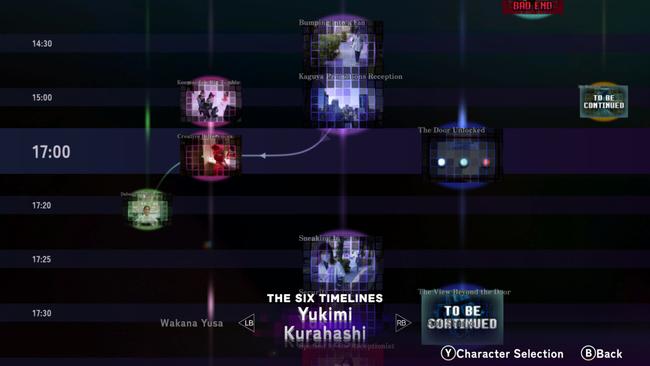
Structurally, the game is divided into distinct chronological time slots (AM and PM) spanning multiple days. After completing a brief prologue, players must methodically navigate and complete the individual storylines of all six female protagonists before unlocking Daiki’s critical path, which serves as the narrative bridge advancing the overarching plot into the next time slot.

To navigate this intricate web of parallel perspectives, players utilize several core mechanics:
- The Timeline System: A branching flowchart that allows players to jump backward whenever a choice leads to a "bad end," providing a seamless trial-and-error loop.
- Status Freezes: Certain routes will abruptly halt when a character’s situation becomes "frozen," signaled by an icy visual overlay. To unfreeze them, players must scour another protagonist’s timeline to locate a highlighted keyword or "key" that acts as a narrative catalyst.
- Causality Alteration: Advanced progression requires players to make specific choices in one character’s route to physically redirect side characters or trigger events that alter the fate of another protagonist in a completely different storyline.
Chronology: The Journey Through Akihabara’s Underbelly
The chronological progression of Akiba Lost is an exercise in meticulous pacing and cognitive juggling. Because the narrative unfolds simultaneously across multiple perspectives, players cannot simply mainline a single character’s story to its conclusion. Instead, the game enforces a rhythm of discovery, deduction, and convergence.

In the early hours, the game establishes its baseline tone: a tense, atmospheric thriller punctuated by moments of genuine dread. Yet, IzanagiGames wisely balances the pervasive gloom with moments of eccentric levity. The supporting cast introduces much-needed levity and flavor to the proceedings. For example, Kokone’s manager is a frantically energetic man in his 40s whose single-minded dedication to launching his idol unit into stardom provides numerous comedic beats. Similarly, the eccentric companion who periodically assists Moe brings a bizarre, musical-themed energy that offsets the heavier psychological themes.
As the days tick forward, the chronological web tightens. Progression roadblocks become more intricate, frequently demanding that players cross-reference timelines to ensure a wandering NPC intersects with the exact location of a distressed protagonist. While this system brilliantly communicates the butterfly effect of human choices, it occasionally stumbles in its execution during the latter third of the game. The narrative begins to lean heavily on recent flashbacks, re-showing events that transpired only moments prior, which slightly dampens the momentum just as the mystery reaches its boiling point.

Supporting Data: Production Scale, Glossaries, and Technical Metrics
From a technical standpoint, Akiba Lost is an absolute behemoth. The PC version demands a hefty 45GB of storage space—a footprint that becomes entirely justified once players experience the sheer volume of high-definition 4K video assets integrated into the experience. FMV sequences frequently punctuate critical narrative beats, most notably playing at the conclusion of a character’s time slot just before the "To Be Continued" screen.
Furthermore, the game’s visual presentation is staggering. Every single scene features multiple photographic angles, lighting setups, and timelapses, ensuring that even bad ends and obscure decision trees boast unique visual assets. When time slots advance, players unlock curated photo albums documenting the preceding events.
Beyond the visuals, Akiba Lost features an exceptionally deep and informative glossary containing nearly 300 entries. Rather than offering basic tourist-guide definitions, the glossary dives deep into contemporary Japanese pop culture, Akihabara subcultures, and historical context. It functions almost as an up-to-date lexicon of modern Japanese internet and otaku vernacular—including entries for terms like oshi, cheki sessions, dandori, and even mobile gaming "apologems"—making every single entry genuinely entertaining to read.
Official Responses and Industry Context
The release of Akiba Lost marks a significant milestone for IzanagiGames, representing a rare, high-profile modern attempt to revive the live-action FMV sound novel format on contemporary hardware. While traditional publishers have largely abandoned live-action interactive drama due to prohibitive production costs and logistical hurdles, the partnership between IzanagiGames, Nippon TV, and AX-ON demonstrates a renewed corporate appetite for cross-media storytelling in Japan.

Industry analysts and critics have praised the publisher’s willingness to take creative risks. In promotional statements surrounding the game’s launch, the development team emphasized their desire to honor the structural DNA of 428: Shibuya Scramble while modernizing the interface and incorporating cutting-edge digital cinematography. Although minor localization hiccups—such as occasional English script typos in the later chapters and rare text-truncation bugs—mar the otherwise polished presentation, the overarching reception highlights a deep appreciation for the game’s bold artistic vision.
Implications: The Future of Live-Action Interactive Fiction
The launch and critical reception of Akiba Lost carry profound implications for the future of interactive cinema and visual novels. For over a decade, the genre has been dominated by 2D illustrated character sprites and traditional anime aesthetics. By proving that a high-budget, live-action sound novel can successfully deploy complex branching timelines, 360-degree investigative environments, and seamless multimedia integration, Akiba Lost reopens a stylistic avenue that many thought was permanently closed.

Moreover, the game’s exploration of grief, public fascination with true crime, and the psychological toll of unresolved disappearances elevates it above a mere stylistic exercise. It proves that live-action casts, when paired with strong writing and competent direction, can convey raw emotional stakes just as effectively as animated counterparts.
As the credits roll on its wildly ambitious, mind-bending true ending—a finale that asks a great deal of the player’s suspension of disbelief—Akiba Lost cements its place as a landmark release for the genre. It may occasionally stumble over its own narrative ambition, but its rich character arcs, staggering production values, and loving homage to Akihabara culture make it an unforgettable journey. For fans yearning for a cerebral, beautifully crafted interactive mystery, Akiba Lost delivers an experience that resonates long after the screen goes dark.

Version Tested: PC (Also available on PlayStation 5, Nintendo Switch, and Nintendo Switch 2).
Review Score: 8/10

