

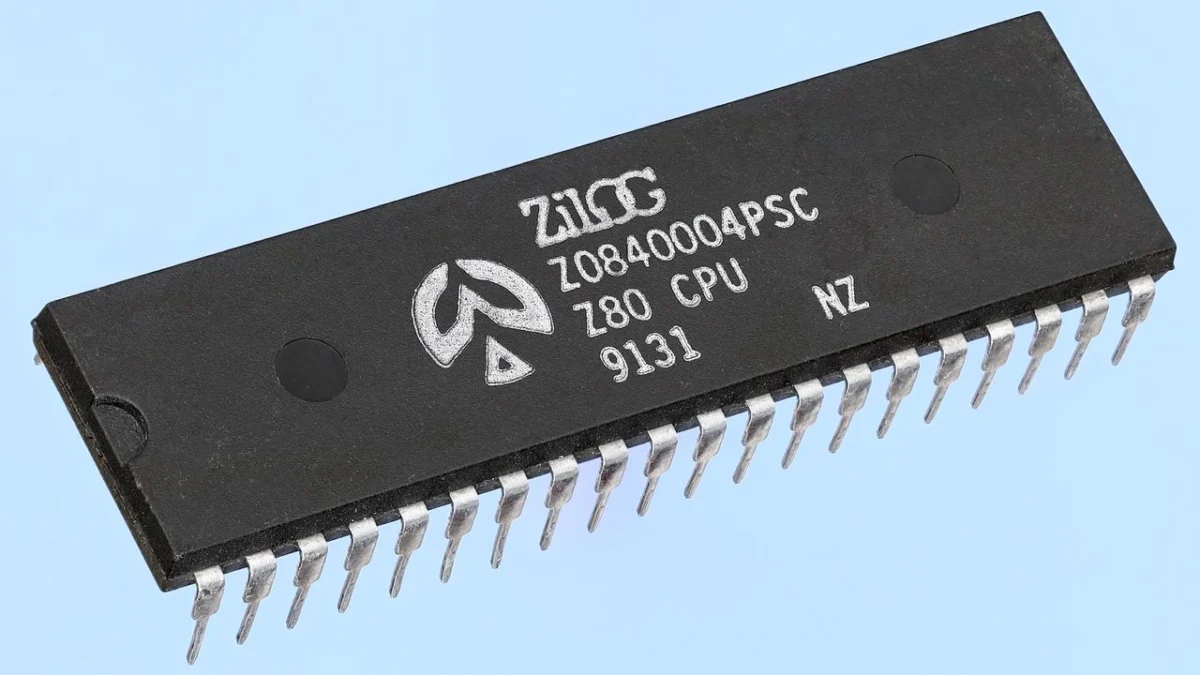
San Francisco, CA – July 2024 – Fifty years after its groundbreaking debut, the venerable Zilog Z80 microprocessor, an 8-bit icon that powered a generation of personal computers, arcade machines, and industrial systems, has officially reached its end-of-life. Zilog, now a subsidiary of Littelfuse, ceased accepting orders for the Z84C00 family in June 2024, marking the conclusion of an extraordinary 48-year production run. However, the story of the Z80 is far from over. In a testament to its enduring influence and the vibrant spirit of the open-source hardware community, a dedicated developer is on the cusp of shipping a community-funded, open-source replacement designed to be a direct, drop-in successor, ensuring the Z80’s legacy continues for decades to come.
Main Facts: The End and The Beginning
The Zilog Z80, first released in July 1976, quickly became a cornerstone of the burgeoning microcomputer revolution. Its innovative design, offering binary compatibility with the Intel 8080 while providing an enhanced instruction set and integrated features like an on-die DRAM refresh counter, made it a superior and more cost-effective choice for system designers. From the classrooms of the UK with the ZX Spectrum to the arcade parlors of America hosting Pac-Man, and deep within the industrial control systems globally, the Z80’s influence was ubiquitous.
Its official discontinuation by Zilog, announced via an end-of-life notice on April 15, 2024, citing the discontinuation of wafer foundry support for the Z84C00 family, created a palpable void for hobbyists, retrocomputing enthusiasts, and industries still reliant on the robust chip. Yet, even before the last-time-buy orders closed, a proactive response emerged from the open-source hardware community. Renaldas Zioma’s FOSS Z80 project, initiated swiftly after the EOL announcement, has already demonstrated working silicon, a remarkable feat of rapid development and community collaboration. The project aims to produce a Z80 clone in its original 40-pin DIP package, leveraging modern fabrication techniques to deliver a fully compatible, and in some aspects, enhanced replacement.
This grassroots effort signifies more than just a replacement part; it represents a commitment to technological preservation, open hardware principles, and the enduring power of a design that, despite its age, continues to inspire and enable innovation.
Chronology: A Half-Century of Digital Revolution
The journey of the Zilog Z80 is a rich tapestry woven through the history of computing, from its origins in the early days of microprocessors to its unexpected resurgence in the open-source era.
The Genesis: From Intel 8080 to Zilog’s Innovation (Early 1970s – 1976)
The story of the Z80 begins not with Zilog, but with Intel. Federico Faggin, a key architect of the Intel 4004 and 8080 microprocessors, along with Masatoshi Shima, a co-designer of the 8080, left Intel in 1974 to co-found Zilog. Their vision was to create a superior 8-bit processor, building upon the foundation of the 8080 but addressing its shortcomings.
The Intel 8080, while groundbreaking, had certain limitations, including a more complex power supply requirement (+5V, +12V, -5V) and the need for external circuitry for DRAM refresh. Faggin and Shima, with their intimate knowledge of the 8080’s architecture, set out to design a chip that was not only binary compatible with the 8080 (meaning it could run 8080 software) but also offered significant improvements. This led to the development of the Z80.
The Golden Age: Dominating the 8-bit Landscape (1976 – Mid-1980s)
Launched in July 1976, the Z80 was an immediate success. It packed approximately 8,500 transistors on a 4¼m process and initially ran at 2.5 MHz, with later CMOS variants reaching speeds up to 20 MHz. Its key advantages over the 8080 were:
- Enhanced Instruction Set: The Z80 offered a superset of the 8080’s instructions, providing more powerful and efficient operations.
- Integrated DRAM Refresh: An on-die DRAM refresh counter significantly reduced the number of external support chips required for a system, simplifying designs and lowering costs.
- Single +5V Power Supply: This was a major advantage over the 8080’s triple-voltage requirement, making Z80-based systems easier and cheaper to build.
- Additional Registers: More general-purpose registers improved programming flexibility and performance.
These features, combined with its relatively low cost, propelled the Z80 into countless applications. It became the heart of iconic home computers such as:
- ZX Spectrum: The hugely popular British computer, instrumental in introducing a generation to programming.
- TRS-80: One of the earliest mass-market home computers in the United States.
- MSX Machines: A standardized home computer architecture popular in Japan and Europe.
- Nintendo Game Boy: The revolutionary handheld console, which used a customized Z80 variant.
- Sega Master System: Another popular 8-bit console.
Beyond home computing, the Z80 found its way into legendary arcade cabinets, including Pac-Man, where its distinct characteristics inadvertently led to gameplay quirks like enemies speeding up as their numbers dwindled. It also became the workhorse for Texas Instruments’ graphing calculators, a role it continues to fulfill in its modern eZ80 iteration.
The Embedded Era: Quiet Longevity (Mid-1980s – 2020s)
As personal computing evolved towards 16-bit and then 32-bit architectures (like the Intel 8086/80286/80386 and Motorola 68000 series), the Z80 gradually receded from the mainstream consumer spotlight. However, its story was far from over. Its reliability, low power consumption, proven instruction set, and vast ecosystem of development tools made it an ideal candidate for embedded systems and industrial controllers. For decades, the Z80 continued to be produced and integrated into a myriad of devices, from cash registers and medical equipment to factory automation systems, often operating unseen but critically important.
Zilog’s Modernization Efforts: The eZ80 (2001 – Present)
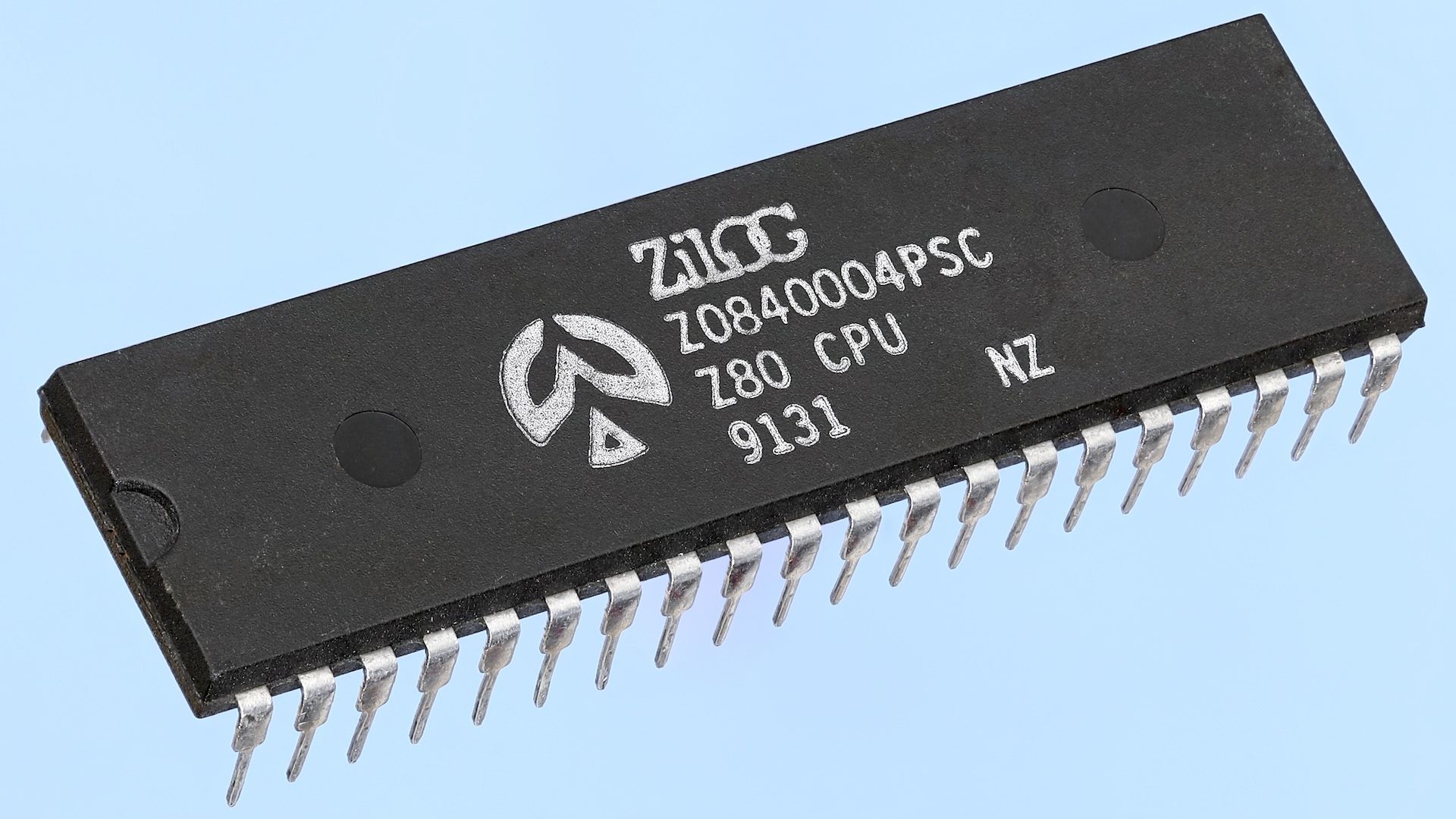
In 2001, Zilog introduced the eZ80 architecture, a pipelined, 24-bit address space enhancement of the original Z80. While maintaining binary compatibility with the Z80 instruction set, the eZ80 offered significantly improved performance, running at higher clock speeds and executing instructions more efficiently. The eZ80 found a new home in devices like the current TI-84 Plus CE graphing calculators, showcasing the enduring relevance of the Z80 instruction set even in modern contexts.
The End of an Era and the Dawn of Open Silicon (April – June 2024)
On April 15, 2024, Zilog issued a product change notification, signaling the end-of-life for the Z84C00 family of Z80 processors. The company cited the discontinuation of support from its wafer foundry as the primary reason. Last-time-buy orders were accepted until June 2024, with final shipments scheduled thereafter. This announcement prompted a wave of concern among those who still relied on or cherished the Z80.
Simultaneously, Zilog also announced the end-of-life for other components, including the eZ80L92 and several Z8F-series microcontrollers, due to "little to no demand," with orders closing in January 2024. This further highlighted the shrinking commercial footprint of Zilog’s classic product lines, even as the core eZ80 architecture persisted in specific niches.
The Open-Source Phoenix: Renaldas Zioma’s FOSS Z80 Project (Post-April 2024)
In response to Zilog’s EOL notice, Renaldas Zioma launched the FOSS Z80 project, aiming to create an open-source, drop-in replacement. Leveraging the burgeoning open-source silicon movement, Zioma’s project rapidly progressed:
- Initial Prototype (Tiny Tapeout 7): The first version, fabricated on SkyWater’s 130nm node through the Tiny Tapeout 7 program, achieved functional silicon on a minuscule die area of just 0.064mm².
- QFN64 Version: A version with all 40 pins exposed in a QFN64 package was developed on the Efabless CI2406 shuttle.
- Further Iterations: Two additional runs went through IHP’s 130nm process.
- DIP40 Goal: The current, ambitious run targets the classic DIP40 form factor, utilizing chip-on-board assembly on GlobalFoundries’ 180nm GF180MCU node via Wafer.Space. This is the crucial step to create a true drop-in replacement for vintage systems and modern retrocomputing kits like the RC2014.
The design is built around Guy Hutchison’s well-regarded TV80 Verilog core, a high-quality open-source implementation of the Z80. Estimates suggest that the 130nm CMOS implementation could support clock speeds up to 50 MHz, a significant leap from the original NMOS part’s typical 4 MHz.
Supporting Data: Technical Prowess and Community Drive
The Zilog Z80’s success was not accidental; it was built on a foundation of clever engineering and strategic design choices that offered compelling advantages in its era. Its longevity, in turn, is sustained by a passionate community and modern open-source initiatives.
Architectural Brilliance
The Z80’s internal architecture, while complex for its time, was highly optimized. It featured a robust register set, including two sets of general-purpose 8-bit registers (AF, BC, DE, HL) that could be used as 16-bit pairs, and an alternate set (AF’, BC’, DE’, HL’) that allowed for rapid context switching. This was a significant improvement over the 8080. Its instruction set included all 78 8080 opcodes plus an additional 80 instructions, making it a powerful and flexible processor for its time. The integration of an interrupt vector register (I) and memory refresh register (R) simplified system design, particularly for dynamic RAM systems, which were common and cost-effective.
The original Z80’s 4µm (micrometer) process technology was cutting-edge in the mid-1970s. For context, modern CPUs today use process nodes as small as 3nm (nanometers), representing an incredible scale of miniaturization. Yet, the Z80’s relatively large features contributed to its robustness and resistance to radiation, making it suitable for certain niche applications even into the 21st century.
Economic and Cultural Impact
The Z80 played a pivotal role in democratizing computing. Its lower system cost, compared to Intel 8080-based systems, made personal computers more accessible. This fueled a boom in home computing, particularly in Europe with machines like the ZX Spectrum, which sold millions. The availability of CP/M (Control Program for Microcomputers), a popular operating system for 8080/Z80 machines, meant that a vast library of business and productivity software was immediately available, further accelerating its adoption.
The enduring appeal of the Z80 is evident in the vibrant retrocomputing scene. Hobbyists continue to build new Z80-based computers (like the RC2014), port modern software, and even experiment with advanced applications on the vintage hardware. A notable example from earlier this year saw a developer successfully run a tiny conversational AI on a Z80 with just 64KB of RAM, demonstrating the ingenuity that can still be coaxed from this half-century-old design. This is not merely nostalgia; it’s a profound appreciation for fundamental computing principles and the challenge of resource-constrained development.
The Open-Source Silicon Movement
Renaldas Zioma’s FOSS Z80 project is a shining example of the broader open-source silicon movement. This movement advocates for transparent, community-driven development of hardware designs, much like open-source software. Initiatives like Google-backed SkyWater PDK (Process Design Kit) and Efabless’s Tiny Tapeout program have democratized access to chip fabrication for individuals and small teams, dramatically lowering the barriers to entry for custom silicon design.
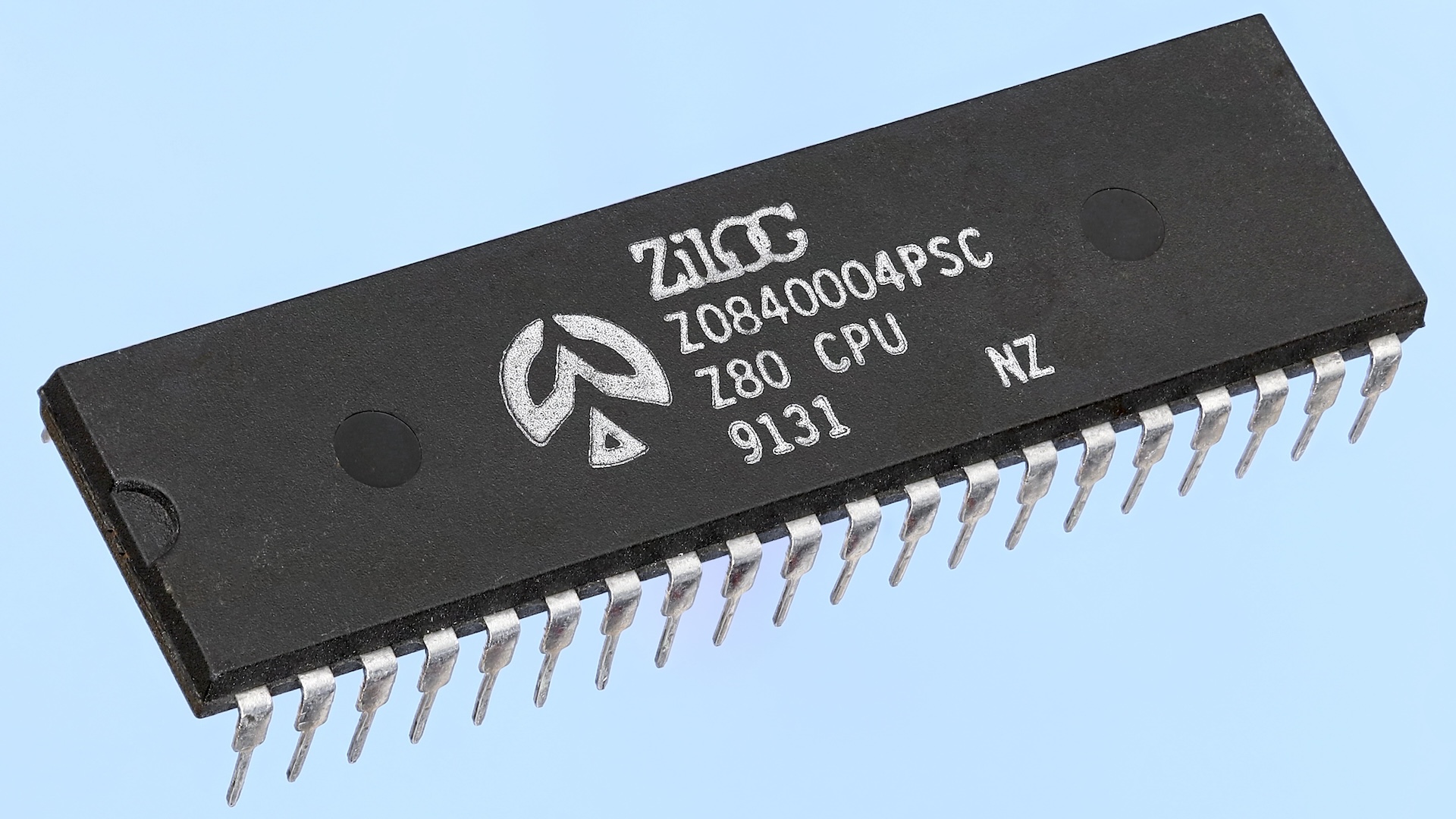
By utilizing these platforms (SkyWater 130nm, IHP 130nm, GlobalFoundries 180nm via Wafer.Space), Zioma and his collaborators are not only creating a Z80 clone but also demonstrating the viability of this new paradigm for hardware development. The fact that a modern CMOS implementation can potentially achieve 50 MHz – more than ten times the speed of the original NMOS part – highlights the performance benefits of leveraging contemporary process nodes while retaining the original architecture. This blend of old and new offers a powerful blueprint for future hardware projects.
Official Responses: Zilog’s Farewell and the Community’s Embrace
Zilog’s Strategic Pivot
Zilog, under the ownership of Littelfuse since 2017, has been gradually shifting its focus. The official end-of-life notice for the Z84C00 family explicitly stated, "Zilog is discontinuing these products due to the wafer foundry discontinuing support for the Z84C00 family of products." This is a common challenge for legacy silicon, where older process technologies become economically unviable or technically unsupported by foundries that have moved on to more advanced nodes. While Zilog did offer a last-time-buy option, it underscored a strategic decision to divest from older product lines that no longer align with their core business or current manufacturing capabilities.
The concurrent end-of-life for the eZ80L92 and certain Z8F-series microcontrollers due to "little to no demand" further clarifies Zilog’s direction. They are streamlining their product portfolio, focusing on more modern and in-demand embedded solutions, while maintaining support for the core eZ80 architecture where it still holds significant market share, such as in the TI graphing calculators. This is a practical business decision in a highly competitive and rapidly evolving semiconductor industry.
Renaldas Zioma’s Vision
Renaldas Zioma’s FOSS Z80 project emerged as a direct, community-driven response to Zilog’s announcement. While Zioma has not issued formal "official responses" in the corporate sense, his actions and public communications via GitHub and project pages articulate a clear vision: to ensure the continued availability and accessibility of the Z80. His motivation stems from a desire to provide a lifeline for existing Z80-based systems and to empower new generations of hobbyists and developers to experiment with this foundational architecture without reliance on dwindling supplies of vintage chips.
The community funding model, a hallmark of open-source hardware, has been crucial. It demonstrates that there is significant demand for such a project and that enthusiasts are willing to contribute financially to preserve and advance these technologies. Zioma’s project embodies the spirit of technological self-reliance and the collaborative power of the open-source movement, effectively filling a void left by a commercial entity’s necessary strategic shift.
Implications: A Future Forged from the Past
The end-of-life of the original Zilog Z80 and the simultaneous emergence of a viable open-source clone carry profound implications across several domains.
Lifeline for Legacy Systems
Perhaps the most immediate and practical implication is for the numerous industrial, medical, and niche embedded systems that continue to rely on the Z80. Many of these systems were designed for long operational lifespans, and finding compatible replacement parts is critical. The FOSS Z80 project offers a direct, drop-in replacement, potentially averting costly redesigns or premature decommissioning of critical infrastructure. This ensures continuity and avoids the pitfalls of "orphan hardware" where essential components become unobtainable.
Sustaining Retrocomputing and Education
For the vibrant retrocomputing community, the open-source Z80 is a godsend. It guarantees a stable supply of new, functional Z80 processors, enabling the restoration of vintage machines like the ZX Spectrum, TRS-80, and Game Boy, as well as the creation of entirely new homebrew systems. This fosters continued experimentation, education, and creative projects, allowing new generations to learn about fundamental computer architecture in a hands-on manner. It preserves a vital piece of computing history not just as museum pieces, but as living, functional technology.
The Triumph of Open-Source Hardware
The FOSS Z80 project serves as a powerful case study for the burgeoning open-source hardware movement. It demonstrates that complex integrated circuits can be designed, verified, and fabricated through community effort, leveraging open design tools and democratized access to foundries. This success story will undoubtedly inspire further open-source silicon projects, potentially leading to more transparent, auditable, and accessible hardware designs across various sectors. It challenges the traditional proprietary model of semiconductor development, offering an alternative path that prioritizes community benefit and longevity.
Technological Preservation and Innovation
Beyond practical applications, the Z80 clone underscores the importance of technological preservation. By ensuring the availability of this foundational processor, we safeguard the ability to understand, replicate, and even innovate upon the early building blocks of the digital age. The project also showcases how older architectures, when combined with modern fabrication processes, can yield unexpected performance benefits (e.g., 50 MHz speeds), proving that "old tech" can still hold significant relevance and inspire new forms of innovation.
In conclusion, the Zilog Z80’s official end-of-life marks the close of a remarkable chapter in commercial semiconductor history. Yet, through the passionate dedication of Renaldas Zioma and the collaborative power of the open-source community, the Z80 is not fading into obscurity. Instead, it is being reborn, poised to continue its extraordinary journey, ensuring its legacy endures not just as a relic of the past, but as a vibrant and accessible component for the future. The Z80, it seems, truly is too important to die.

