

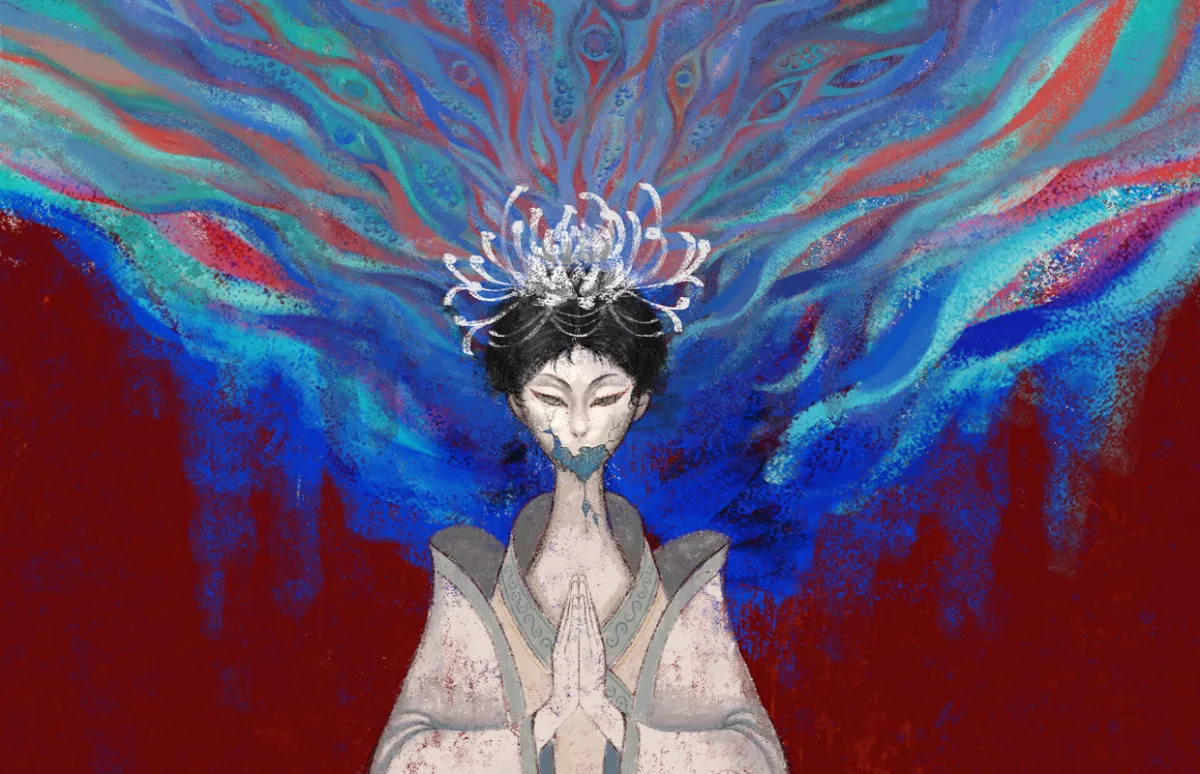
In the ever-evolving landscape of indie gaming, few genres have captured the imagination of developers quite like the Lovecraftian tabletop role-playing game (TTRPG). However, a new contender from the Chinese indie studio Largeland is poised to disrupt the formula. The Unleaving, a forthcoming PC title, merges the unsettling aesthetics of Chinese rural folklore with the cosmic dread of Cthulhu mythos, all while utilizing cutting-edge Large Language Model (LLM) technology to offer a narrative experience that feels truly boundless.
Main Facts: A Convergence of Folk-Horror and High-Tech
The Unleaving is an ambitious project currently being prepped for a Steam release. Described as a Chinese folk-horror Cthulhu RPG, the game draws heavy inspiration from the narrative-heavy, choice-driven mechanics of Disco Elysium. At its core, the game acts as a digital adaptation of the TTRPG experience, where players assume the role of paranormal investigators venturing into the deep, mysterious countryside.
The game distinguishes itself through its dual-mode architecture:
- Story Mode: A curated, branch-based narrative experience where players select from predefined choices, leading to specific thematic endings.
- Free Mode: A groundbreaking interactive layer that allows players to type natural language inputs to interact with the game world, powered by the deepseek AI service.
With a wide array of occupations—ranging from Feng Shui Masters to traditional Detectives—and a complex skill-check system based on dice rolls, The Unleaving promises a dense, atmospheric investigation where HP and Sanity are constantly at risk.
The Chronology of Development: From Tabletop to AI
The development of The Unleaving reflects a broader trend in the Chinese indie scene: the marriage of classic analog gaming roots with the rapid advancement of domestic AI technology.
Early development focused on establishing a rigid, TTRPG-compliant engine. Largeland prioritized the "dice + skill versus difficulty" mechanic, ensuring that every interaction—whether investigating a suspicious village clinic or attempting to defuse a confrontation—feels earned. The developers spent significant time refining the "Critical Success" to "Critical Failure" probability spectrum, which serves as the backbone of the game’s challenge.
The integration of AI came later in the production cycle. Recognizing that traditional branching narratives, while deep, are inherently limited by the author’s imagination, Largeland sought to bridge the gap between static scripts and generative freedom. By integrating the deepseek AI service, the studio moved toward a hybrid model. The "Free Mode" is not merely an afterthought; it is a technical challenge that the studio is currently testing, beginning with the game’s initial chapter. This phased rollout suggests a cautious, iterative approach to implementing generative AI in a narrative-sensitive environment.
Supporting Data: Mechanics and World-Building
To understand the depth of The Unleaving, one must look at the mechanical systems that govern the player’s experience.
The Anatomy of an Investigator
Players define their characters through a granular system of occupations and skills. The "Feng Shui Master," for instance, utilizes a compass to manipulate fate, effectively mitigating the risk of "Critical Failures." Conversely, the "Psychic" offers a unique window into the supernatural, allowing communication with animals—though at the cost of social efficacy.
Skills such as Observation, Folklore, Eloquence, and Medicine are not just stats; they are the keys to the narrative. A high Eloquence score might talk a player out of a lethal situation, while Medicine might reveal the truth behind the "soul-loss" plaguing the children of Wild Lotus Pond.
The Dice and the Void
The game’s tension is maintained by a constant threat to two meters: HP and Sanity. In classic Cthulhu fashion, death is not the only failure state; the erosion of one’s sanity is equally final. Players can influence these outcomes through item management—such as swapping in different dice—or by "burning Luck" to force a reroll when the stakes are at their highest.
The First Story: The Revelation of Xie Niangniang
The narrative debut drops players into the eve of the Ghost Festival. The setting is the Wild Lotus Pond, a village suffering from a mysterious, inexplicable illness. What begins as a routine investigation is quickly derailed by a car crash, forcing the player to navigate a landscape of water lanterns, temple rites, and late-night corridors. It is here that the game’s "folk-horror" tag shines; the horror is not found in jump scares, but in the slow realization that the truth of the village is something that actively wishes to remain buried.
Official Responses and AI Disclosure
Largeland has been transparent regarding the game’s technical infrastructure. In a move that aligns with modern digital storefront transparency, the studio has included a formal AI disclosure segment, primarily written in Simplified Chinese. This disclosure highlights the connection to the deepseek AI service, ensuring that players understand the distinction between the authored narrative branches and the generative interactions available in Free Mode.
The studio has emphasized that while Free Mode allows for "typing whatever you like," it is designed to exist within the context of the game’s world. The AI is trained to respond within the tone and limitations of the Chinese folk-horror setting, preventing the immersion-breaking "hallucinations" common in less specialized AI integrations.
Implications for the RPG Genre
The potential implications of The Unleaving are significant. By successfully integrating an LLM into a TTRPG-style game, Largeland is challenging the definition of a "finished" narrative.
The End of the "Branching" Limit
For decades, RPG writers have been constrained by the "tree" model of narrative design: every choice must be mapped, written, and programmed by a human. The Unleaving suggests a future where the writer sets the stage, the tone, and the stakes, but the player is allowed to "improvise" within the bounds of the world. If successful, this could usher in a new era of "infinite" investigative games where the mystery isn’t just about what the developers wrote, but what the player can deduce through direct conversation with the game’s cast.
Cultural Authenticity in Global Markets
The Unleaving is positioning itself as a global product, with support for English, Spanish, Russian, Brazilian Portuguese, Japanese, and Korean. This is a crucial move. For many international players, "Cthulhu" is synonymous with Lovecraft’s New England. By presenting a "Chinese folk-horror Cthulhu," Largeland is not only expanding the genre’s aesthetic horizons but also inviting a global audience to engage with Chinese mythos, local folklore, and regional supernatural anxieties.
Ethical and Technical Hurdles
Of course, the use of AI in gaming remains a point of contention. Largeland’s success will likely hinge on how well they can maintain the "writerly" quality of the game while ceding control to an LLM. If the AI interactions feel shallow or generic compared to the hand-crafted story segments, the "Free Mode" could be perceived as a gimmick rather than an evolution. Furthermore, the reliance on deepseek—an external service—raises questions about long-term stability and server-side reliance for a single-player experience.
Conclusion: A New Frontier for Horror
The Unleaving represents a bold synthesis of old-school TTRPG mechanics and modern generative AI. By grounding its cosmic horror in the specific, haunting atmosphere of rural Chinese folklore, Largeland has created a compelling hook that transcends the traditional "investigation" game format.
Whether the game succeeds as a cohesive whole or remains a fascinating experiment, its existence signals a shift in how indie developers are approaching the "infinite game." As we wait for the official release, the questions remain: Can the AI truly replicate the dread of a hand-written mystery? And can the player ever really trust their own sanity when the very game engine is capable of rewriting its own dialogue?
One thing is certain: in the corridors of Wild Lotus Pond, the truths that refuse to be found are exactly the ones you should fear the most. With its diverse language support and ambitious scope, The Unleaving is an essential title to watch for any fan of the RPG genre, promising that when it comes to the supernatural, some things truly never leave.

