

By Francesco Cacciatore
Published: October 3, 2026
Main Facts: The Enduring Power of a Cinematic Legend
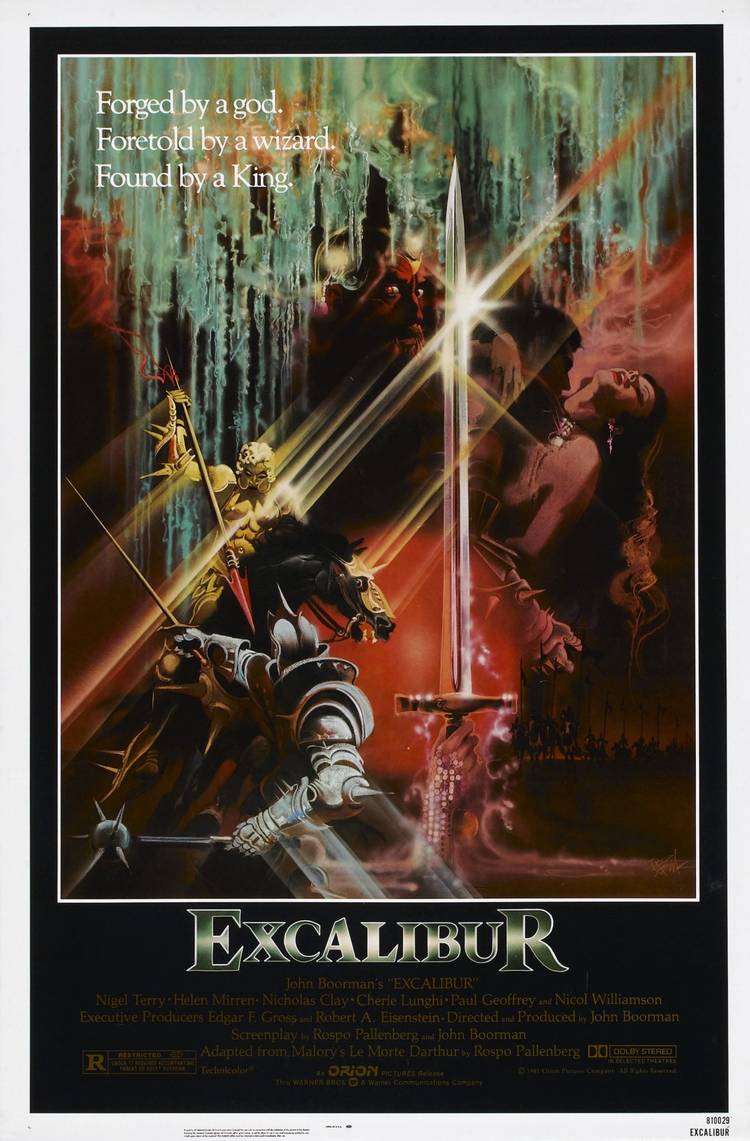
Forty-five years after its theatrical release by Warner Bros. Pictures in 1981, John Boorman’s Excalibur remains an isolated monument in the landscape of fantasy cinema. While the contemporary cinematic landscape is saturated with predictable franchises, digital world-building, and sanitized mythologies, Excalibur stands out as a singular act of artistic audacity. Adapted loosely from Thomas Malory’s late 15th-century compilation of Arthurian legends, Le Morte d’Arthur, Boorman’s film refuses to conform to the standard conventions of modern narrative pacing.
Instead, it operates on the logic of folklore and sacred ritual. Critics at the time were frequently confounded by its disjointed flow, stylistic shifts, and idiosyncratic dialogue. Yet, these elements were not structural flaws; they were deliberate choices. Boorman was not trying to tell a story in the traditional, linear sense. He was attempting something far rarer and far more difficult: he was visualizing a myth.
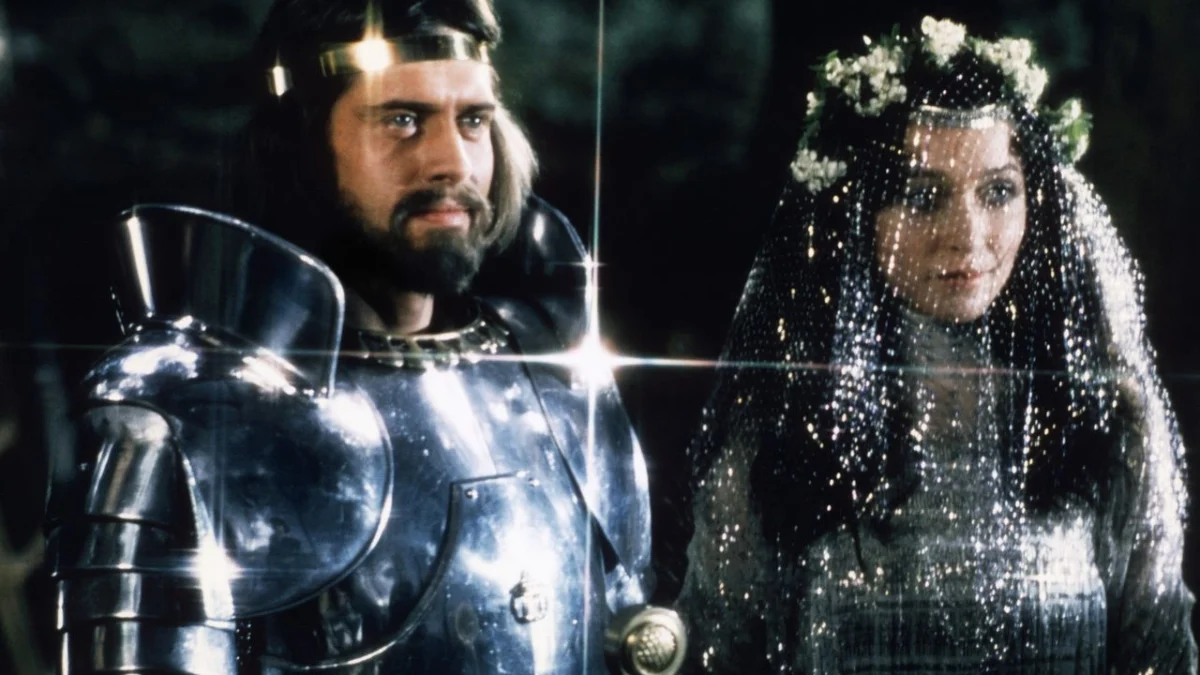
Featuring iconic performances by Nigel Terry as King Arthur, Cherie Lunghi as Guenevere, Helen Mirren as Morgan le Fay, and a nascent Liam Neeson as Sir Gawain, the film bridges the gap between primitive oral tradition and high cinematic art. It remains the most uncompromising attempt to bring the Arthurian corpus to the silver screen—a rare fusion of sensory overload, Freudian psychological depth, and Pre-Raphaelite visual splendor.
Chronology: From Middle-earth to Camelot
The genesis of Excalibur is one of the most fascinating trajectories in film history, rooted in a massive Hollywood pivot that reshaped the fantasy genre for decades to come.

- The Late 15th Century: Thomas Malory compiles and refines centuries of oral and written folklore regarding King Arthur, resulting in Le Morte d’Arthur, the definitive text for subsequent iterations of the Arthurian mythos.
- The Mid-1970s: United Artists approaches British director John Boorman—celebrated for gritty, uncompromising works like Deliverance (1972)—with a proposition to adapt J.R.R. Tolkien’s monumental high-fantasy epic, The Lord of the Rings.
- The Failed Tolkien Adaptation: Boorman and co-writer Rospo Pallenberg spend months drafting an exhaustive, highly ambitious script for The Lord of THE Rings. Ultimately, United Artists scraps the project, deeming the projected budget financially unviable. (The property eventually finds new life as Ralph Bakshi’s 1978 animated adaptation).
- The Pivot to Merlin and Arthur: Refusing to let his exhaustive conceptual groundwork go to waste, Boorman pivots back to a long-held passion project centering on Merlin and the Arthurian cycle. When funding is secured, he reuses much of the set design, aesthetic philosophy, and topographical world-building originally conceived for his aborted Middle-earth project.
- April 1981: Excalibur premieres in theaters worldwide. Distributed by Warner Bros., it polarizes contemporary reviewers—some decrying its narrative abstraction, while others praise its unbridled visual brilliance. Over the next four and a half decades, its reputation undergoes a massive critical reassessment, cementing its status as a masterpiece of speculative cinema.
Supporting Data: Mythography, Art History, and the Theology of Light
To truly understand Excalibur, one must look beyond traditional cinematic analysis and examine the dense web of comparative mythology and art history that informs its construction.
The Influence of The Golden Bough
While Malory provides the narrative skeleton, James George Frazer’s seminal 1890 comparative study of myth and religion, The Golden Bough, serves as the film’s thematic soul. The central conceit of the Fisher King—wherein the physical health of the monarch is mystically and inextricably bound to the fertility of the land—is pushed to its absolute limits in Boorman’s film. When Arthur falls into spiritual despair and moral ambiguity, the kingdom of Camelot literally withers, turning into an arid, desolate wasteland until the arrival of Perceval restores balance. In a 1981 interview with journalist Harlan Kennedy, Boorman stated plainly:
"The film has to do with mythical truth, not historical truth… What I’m doing is setting it in a world, a period, of the imagination. I’m trying to suggest a kind of Middle-earth, in Tolkien terms."
The Theology of Light and Color
Art historian Jean-Marc Elsholz has written extensively on the visual texture of Excalibur, noting the presence of a distinct "theology of light" running through the Arthurian cycle. In Boorman’s vision, light is not merely a tool for illumination; it is a spiritual substance. The characteristic, shimmering green light that bathes the knights’ armor, the forest floors, and the waters from which the mystical sword emerges is a visual manifestation of a primal, elemental force. The knights and ladies of Excalibur look less like historical figures of the Early Middle Ages and more like direct descendants of 19th-century Pre-Raphaelite paintings—simultaneously chaste and erotic, heroic and tragic.
Official Responses and Critical Evolution
The critical reception of Excalibur serves as a textbook example of a film ahead of its time, transitioning from a misunderstood box-office oddity to a critically revered masterwork.

Upon its release in the spring of 1981, mainstream outlets were frequently thrown off balance. Legendary critic Roger Ebert and reviewers for The New Yorker pointed out that the narrative leaps, archaic dialogue, and abrupt time jumps drained the central characters of consistent psychological motivation, creating a perceived lack of dramatic intensity.
However, modern retrospectives view these very traits as the film’s greatest strengths. By shedding the constraints of psychological realism favored by Hollywood, Excalibur embraces the theatricality of ancient pageantry. Every scene is meticulously composed as a self-contained tableau vivant.
Furthermore, political and sociological interpretations of the film have evolved. In the early 1980s, amidst the shifting political tides of the Western world, some cultural commentators interpreted the film’s conflation of the Holy Grail, the Sacred King, and absolute political authority as a conservative, Thatcher-era validation of centralized power. Modern academic analyses, conversely, view the film as a deconstruction of authoritarianism, where the rigidity of absolute rule inevitably breeds its own destruction through figures like Mordred.
Implications: The Legacy of Excalibur on Modern Cinema
The cultural footprint of Excalibur extends far beyond its specific runtime, casting a long, influential shadow over the fantasy genre and visual media at large.
Spurring the Sword-and-Sorcery Renaissance
While Excalibur is distinct from the low-budget, creature-feature "sword-and-sorcery" films that flooded the market in the wake of its release (such as 1982’s Conan the Barbarian), it single-handedly proved that studios could invest heavily in mythic, sword-bearing epics and achieve striking visual poetry.
The Masterclass in Visual Storytelling
Decades later, directors continue to draw inspiration from Boorman’s uncompromising framing. From the iconic, melancholic sequence where King Arthur discovers Lancelot and Guinevere sleeping chastely in the woods with Excalibur planted between them as a barrier of honor, to the breathtaking climax of the Knights of the Round Table riding out to battle accompanied by the thunderous, primal notes of Carl Orff’s Carmina Burana while spring erupts in their wake, the film provides a masterclass in visual composition.
The Survival of Myth in the Digital Age
As modern cinema increasingly relies on green screens, algorithmic pacing, and intellectual property recycling, Excalibur stands as a reminder of what happens when a singular artistic vision is allowed to manifest without filtered compromises. It demonstrates that myths survive not because they are historically accurate or logically airtight, but because their underlying visual symbolism and emotional truths echo eternally across generations.
For those wishing to revisit or discover John Boorman’s masterwork, Excalibur is currently available to rent on major digital platforms including Prime Video and Apple TV.

