

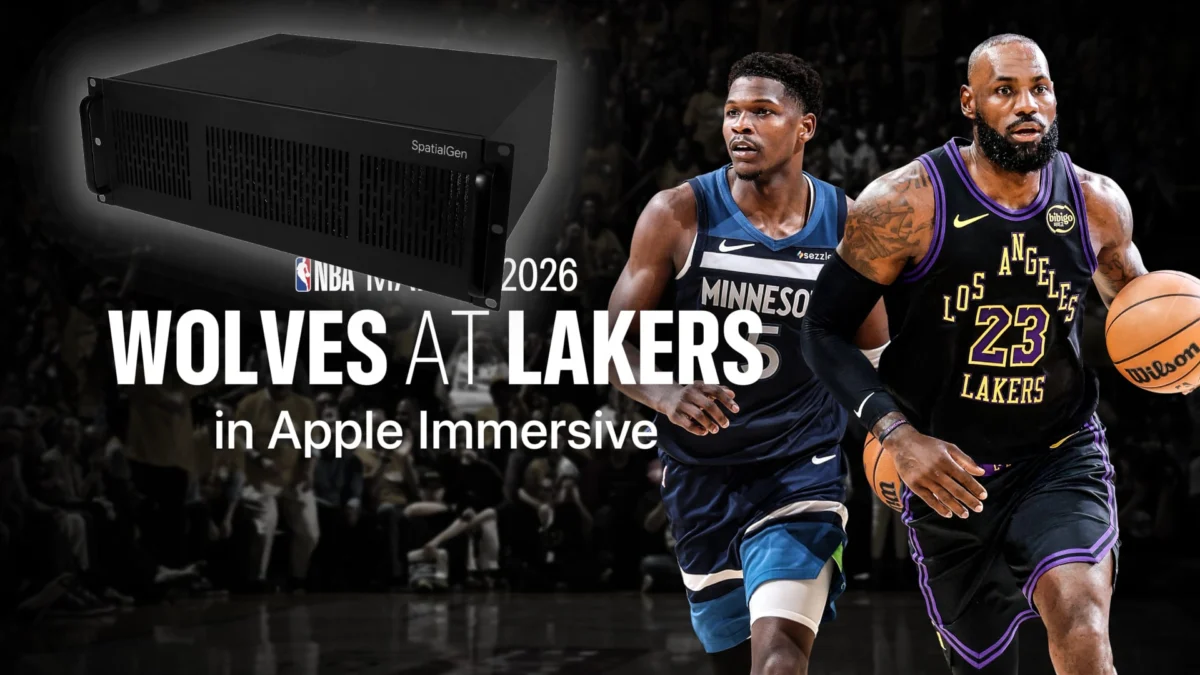
As the Apple Vision Pro and its counterparts redefine the boundaries of digital presence, the consumer-facing excitement often centers on the headset itself. However, the true revolution is happening behind the scenes, within the "invisible infrastructure" that makes real-time, high-fidelity spatial experiences possible. Enter the SpatialGen Zeus, a 3U rack-mounted powerhouse engineered to solve the industry’s most pressing technical bottleneck: how to ingest, encode, and deliver professional-grade Apple Immersive Video in real time.
The Main Facts: Bridging the Gap Between Capture and Headset
SpatialGen’s Zeus is not merely a piece of hardware; it is a full-stack, end-to-end ecosystem designed to handle the grueling technical demands of live immersive production. Apple Immersive Video, which utilizes high-resolution 180-degree stereoscopic 3D footage combined with spatial audio, requires a throughput capacity that traditional streaming architectures simply cannot handle.
The Zeus system is built to ingest and distribute Apple’s ProRes video—a codec prized for its quality but notorious for its massive data requirements. By streamlining the pipeline for live 2D and immersive experiences, Zeus provides a standardized workflow for content creators. The system’s core capabilities include:
- Massive Throughput: Support for 100 Gb/s peak sustained throughput.
- High-Fidelity Ingest: Capable of handling 16K resolution streams.
- Fluid Motion: Support for frame rates exceeding 90 FPS, essential for preventing motion sickness in VR environments.
- Universal CDN Integration: Seamless distribution across major platforms, including AWS CloudFront, Azure, Google Cloud Platform, and Akamai, alongside SpatialGen’s proprietary delivery network.
A Chronology of Immersive Evolution
The path to current immersive standards has been long and fraught with experimental, often clunky, technological hurdles.
The Early Phase (2016–2020)
Early efforts in live VR streaming were characterized by "one-off" technical experiments. Producers utilized disjointed software chains, often resulting in low-resolution, monoscopic video that failed to capture the depth required for true immersion. Latency was a persistent enemy, and high-quality spatial audio was often an afterthought.
The Emergence of High-Fidelity Standards (2021–2023)
As hardware advanced, the demand for higher resolution became paramount. Companies began shifting from 4K per eye to higher, more pixel-dense formats. During this period, the industry recognized that the bottleneck was not the headset’s display capabilities, but the "pipe" through which the data flowed. The integration of ProRes workflows into live streaming became the "Holy Grail" for broadcast engineers.
The SpatialGen Breakthrough (2024–Present)
With the launch of the Apple Vision Pro, the "Immersive Video" format became the new industry benchmark. SpatialGen recognized that without a dedicated, optimized rack-mount system, the vision of "live concerts and sports in 3D" would remain a niche, expensive, and fragile endeavor. The Zeus system was developed to provide the reliability of traditional broadcast TV to the emerging world of spatial computing.
Supporting Data: Why "ProRes" Matters
The technical specifications of the Zeus system are a direct response to the requirements of the Apple Immersive Video format. Unlike standard H.264 or HEVC streams, which heavily compress data to save bandwidth, ProRes preserves the integrity of the image.
Technical Performance Metrics
- Resolution: 16K ingest allows for significant cropping and post-production flexibility while maintaining a razor-sharp image in the final 8K-per-eye output.
- Bitrate Management: Processing multi-terabyte ProRes footage in real time requires specialized hardware acceleration. Zeus utilizes internal dedicated processing units to ensure that the "live" aspect of the broadcast does not suffer from frame drops or stuttering.
- Latency: In sports broadcasting, latency is the difference between a successful experience and a ruined one. SpatialGen’s optimized pipeline ensures that the delay between the Blackmagic URSA Cine Immersive camera capturing the action and the Vision Pro user seeing it is kept to an absolute minimum.
Official Perspectives and Industry Impact
In recent industry briefings, including previews at AWE (Augmented World Expo), SpatialGen representatives highlighted that their infrastructure currently underpins over 90% of third-party immersive video content available on the Apple Vision Pro. This is a staggering statistic that positions the company as the "Intel Inside" of the spatial era.
The Role of Professional Hardware
SpatialGen has explicitly integrated support for the Blackmagic URSA Cine Immersive 100G camera. This camera is the industry-standard tool for 8K stereoscopic 3D capture. By ensuring that Zeus is "plug-and-play" compatible with such high-end hardware, SpatialGen has removed the integration friction that previously hindered production houses.
The Support Ecosystem
One of the most critical aspects of the Zeus offering is the service model. Every system includes a lifetime software license and one year of direct access to SpatialGen engineers. In the world of live broadcasting, there is no "reset button" for a global sports event. Having a direct line to the architects of the delivery system provides the security that enterprise-level clients—such as those producing for Spectrum Front Row—require to feel confident in their workflows.
The Implications: Changing How We View the World
The implications of the SpatialGen Zeus extend far beyond technical specifications; they signal a shift in the media landscape.
1. The Death of the "Technical Experiment"
For years, live VR streaming was considered an experimental marketing stunt. If the stream failed, it was a disappointment but not a failure of a primary business model. With the integration of systems like Zeus, the transition to professional-grade, reliable immersive streaming means that broadcasters can now treat spatial content as a permanent, revenue-generating pillar of their business.
2. The Future of Live Sports
The success of the Los Angeles Lakers games on Apple Vision Pro, facilitated by Spectrum SportsNet and the NBA app, serves as the definitive blueprint for the future. As these experiences become common, the bar for "live sports" will rise. Fans will eventually expect to sit courtside in 3D from their living rooms. This level of demand requires the robust, scalable infrastructure that Zeus provides.
3. Democratizing the "Invisible" Pipeline
While Zeus is not a consumer product—it is an expensive, rack-mounted enterprise solution—it serves as the foundation for the content that will eventually reach millions of users. By simplifying the path from camera to headset, SpatialGen is lowering the barrier to entry for content creators. As the infrastructure becomes more refined, we can expect the costs of immersive production to drop, leading to an explosion of diverse content, from theater performances to global news coverage.
Conclusion
The SpatialGen Zeus is the quiet titan of the immersive video revolution. By solving the complex problems of ProRes ingest, massive throughput, and reliable distribution, it has effectively "future-proofed" the live immersive pipeline.
While the average Vision Pro owner may never see a Zeus unit, they will undoubtedly feel its impact. Every time a live game, concert, or keynote address streams flawlessly in high-resolution, stereoscopic 3D, it is due in large part to the work happening in these rack-mounted systems. As we move toward a future where spatial computing is as ubiquitous as the smartphone, the role of "invisible infrastructure" like SpatialGen Zeus will only become more vital, turning the once-impossible dream of real-time 3D immersion into a daily reality for users worldwide.

