

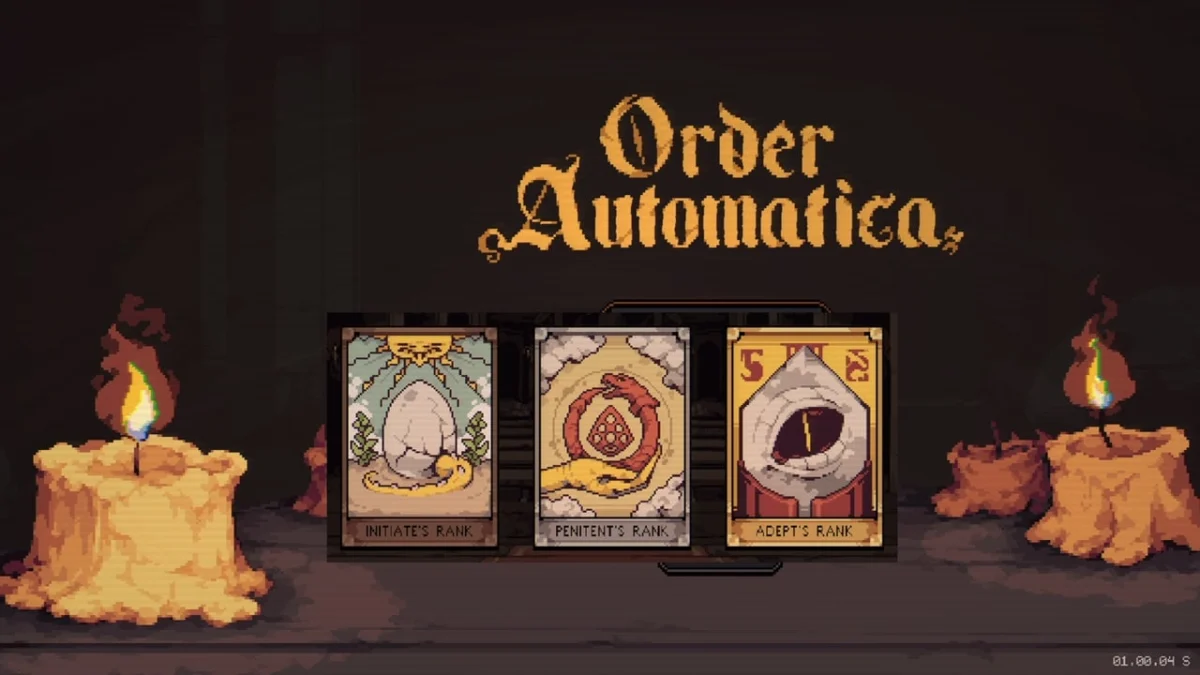
In the ever-expanding universe of mobile gaming, where auto-battlers often blur the lines between passive observation and strategic engagement, Order Automatica has emerged as a refreshing, albeit punishing, anomaly. Developed with a focus on "pre-battle agency," this dark tactical roguelite challenges the conventional wisdom that auto-battlers are "hands-off" experiences. By distilling complex combat mechanics into a confined 3×3 ritual grid, the developers have created a game where the outcome of a fight is effectively written before the first strike is landed.
Now available on the Google Play Store, Order Automatica represents a masterclass in minimalist design. It is a title that demands meticulous preparation, rewarding the player not for their reflexes, but for their foresight, mathematical planning, and ability to navigate the volatile nature of demonic RNG.
The Core Concept: Chess with Demons
At its heart, Order Automatica is a game of architecture. The player is presented with a 3×3 grid—a small, cramped space that serves as the altar upon which your tactical legacy is built. While the term "auto-battler" might suggest a game that plays itself, the developers are quick to clarify that this is a misnomer. In this title, the battle is merely the cinematic payoff for the real gameplay: the preparation phase.
The "Chess with demons" descriptor used by the development team is apt. Just as a grandmaster anticipates an opponent’s moves several turns in advance, a player in Order Automatica must anticipate the demonic onslaught through unit placement, tile manipulation, and the careful curation of relics. Every square on that 3×3 grid acts as a variable in an equation that either resolves in a triumphant victory or a swift, brutal defeat.
The Mechanics of Mastery
The depth of the game lies in the compounding nature of its systems. Positioning is paramount, but it is only the foundation. Players must navigate:
- Unit Merging: Combining forces to create higher-tier entities.
- Tile Effects: Utilizing the grid itself to buff units or debuff incoming foes.
- Relic Combinations: Equipping artifacts that fundamentally alter the rules of engagement.
- Curses: Managing high-risk, high-reward debuffs that can pivot a build from "average" to "game-breakingly powerful."
Chronology of Development and Design Philosophy
The genesis of Order Automatica stems from a desire to strip away the "bloat" often found in modern roguelites. While many games in the genre rely on lengthy progression trees and endless unlocks to keep players engaged, Order Automatica opts for a leaner approach.
The Iterative Process
Early development focused on the constraints of the 3×3 grid. The designers wanted to ensure that every square felt significant. By limiting the board, they effectively forced players to engage with the "opportunity cost" of every decision. If a player places a high-damage unit on a specific tile, they are inherently deciding not to place a support unit there—a decision that dictates the entire flow of the coming round.
Following the initial prototype phase, the team implemented the "Challenge Mode." This was a pivotal moment in the game’s design, as it allowed players to preview the enemy roster. By removing the veil of complete uncertainty, the developers shifted the focus from "guessing" to "problem-solving." This ensures that even when the RNG (Random Number Generator) provides sub-optimal units, the player still feels they have the agency to build a counter-strategy.
Supporting Data: Why the Numbers Matter
One of the most satisfying elements of Order Automatica is the exponential growth of unit statistics. In the later stages of a successful run, the numbers on the screen can reach absurd, screen-filling heights. This is not an accident of balance; it is a feature of the "engine-building" nature of the game.
The Math of Synergy
Synergy is the lifeblood of the title. For instance, pairing a relic that increases attack speed based on adjacent units with a unit that gains "cleave" damage creates a snowball effect. Because the grid is so small, these interactions are tightly packed, causing status effects and damage multipliers to chain together in ways that can trivialise even the most daunting demonic bosses.
However, the game balances this power creep with the inherent danger of its roguelite elements. If a player leans too heavily into a "glass cannon" build, a single misplaced unit or an unlucky curse can dismantle their entire strategy. The data suggests that successful players are those who treat the grid like a circuit board, ensuring that each component supports the next, creating a self-sustaining loop of destruction.
Official Responses and Developer Intent
The development team has been vocal about their desire to keep the "meta-progression" elements light. In an era where mobile games are often criticized for aggressive grinding and "pay-to-progress" mechanics, Order Automatica stands in stark contrast.
"Your choices matter more than your collection," a representative noted during the launch phase. This philosophy is evident in the lack of forced grinding. While there are unit unlocks that provide variety, the game does not hide its core mechanics behind a wall of progression. Whether you are a veteran of the genre or a newcomer, the tools to succeed are available from the outset, provided you have the tactical acumen to wield them.
The developers have also emphasized the importance of the game’s difficulty modes. By offering a wide range of challenges, they accommodate both the casual player looking for a relaxing, rhythmic experience and the hardcore tactician looking to push the game’s systems to their absolute breaking point.
Implications for the Mobile Roguelite Market
The release of Order Automatica carries significant implications for the mobile gaming landscape. It proves that there is a hunger for "high-intensity, small-format" strategy games. As mobile devices continue to be used in short bursts, the ability to play a deep, complex, and rewarding session within a few minutes—without the need for massive save files or complex controls—is a massive selling point.
The Shift Toward Minimalism
The industry has seen a trend toward bloated, open-world mobile experiences, but Order Automatica suggests that "less is more." By narrowing the scope to a 3×3 grid, the developers have managed to create a game that is technically impressive yet accessible. This shift toward minimalist, high-impact design is likely to influence future indie titles, particularly those looking to avoid the high overhead of modern 3D development while still offering deep, replayable content.
Furthermore, the game’s approach to RNG is a masterclass in design. Rather than letting randomness dictate failure, the game provides the player with the tools to mitigate, manipulate, or embrace the chaos. This is a critical lesson for other developers: players do not hate RNG; they hate feeling like their decisions do not matter in the face of it.
Conclusion: A Must-Play Tactical Experience
Order Automatica is, at its core, a puzzle masquerading as a war. It is a game that respects the player’s intelligence, demanding that they become architects of their own destiny within a brutal, demonic landscape.
With its current launch pricing of $4.79, it represents one of the best value propositions in the mobile roguelite market. Whether you are looking for a game to test your logical reasoning or simply want to see just how high you can push your damage numbers before the screen explodes with math, this is a title that deserves a permanent spot on your device.
As the genre continues to evolve, Order Automatica will likely be remembered as a high-water mark for tactical design. It is a reminder that you don’t need a massive battlefield to create an epic struggle; sometimes, all you need is nine squares, a few demonic enemies, and the foresight to outplay them before the first turn begins.
For those ready to test their wits against the void, the game is available now on the Google Play Store. Prepare your grid, sharpen your relics, and remember: in this game, the battle is decided long before the fighting starts.

