

For PC gamers watching the horizon for the elusive release of Grand Theft Auto VI, the waiting game has birthed a bizarre subculture of radical experimentation. While Rockstar Games remains tight-lipped about the definitive PC launch timeline for its next generation of open-world crime, modders are taking matters into their own hands.
Enter a daily, high-stakes journalistic and technical experiment: modding Grand Theft Auto V every single day until it either miraculously morphs into a PC equivalent of GTA 6 or collapses under its own structural weight. What begins as a simple quest for next-gen fidelity quickly spirals into a digital fever dream where sci-fi dimensions, physics engines, and pop-culture phenomena collide in the streets of Los Santos.
Chronology of Chaos: From Missiles to Multiverses
Phase 1: The Escalation of Firepower
The daily modding gauntlet did not begin with subtlety. The opening salvo of the experiment involved injecting a brand-new, heavily customized vehicle into the world of San Andreas—one outfitted with enough high-explosive ordnance and tracking missiles to level a dense metropolitan city block in seconds. This established the baseline rule of the project: stability is secondary, and maximum visual and kinetic disruption is the primary objective.
Phase 2: Entering the Multiverse of Rick and Morty
With the baseline of destruction established, the experiment pivoted toward cultural crossover territory. Admitting a total unfamiliarity with Adult Swim’s acclaimed animated series Rick and Morty—knowing only of the scientist, the boy, the lingering cultural touchstones like Sichuan sauce, and a ubiquitous Blonde Redhead song—the modder installed the community-made script “Rick, Two Crows, and Morty” into GTA 5.
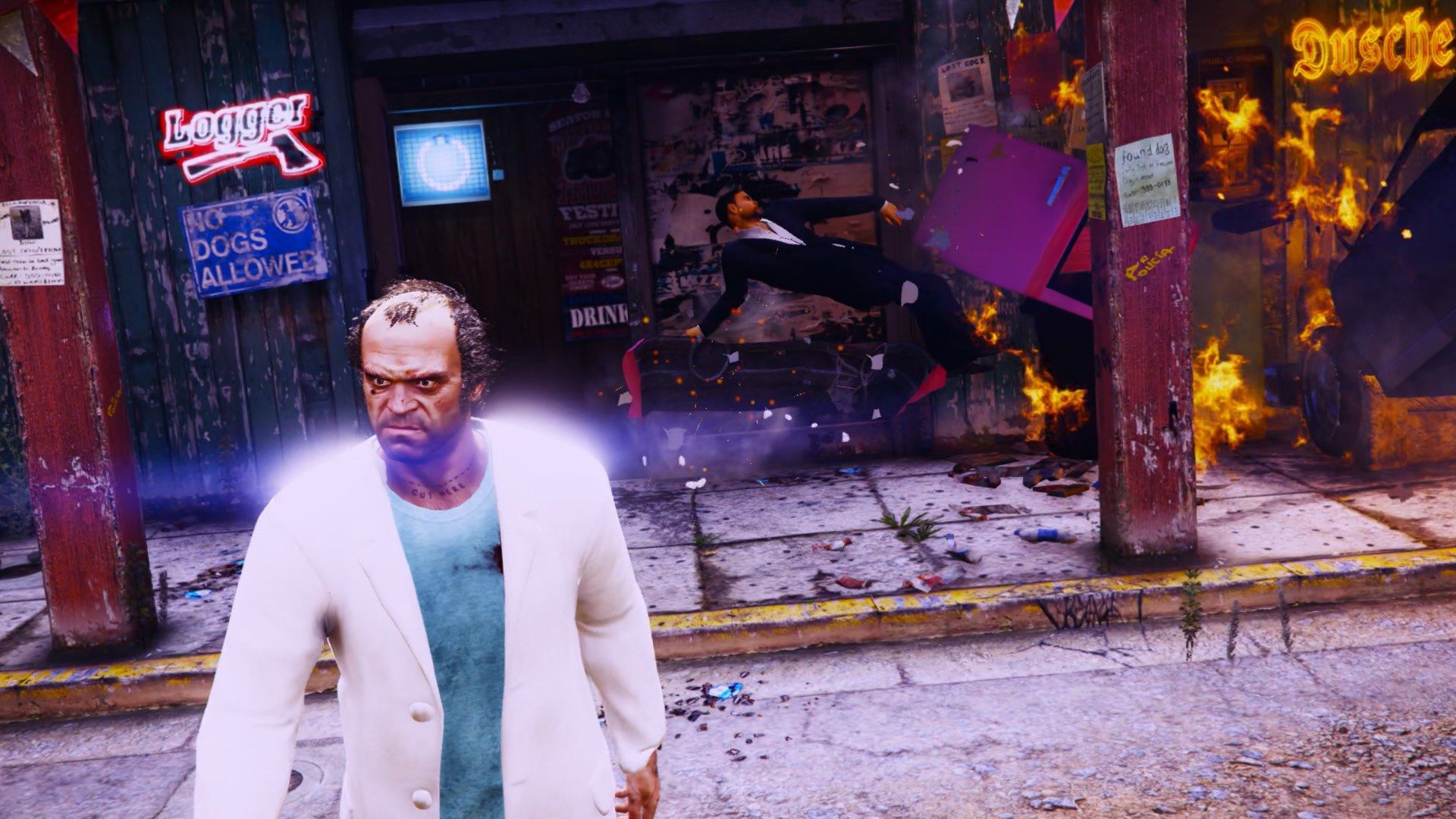
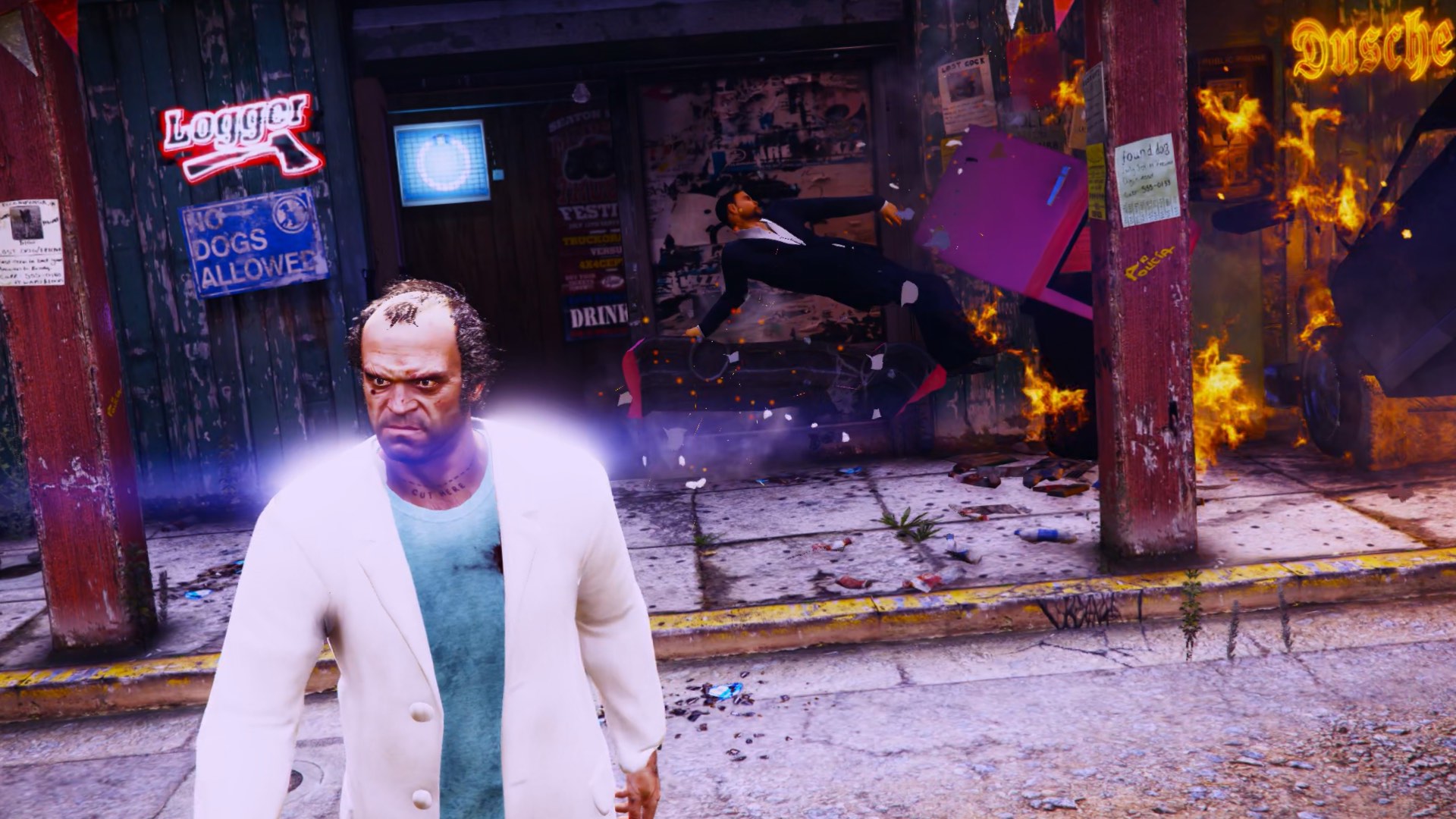
At the press of a single function key (F7), the bleak, sun-bleached realism of Los Santos undergoes an immediate paradigm shift. Protagonist Trevor Philips is abruptly transformed into Rick Sanchez (or perhaps Morty, depending on the erratic logic of the script), draped in a standard-issue white lab coat over a begrimed graphic t-shirt.
Supporting Data & Mod Mechanics: What Happens When Dimensions Collide?
The Rick and Morty integration is not merely a cosmetic skin swap; it injects a chaotic sandbox toolkit straight out of interdimensional cable:
- Adjustable Companions: Players can summon a resizing boy whose scale fluctuates unpredictably.
- Sci-Fi Arsenals: Standard firearms are replaced with high-powered laser rifles and concentrated light-ring projectors.
- Aviation Anomalies: The traditional helicopter and plane rosters are supplemented by a functional flying saucer.
- Interdimensional Munitions: Pokéballs that generate localized black holes are added to the inventory—completely distinct from the separate suite of standard Pokéballs ported over from previous experimental mods (drawing clear inspiration from Pokémon GO).
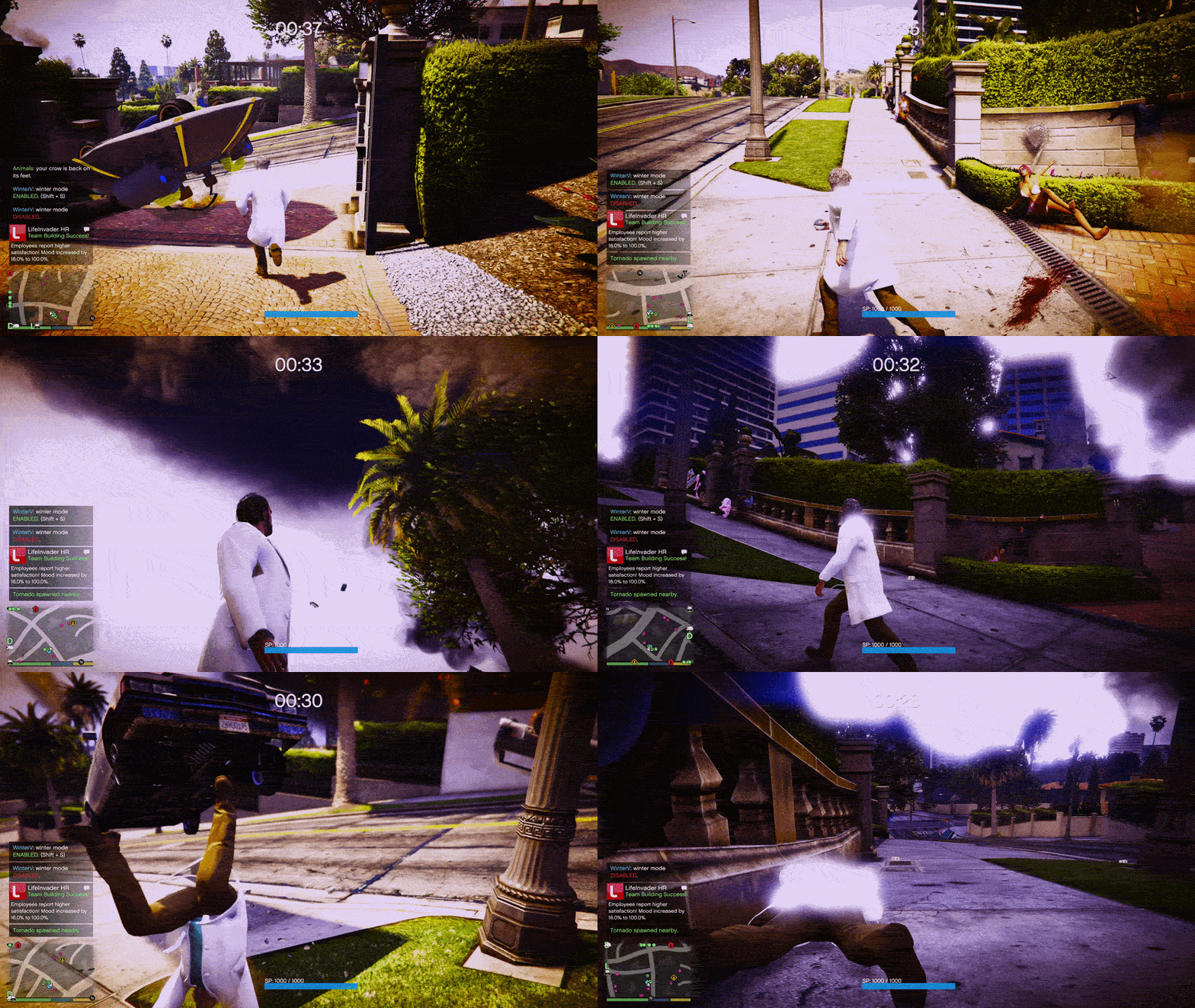
As Trevor wanders the streets in his lab coat, the ambient AI systems of Los Santos react in real-time to the compounding modifications. Natural disasters triggered by concurrent mods—such as localized tornadoes and vanishing exterior world-cells—wreak havoc on civilian routines. In one surreal snapshot of the experiment, a system notification flashes across the screen: "The American People have been wiped out." Concurrently, a battalion of furries finds themselves caught directly in the path of a swirling downtown tempest.
Piloting the modded flying saucer proves to be a masterclass in frustration, offering little more than awkward vertical ascent, descent, and erratic mid-air rotation. Abandoning the spacecraft, the player is suddenly teleported to a remote drinking hole deep in rural northern San Andreas. A black-hole-generating Pokéball tossed behind the wooden bar creates an instant localized gravitational vortex. The player’s assigned bodyguard, hypnotized by the swirling spatial anomaly, becomes physically plastered to an exterior wall like microscopic iron filings clinging to a hidden neodymium magnet, screaming into the digital void.
Official Responses and Community Reception
While Rockstar Games has not officially commented on this specific daily stress-test of its engine, the broader developer community has long acknowledged the tenacity of the GTA 5 modding scene. Having survived over a decade on PC, the Grand Theft Auto V modding ecosystem remains one of the most robust and unpredictable software modification communities in gaming history.
Creators of scripts like “Rick, Two Crows, and Morty” operate in a grey area of intellectual property appreciation and technical wizardry, pushing the RAGE engine far beyond the parameters its original architects ever envisioned in 2013. Forums on platforms like GTA5-Mods.com continue to see massive traffic as players attempt to graft modern anime, sci-fi franchises, and next-generation environmental physics onto an engine approaching its twelfth year.
Implications: The Future of PC Open-World Modding
What does this daily descent into madness mean for the future of PC gaming?
- The Engine Limit: GTA 5 is rapidly approaching its absolute structural limits. By forcing conflicting script hooks—weather manipulation, particle physics engines, dimension-hopping inventories, and asset replacements—modders are effectively mapping out the breaking point of aging game architectures.
- The Wait for GTA 6: As Rockstar Games maintains radio silence regarding a concrete PC release date for GTA 6, PC players are utilizing mods as a psychological coping mechanism. If official next-gen features cannot be experienced natively, the community will simply construct a Frankenstein’s monster facsimile using the tools at hand.
- Emergent Storytelling: The true value of these daily experiments lies not in the fidelity of the simulation, but in the unscripted comedic chaos. When a bodyguard sticks to a wall while the UI casually announces the extinction of the American populace, it highlights the unique, unpredictable magic of sandbox video games when driven past the brink of sanity.
The experiment continues tomorrow. Will GTA 5 finally evolve into a stable, next-generation masterpiece, or will it implode into a black hole of cascading script errors? Only the code knows for sure.

