

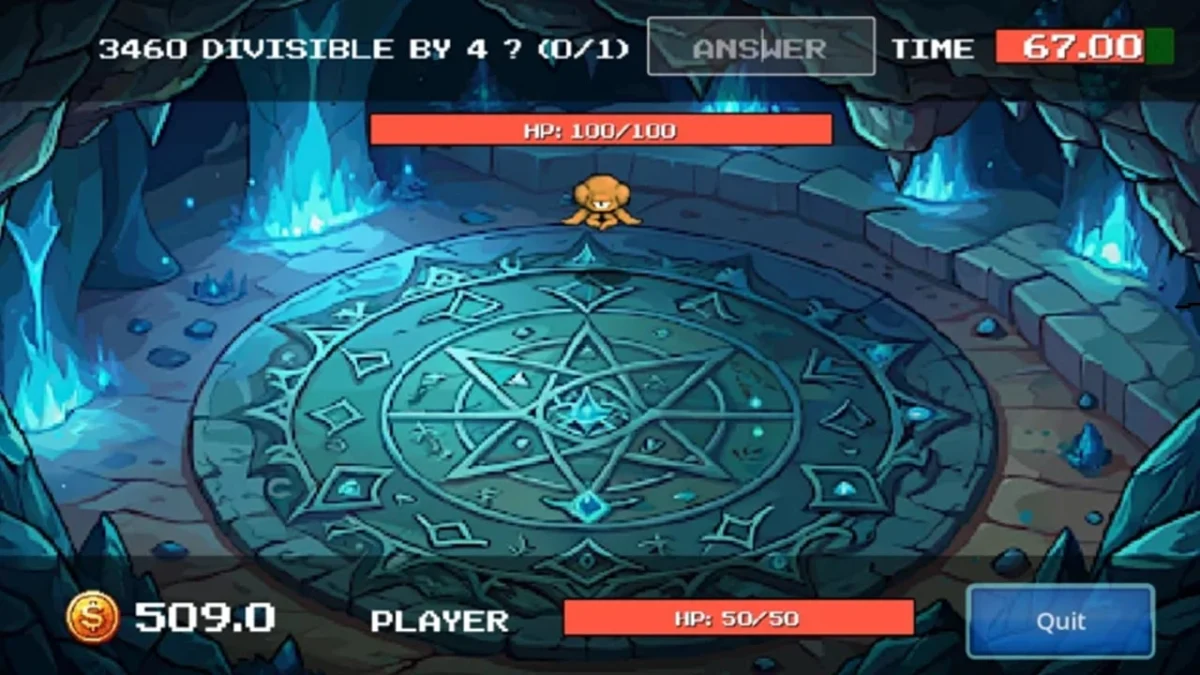
For many, the mere mention of a math textbook evokes memories of stifling classrooms, confusing equations, and the urge to walk away from the subject entirely. However, a new title is looking to rewrite that narrative, transforming the often-daunting world of mental arithmetic into an immersive, JRPG-inspired adventure. Wizard of Maths, a title recently released on mobile platforms with a PC port slated for Q4 2026, aims to prove that numerical fluency doesn’t have to be a chore—it can be a quest.
The Core Concept: Where RPG Mechanics Meet Numerical Mastery
At its heart, Wizard of Maths is designed to bridge the gap between educational utility and engaging entertainment. By wrapping rigorous mathematical training in the trappings of a Japanese Role-Playing Game (JRPG), the developers have created an environment that feels less like a classroom and more like a heroic journey.
The target demographic for this software is remarkably broad. Whether you are a primary school student grappling with the fundamentals, a high schooler looking to boost your test scores, or a professional aiming to regain the mental sharpness required for high-stakes environments, the game scales its difficulty to meet the user where they are.
Unlike traditional rote-learning software, which can become monotonous, Wizard of Maths utilizes a progression system that pushes the player forward. As your numerical fluency improves, the game increases the complexity of the arithmetic challenges, ensuring that players are constantly pushed just beyond their current comfort zone. This "Zone of Proximal Development"—a concept borrowed from educational psychology—is the engine that drives the game’s efficacy.
Chronology of Development and Availability
The trajectory of Wizard of Maths is one of calculated expansion. The title is currently available for purchase on the Google Play Store for $5.99, marking its entry into the mobile gaming space. The development team has signaled a long-term roadmap that extends well into the next two years.
- Initial Launch (Q3 2024): The game debuted on Android, focusing on mobile-first accessibility. This phase was prioritized to allow users to practice in "micro-sessions"—perfect for commutes or short breaks.
- Feature Expansion (Ongoing): Following the launch, the developers have been monitoring user feedback to refine the difficulty curves and pedagogical algorithms.
- PC Port Development (Scheduled Q4 2026): Recognizing the need for a more immersive, desktop-based experience, the team has committed to a PC release. This version is expected to leverage higher-resolution assets and potentially more complex, multi-tasking arithmetic scenarios that benefit from a keyboard-and-mouse interface.
Supporting Data: The Science of Mental Fluency
The developers claim that Wizard of Maths is not merely a collection of puzzles, but a product backed by modern educational research. The gameplay loop is designed to foster "numerical fluency," defined as the ability to perform calculations with both speed and accuracy.
Central to this are the 72 practical arithmetic tricks integrated into the gameplay. These are not arbitrary puzzles; they are curated techniques sourced from best-selling literature on mental math and shortcut methodologies. By teaching users how to break down complex problems into manageable chunks—such as Vedic math principles or rapid estimation techniques—the game aims to turn casual players into "human calculators."
The efficacy of this approach is supported by recent studies in cognitive science suggesting that gamified learning increases dopamine release, which in turn improves information retention. By providing immediate feedback in a low-stakes environment, the game lowers the "math anxiety" that often prevents individuals from mastering these skills.
Official Perspectives: The Developer’s Vision
In statements provided by the development team, the philosophy behind Wizard of Maths centers on accessibility and utility. "Our goal was to strip away the intimidating facade of mathematics," a spokesperson noted. "By placing these challenges inside an RPG world, we allow players to view a difficult equation as a ‘boss fight’ to be conquered, rather than an insurmountable barrier."
The developers have also emphasized the importance of localization. Recognizing that math is a universal language, the game has been localized into nine different languages. This is a critical step in their mission to reach a global audience, ensuring that users in diverse educational systems can benefit from the same pedagogical techniques.
Furthermore, the team highlights the inclusion of a "game editor." This feature allows users to curate their own curriculum. If a student is struggling specifically with percentages, or if a finance professional needs to sharpen their skills in rapid division, they can configure their training sessions to prioritize these specific operations.
Implications: From Gaming to Professional Advancement
The potential applications of Wizard of Maths extend far beyond the casual gamer. The software is being positioned as a legitimate tool for professional development, particularly in sectors where quick mental math is an essential job requirement.
Preparing for High-Stakes Interviews
Many high-pressure roles, particularly in finance, banking, and casino management (such as croupiers), require candidates to perform rapid mental arithmetic under the watchful eyes of recruiters. The game serves as a simulator for these high-pressure scenarios, helping candidates build the "mental stamina" required to perform under stress.
Changing the Public Perception of Mathematics
The cultural stigma surrounding "being bad at math" is a significant hurdle in modern education. By packaging high-level arithmetic as a game, Wizard of Maths aims to democratize access to advanced calculation techniques. It shifts the narrative from "I am not a math person" to "I have not yet practiced the right techniques."
The Future of Edutainment
The success of this title could signal a shift in the broader edutainment industry. If players are willing to pay for a product that combines, for example, complex data analysis with dungeon-crawling, we may see a wave of developers integrating more "hard skills" into the gaming medium.
Conclusion: Is It Worth the Investment?
With a price point of $5.99, Wizard of Maths occupies a unique space in the mobile app market. It is more expensive than many casual "time-waster" games, yet it is significantly more affordable than traditional tutoring services or specialized cognitive training software.
The aesthetic of the game—described as "cute on the outside, but unforgiving on the inside"—is a testament to the developers’ commitment to substance over style. While the visuals may appeal to a younger audience, the underlying math engine is designed for serious, rigorous practice. For the professional looking to sharpen their edge, the student looking to improve their grades, or the casual player looking to keep their mind agile, Wizard of Maths offers a compelling, long-term value proposition.
As we look toward the PC release in 2026, it is clear that the project is not just a passing trend in mobile gaming. It is a serious attempt to leverage the psychological hooks of video games to solve a perennial, real-world educational problem. If you have ever felt that your mathematical abilities were lacking, this might be the most productive way to "level up" that you encounter this year.
For those interested in exploring similar intersections between gaming and personal development, consider reading our previous coverage on ‘Sakumon,’ a multiplayer companion title that blends collectible mechanics with real-world interactivity.

