

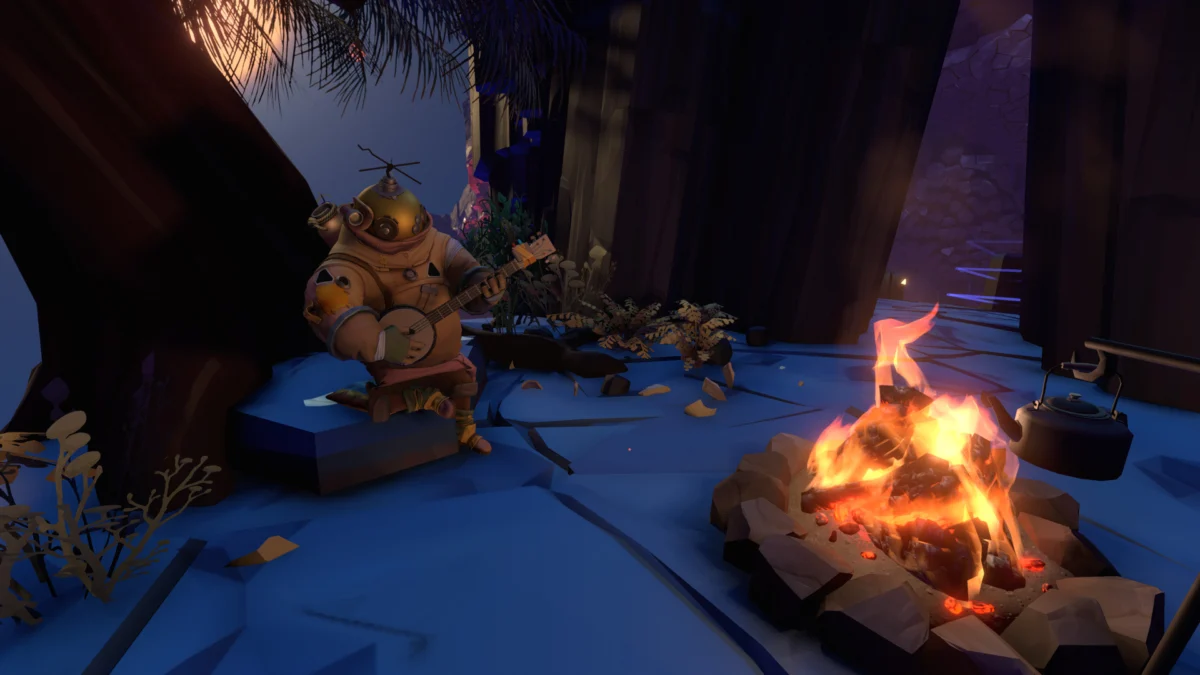
Since its debut in 2019, Mobius Digital’s Outer Wilds has transcended the typical lifecycle of a video game. While most titles experience a surge of interest followed by a quiet decline into obscurity, Outer Wilds has maintained a persistent, almost gravitational pull on the gaming community. It is a rare example of a game that is spoken about in hushed, reverent tones on podcasts, forums, and critic circles years after its initial launch. For those looking for an immersive experience to lose themselves in during the holiday season or any period of respite, Outer Wilds stands as an essential, albeit challenging, pillar of contemporary interactive media.
The Core Concept: Knowledge as Progression
At its heart, Outer Wilds is a game about the intersection of time, space, and existential discovery. Players assume the role of an astronaut—the newest recruit of a burgeoning space program—who is tasked with exploring a hand-crafted, miniature solar system. The catch? The entire system is trapped in a 22-minute time loop. At the end of every cycle, the sun goes supernova, vaporizing everything in its vicinity, only for the player to wake up back at the campfire, ready to begin the cycle anew.
Unlike traditional RPGs where progress is measured by leveling up stats or acquiring better gear, Outer Wilds operates on a foundation of "knowledge-based progression." You do not get stronger; you simply get smarter. The game provides no artificial barriers or locked doors that require a specific item to bypass. Instead, the barriers are entirely cognitive. A door is locked because you haven’t yet learned the mechanism of how to open it; a planet is inaccessible because you haven’t discovered the physics of how to navigate its unique environment.
Chronology of a Cult Phenomenon
The trajectory of Outer Wilds from a crowdfunded passion project to a critically acclaimed titan is a study in sustained momentum.
- 2012–2015: The Prototype Phase: Originally created by Alex Beachum as a master’s thesis at the University of Southern California (USC) Interactive Media & Games Division, the game began as a small experiment in open-world design within a constrained, looping time frame.
- 2015: Fig Crowdfunding: Mobius Digital launched a campaign on the Fig platform, which was instrumental in securing the creative freedom the team needed to maintain the game’s unique vision.
- May 2019: The Launch: The game debuted on Windows and Xbox One, immediately capturing the attention of critics who were struck by its dense, interconnected narrative design.
- 2020–2021: Post-Launch Growth: The game’s reputation grew through word-of-mouth. Its inclusion on platforms like Xbox Game Pass and the eventual release of the Echoes of the Eye expansion in late 2021 cemented its status as a "must-play" title.
- 2021–Present: The game continues to be cited as a pinnacle of environmental storytelling, appearing on virtually every "best of the decade" list.
The Mechanics of Curiosity: Why It Works
The genius of Outer Wilds lies in its ability to trust the player. In an era where many modern games hold the user’s hand with intrusive tutorials and waypoint markers, Outer Wilds gives the player a spaceship and a solar system, then steps back.
The Physics of Failure
The game is admittedly difficult. Navigating a ship in zero-gravity, managing fuel levels, and calculating landing trajectories on planets with shifting tectonic plates or liquid sand requires patience. Players will die—frequently and sometimes quite spectacularly. Whether it’s being crushed by falling debris, suffocating in a deep cavern, or getting caught in the gravity well of a collapsing star, the game turns "failure" into a teaching tool. Every death is a lesson in the mechanics of the universe, and every respawn is an opportunity to apply that newfound wisdom to a different corner of the map.
Narrative Architecture
The story of the Nomai—an ancient, extinct race whose ruins litter the solar system—is told entirely through environmental cues and text logs. There are no cutscenes. There is no narrator. The story is a puzzle, and it is up to the player to piece together the history of a lost civilization to understand why they are caught in this temporal trap. The satisfaction of uncovering a piece of the puzzle is arguably one of the most rewarding experiences in gaming history, triggering those "eureka" moments that make the struggle worthwhile.

Supporting Data: Critical Reception and Legacy
The critical reception of Outer Wilds has been near-unanimous in its praise. Upon release, the game garnered an aggregate score on platforms like Metacritic that placed it among the highest-rated titles of 2019. However, the true data point for its success is the "long tail" of its engagement.
- Awards: Outer Wilds won the "Best Game" award at the 2020 BAFTA Games Awards and was honored with the Seumas McNally Grand Prize at the Independent Games Festival.
- Community Sentiment: Steam reviews and community discussions reflect an overwhelmingly positive trend. A recurring theme in player feedback is the "desire to play the game for the first time again," a testament to how deeply the narrative resonates with the audience.
- The "Spoiler" Problem: The game is so uniquely dependent on player discovery that the community has formed a protective barrier around it, often warning new players to avoid spoilers at all costs. This protective culture has kept the game relevant, as every new wave of players discovers the mystery for themselves.
Official Responses and Developer Philosophy
Alex Beachum, the creative director at Mobius Digital, has frequently commented on the game’s design philosophy in interviews. He has often emphasized that the game was built to reward "insatiable curiosity." The development team sought to create a world that didn’t revolve around the player’s presence, but rather one that existed independently of them.
"We wanted to make a game where the world is doing its own thing, and the player is just a witness to it," Beachum noted during a 2020 post-mortem discussion. This philosophy is evident in the planetary systems—planets that crumble, stars that explode, and black holes that pull in debris—all of which occur regardless of whether the player is watching. This "clockwork universe" approach is what makes the experience feel so grounded and tangible.
Implications: Why You Must Play It Now
If you have avoided Outer Wilds because of its reputation for being "difficult" or "frustrating," it is time to reconsider. The frustration is not a bug; it is a feature. It is a necessary friction that makes the eventual revelation feel earned.
The Value of Time and Money
In a market saturated with "service games" designed to keep you playing forever through microtransactions and grind-heavy loops, Outer Wilds offers a finite, high-density experience. You can finish it in 20 to 30 hours, and you will walk away feeling as though you have experienced a complete, profound story. It is a value proposition that prioritizes quality of time over quantity of hours.
The Gateway to New Genres
For players who typically stick to shooters or action games, Outer Wilds can be a gateway into the "metroidvania" or "puzzle-adventure" genres. It teaches a specific type of logic—one that is applicable not just in games, but in how we approach problem-solving in real life. It asks the player to look at a complex system, break it down into its constituent parts, and understand how they relate to one another.
Conclusion
Outer Wilds is not just a game; it is an experience that demands your full attention. It is a masterclass in game design, proving that you don’t need photorealistic graphics or massive budgets to create a world that feels alive, poignant, and deeply mysterious. Whether you are looking to challenge your intellect, engage with a hauntingly beautiful narrative, or simply experience one of the finest pieces of interactive art created in the last decade, Outer Wilds is waiting. It is time to step into your ship, look up at the stars, and start the loop. You will die, you will learn, and you will eventually understand why this game is the topic of conversation that never ends.

