

Main Facts
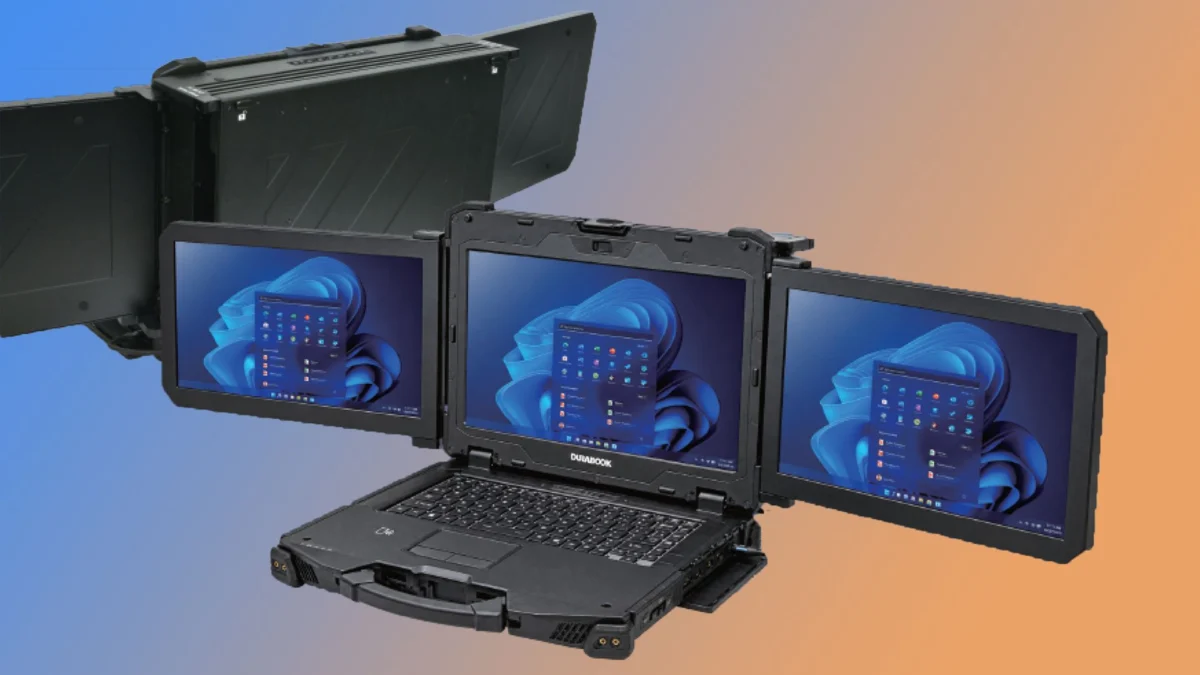
In an era where remote field operations, military logistics, and industrial engineering demand desktop-level computing power coupled with expansive visual workspace, Taiwan-based rugged device manufacturer Durabook has answered the call. The company has officially introduced its newest flagship device: the Durabook Z14I-DX3, an ultra-rugged mobile workstation that shatters conventional laptop limitations by integrating three distinct 14-inch 1080p displays into a single, portable clamshell design.
At first glance, the Z14I-DX3 resembles a heavy-duty enterprise laptop. However, opening the device reveals its defining characteristic. Flanking the central 14-inch screen are two additional 14-inch panels that fold inward during transit, deploying seamlessly to offer users an unprecedented panoramic field of vision in the middle of a desert, aboard a naval vessel, or inside a mobile command center.
Engineered specifically for mission-critical operations, the Z14I-DX3 is not built for the average office worker or content creator working from a coffee shop. It is a specialized, military-grade powerhouse designed for the United States Armed Forces, public safety agencies, emergency response teams, field engineers, and industrial operators who require uncompromising reliability in the most hostile environments on Earth.
Key specifications and features of the Durabook Z14I-DX3 include:
- Triple 14-inch Full HD (1920 x 1080) Displays: Featuring proprietary DynaVue sunlight-readable technology with capacitive multi-touch capabilities and up to 1,200 nits of peak brightness.
- Extreme Durability: Fully certified to MIL-STD-810H and MIL-STD-461G standards, ensuring resistance to drops, shocks, vibrations, extreme temperatures, and electromagnetic interference.
- Versatile Input Methods: Displays support finger, gloved hand, water-rejection, and stylus inputs, catering to harsh weather and specialized working conditions.
- Clamshell Portability: A deployable multi-screen configuration that folds securely into a transportable, armored chassis, eliminating the need to carry external portable monitors into the field.
Chronology
The evolution of multi-monitor setups in portable computing has been a long time coming, tracing a clear path from bulky multi-device field kits to integrated multi-screen engineering marvels.
The Era of Single-Screen Limitations (Late 2000s – 2010s)
For decades, field engineers, defense personnel, and emergency dispatchers faced a frustrating compromise. While desktop environments easily accommodated multi-monitor arrays for complex data visualization, mapping, and command-and-control software, mobile workers were restricted to a single laptop screen. To achieve dual- or triple-screen workflows on location, operators had to transport fragile external monitors, messy cabling, and secondary power supplies—a logistical nightmare in fast-moving tactical or industrial environments.
The Rise of Ruggedization (2015 – 2020)
As processors grew more powerful, manufacturers like Durabook began specializing in fully rugged laptops capable of surviving drops, dust, and driving rain. While these machines solved the durability problem, the screen real estate bottleneck persisted. Professionals still craved more visual space to run diagnostic tools, satellite mapping feeds, and telemetry data simultaneously without toggling endlessly between overlapping windows.
The Innovation Breakthrough and the Launch of the Z14I-DX3 (2023 – Present)
Recognizing the demand for "command center portability," Durabook’s engineering teams began prototyping a multi-display architecture that did not sacrifice structural integrity. Building upon the success of their established Z14I rugged laptop series, Durabook integrated two supplemental side-displays directly into the housing mechanism.
The culmination of this research and development cycle is the Z14I-DX3. By moving from concept to production, Durabook has established a new benchmark for field workstations, bridging the gap between desktop multi-monitor productivity and go-anywhere rugged reliability.
Supporting Data
To truly understand the engineering achievement behind the Durabook Z14I-DX3, one must examine the rigorous testing, display specifications, and performance metrics that justify its classification as a premier military-grade mobile workstation.
Display Specifications and Optical Performance
Working under direct sunlight has historically rendered traditional laptop screens virtually useless. Durabook has countered this by outfitting all three Z14I-DX3 panels with its proprietary DynaVue sunlight-readable technology.
- Brightness: Each panel boasts an exceptional peak brightness of up to 1,200 nits, ensuring legibility even under glaring desert sun or high-glare industrial lighting.
- Synchronization: The displays can be easily synchronized to mirror content or adjusted individually via built-in On-Screen Display (OSD) controls, allowing users to configure a continuous 42-inch panoramic workspace or dedicate screens to separate applications.
- Touch and Input Flexibility: Recognizing that field professionals operate in diverse conditions—from torrential downpours to freezing alpine environments—the capacitive multi-touch panels support inputs from bare fingers, wet hands, heavy-duty work gloves, and dedicated styluses.
Military-Grade Certifications (MIL-STD-810H and MIL-STD-461G)
A multi-screen laptop with hinges and moving parts immediately raises concerns regarding structural vulnerability. However, Durabook has subjected the Z14I-DX3 to some of the most punishing testing protocols in the technology sector:
- MIL-STD-810H: This standard certifies that the workstation can withstand repeated drops from height, severe mechanical shock, continuous high-frequency vibrations, explosive atmospheres, salt fog, high humidity, and extreme thermal shock (operating seamlessly in sub-zero winters and blistering desert heat).
- MIL-STD-461G: Essential for military and defense deployments, this certification guarantees that the device’s electronic emissions are controlled and that the workstation is immune to electromagnetic interference (EMI) generated by surrounding radar, communication arrays, and heavy machinery.
Official Responses
Industry analysts and Durabook representatives have highlighted the strategic importance of the Z14I-DX3 release, emphasizing its role in redefining mobile productivity for high-stakes industries.
In product release statements, Durabook’s engineering and product management teams emphasized that the Z14I-DX3 was built explicitly to solve real-world friction points reported by their enterprise and government clients.
"Field professionals no longer have to choose between mobility and the expansive data visualization tools they rely on to save lives, secure perimeters, or maintain critical infrastructure," noted a senior Durabook product strategist. "With the Z14I-DX3, we have packed an entire command post into a single, armored chassis that goes wherever our customers go, without missing a beat."
Early feedback from beta testers in the public safety and defense sectors has validated the manufacturer’s design choices. Emergency management coordinators praised the ability to monitor live incident feeds, GIS mapping software, and communication channels simultaneously without external monitors. Meanwhile, field engineers highlighted how the elimination of external cables and secondary power bricks drastically reduces setup and teardown times during rapid deployments.
Implications
The introduction of the Durabook Z14I-DX3 carries profound implications for multiple industries, signaling a shift in how mobile computing is conceptualized for high-stress environments.
Transforming Defense and Public Safety Operations
In military command scenarios and emergency response situations, information velocity dictates success or failure. First responders dealing with natural disasters, search-and-rescue operations, or active tactical situations require immediate access to vast quantities of data. The Z14I-DX3 allows commanders and specialists to maintain persistent situational awareness by displaying telemetry, mapping, and video feeds concurrently. This reduces cognitive fatigue and speeds up decision-making processes where every second counts.
Revolutionizing Field Engineering and Industrial Diagnostics
Modern industrial operations—such as oil and gas exploration, aerospace maintenance, and renewable energy grid management—rely on complex diagnostic software. Engineers working on remote wind farms or deep-sea drilling platforms often need to cross-reference schematics, live sensor data, and system logs in real-time. By providing a triple-screen workstation that requires no complex assembly in the field, Durabook empowers engineers to bring full desktop diagnostic capabilities directly to the point of service.
Setting a New Industry Standard for Rugged Hardware
Competitors in the rugged device market will undoubtedly take note of Durabook’s design. While dual-screen productivity laptops have made headway in the consumer and creative markets (such as dual-OLED creator laptops), bringing a multi-screen array into the fully rugged space presents unique thermal, mechanical, and power-distribution challenges. The Z14I-DX3 proves that such engineering hurdles can be overcome, raising consumer expectations across the board.
As vertical industries increasingly demand high-density data processing capabilities at the edge, devices like the Durabook Z14I-DX3 ensure that field professionals will never again be constrained by the boundaries of a single screen.

