

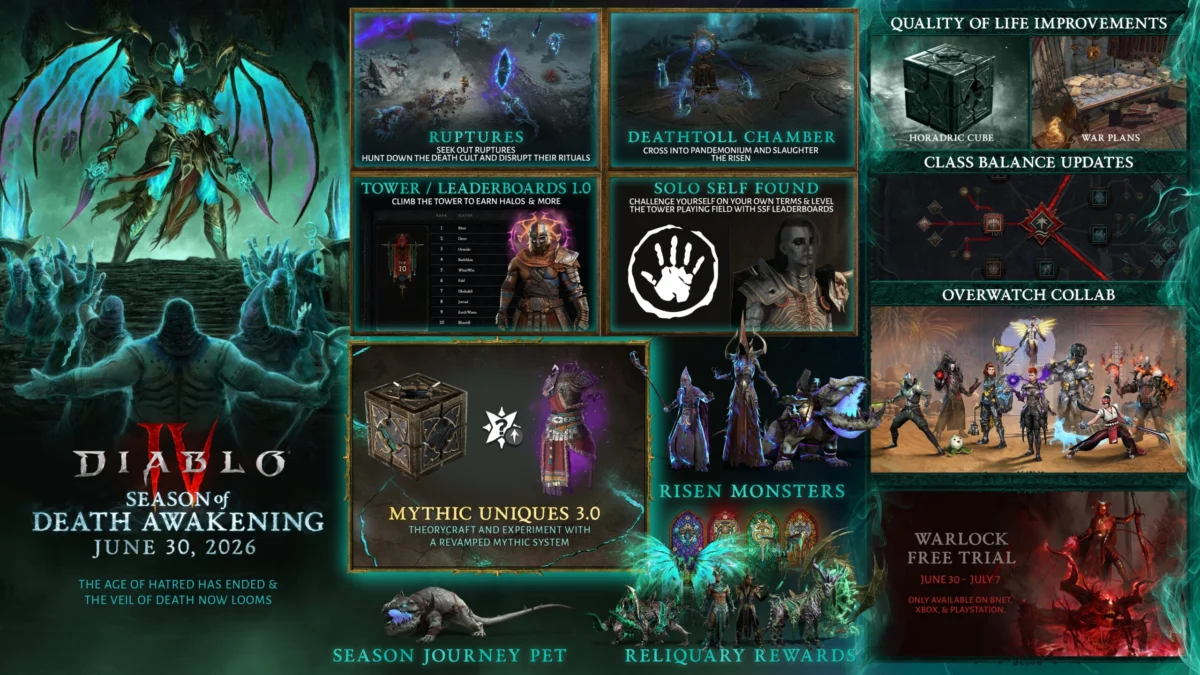
The landscape of modern live-service gaming is often defined by the delicate balance between challenge and reward. In the case of Diablo 4, Blizzard Entertainment has long championed the idea of seasonal content as a playground for experimentation. However, the recent launch of "Season of Death Awakening" proved that even the most ambitious design choices can quickly sour when they impede the player’s ability to enjoy the core power-fantasy of the franchise. Following a wave of community backlash, Blizzard has deployed an emergency patch that effectively dismantles the restrictive systems introduced at the start of the season, marking a significant pivot in the game’s live-service strategy.
The Core Conflict: Mythic Uniques and the "Grind" Paradox
The heart of the controversy lay in the redefinition of Mythic Uniques. Traditionally, Mythic Uniques served as the "holy grail" of Diablo 4—items of immense power that were difficult to obtain but transformative for a character’s build. In the Season of Death Awakening, Blizzard attempted to broaden this category by allowing standard Unique items to be "upgraded" into the Mythic tier.
On paper, this appeared to be a democratizing move. By turning a larger pool of items into potential Mythics, the developers hoped to give players more agency over their end-game gear. However, the execution was fundamentally flawed. The drop rates for the necessary upgrade materials were tuned to be abysmally low, creating a "needle in a haystack" scenario. Players found themselves spending hours grinding for items that, even when upgraded, were often randomized or incompatible with their specific class builds.
Furthermore, the introduction of a new seasonal currency designed to facilitate this crafting process created a bottleneck. The resulting items were subject to confusing RNG mechanics, and to make matters worse, Blizzard imposed a strict limit: players could only equip a single crafted Mythic Unique at any given time. This effectively crippled the build-diversity that the system was supposed to foster.
Chronology: From Launch to Capitulation
The trajectory of the Season of Death Awakening was marked by a rapid escalation of player frustration.

- Launch Week: The season debuted with fanfare, introducing new boss encounters and seasonal activities. Almost immediately, the community identified that the new Mythic crafting system was restrictive, unintuitive, and unrewarding.
- The First Pivot: Observing the outcry, Blizzard attempted a "soft fix" earlier this week, slightly increasing base drop rates. However, this failed to address the underlying issue: the itemization process was still too grind-heavy and the equipment limit remained in place.
- The Boiling Point: Social media platforms, including the official Diablo subreddit, were flooded with criticism. Players argued that the "vision" of the season was actively preventing them from engaging with the most exciting gear in the game.
- The Emergency Patch (Patch 3.1.1a): On Thursday, acknowledging that the seasonal mechanics were failing to meet player expectations, Blizzard released a comprehensive patch. This update removed the equipment cap on crafted Mythic Uniques and significantly buffed drop rates across the board.
Supporting Data: Why the Community Rebuked the System
To understand why the backlash was so intense, one must look at the historical context of Diablo 4. Since the "Lord of Hatred" expansion, the game has been widely praised for its improved loot systems and faster progression loops. Players had grown accustomed to a game where "perfecting" a character was a matter of focused grinding rather than a chore-heavy marathon.
The data provided by community trackers and player reports during the first two weeks of the season indicated a sharp decline in seasonal participation. Players were finding that the time-to-reward ratio for Mythic Uniques was effectively infinite for the average user. By limiting the use of crafted items, Blizzard had inadvertently removed the incentive to participate in the seasonal boss encounters. Once a player had obtained their single allowed Mythic, there was little reason to continue the seasonal loop, as the acquisition of a second or third piece would yield no immediate mechanical benefit.
Official Responses: A Philosophy of "Learning by Doing"
In the wake of Patch 3.1.1a, Blizzard has taken a transparent, if contrite, approach to the situation. Dan Tanguay, the Live Service Design Director, addressed the community via the official forums, emphasizing that the seasonal model is intended to be a sandbox for innovation—even if some experiments fall flat.
"Seasons are where we experiment with new ideas and push Diablo 4 in new directions," Tanguay wrote. "Not every idea lands exactly as intended, but we’ll continue listening to your feedback, addressing what’s not working, and applying those lessons to future seasonal updates."
This statement highlights a growing maturity in Blizzard’s relationship with its player base. Rather than doubling down on a system that was clearly failing to provide "fun," the developers opted for a rapid correction. The studio has also hinted at future tweaks, stating that while they may reintroduce restrictions on crafting in future seasons to maintain a specific balance, those systems will be far more transparent and rewarding than what was seen in the initial launch of the Season of Death Awakening.

The Broader Implications for Live Service Gaming
The events of this season serve as a textbook case study for the risks inherent in live-service design. When developers prioritize "long-term engagement" (i.e., making things hard to get) over "player agency," they risk alienating the core audience. Diablo 4 players are not necessarily opposed to a grind, but they are opposed to a grind that feels unrewarding or disconnected from their build goals.
Lessons Learned
- Complexity is not Depth: Adding layers of currency and RNG to item crafting does not necessarily add depth to the gameplay. Often, it merely adds friction.
- The "Fun" Threshold: If an experimental feature makes the core gameplay loop (slaying demons and getting loot) less enjoyable, it should be removed or hotfixed immediately, regardless of the original design intent.
- Communication as a Tool: Blizzard’s quick pivot saved the season from being a total loss. By acknowledging the failure publicly and acting on the feedback within days, the studio maintained the goodwill of the community, even after a rocky start.
Conclusion: The Path Forward
The Season of Death Awakening is now in a much healthier state. With the removal of the crafted Mythic limit, players are currently flooding the servers, engaging with the seasonal boss, and experimenting with powerful, multi-Mythic builds.
Looking ahead, the challenge for Blizzard will be to maintain this momentum. The "lessons learned" during this crisis will likely influence the design of future seasons, particularly regarding how they handle the power curve of top-tier gear. For now, the takeaway is clear: in a genre built on the pursuit of power, the developer’s primary job is to ensure that the journey to that power remains as satisfying as the destination itself. Diablo 4 has proven that it is capable of evolving, and if it continues to prioritize the player’s experience over rigid design doctrines, it will likely remain the premier destination for action RPG enthusiasts for years to come.

