

Main Facts
In an era defined by relentless price hikes across critical computer components—ranging from volatile RAM modules to increasingly expensive solid-state drives (SSDs) and traditional mechanical hard drives—PC gamers and enthusiasts are in desperate need of a financial breather. Fortunately, a major reprieve has arrived in the display market. The high-performance Acer Predator X27U (specifically model F5bmiippruzx to industry insiders) is currently seeing a substantial markdown, bringing one of the most advanced gaming monitors on the market down to a remarkably accessible price point of $509.99 at Newegg.
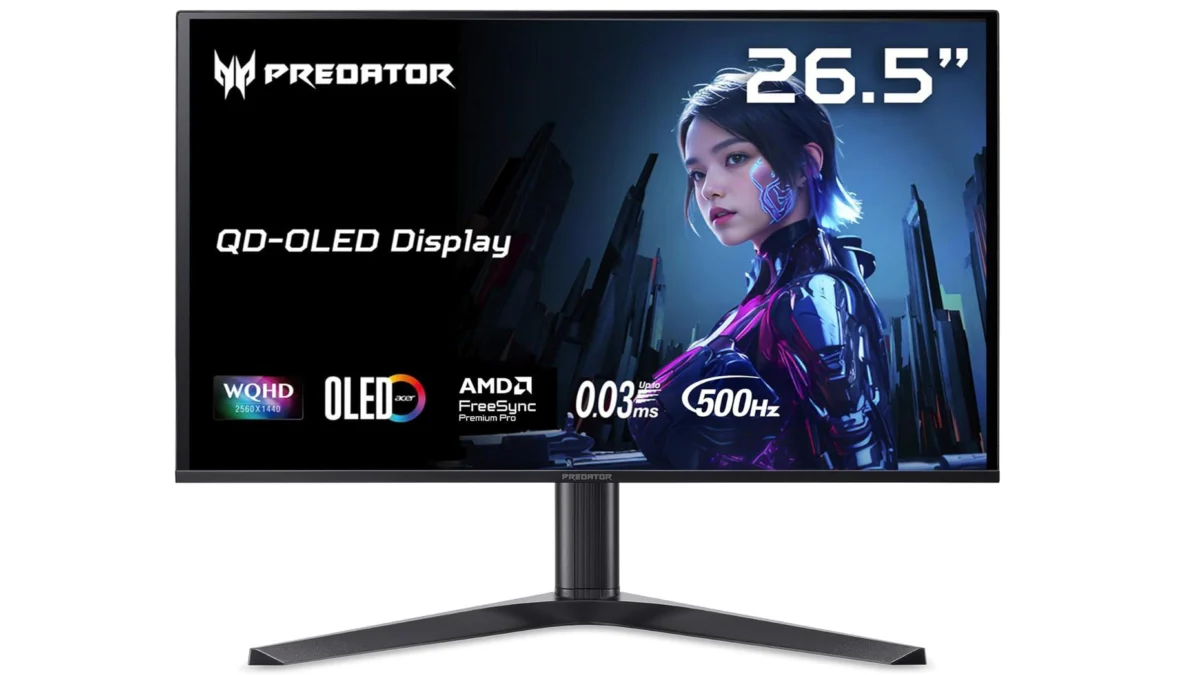
The Acer Predator X27U is far from a standard desktop monitor. Built around a cutting-edge 27-inch Quantum Dot OLED (QD-OLED) panel, it bridges the gap between vibrant, high-contrast cinematic visuals and ultra-responsive competitive esports performance. Its defining specification is an astonishing 500 Hz refresh rate, a metric that pushes the absolute boundaries of current display technology. Coupled with a crisp 1440p (2560 x 1440) resolution, the monitor strikes the optimal sweet spot for modern desktop gaming: offering significantly sharper pixel density than standard 1080p without imposing the devastating GPU performance penalties associated with native 4K gaming.
Furthermore, the display carries a DisplayHDR True Black 500 certification, guaranteeing deep, inky black levels, exceptional peak luminance capabilities, and an expansive color gamut native to QD-OLED technology. For competitive players, sim-racers, and single-player enthusiasts alike, securing a top-tier OLED display featuring these specifications for roughly $510 represents a major market value—particularly as component costs elsewhere in the PC building ecosystem continue to climb.
Chronology
To understand the significance of the Acer Predator X27U’s current markdown, it is necessary to examine the rapid evolutionary timeline of high-refresh-rate OLED displays and the broader economic climate of the PC hardware market.
The Rise of OLED in PC Gaming (2022–2023)
For years, high-end PC displays were dominated by In-Plane Switching (IPS) and Vertical Alignment (VA) liquid crystal technologies. While IPS offered great viewing angles and color accuracy, and VA provided superior contrast ratios, both struggled with motion blur, slow pixel response times, and blooming caused by rudimentary local dimming zones.
The introduction of OLED (Organic Light-Emitting Diode) technology to desktop monitors fundamentally changed the landscape. Each pixel on an OLED panel generates its own light, allowing individual pixels to turn completely off to achieve true black. This results in an infinite contrast ratio and virtually instantaneous pixel response times (often measured at 0.03 milliseconds). Early adopters praised OLED for eliminating ghosting and smearing, though initial models were prohibitively expensive, typically retailing well north of $900 to $1,000, and were largely restricted to 240 Hz refresh rates.
The QD-OLED Revolution and Panel Maturation (2023–2024)
As Samsung Display and LG Display ramped up production of large-format and desktop-class OLED panels, competition intensified. The introduction of Quantum Dot OLED (QD-OLED) combined the self-emitting nature of OLED with quantum dot enhancement layers. This technological marriage yielded vastly superior color volume, higher sustained brightness, and wider viewing angles compared to standard WOLED panels.
Manufacturers quickly realized that gamers demanded not just better colors and contrast, but unprecedented motion clarity. This realization sparked a frantic technological race to push refresh rates higher. What began at 240 Hz rapidly escalated to 360 Hz, and eventually, the staggering 500 Hz threshold.
The Current Hardware Landscape and the Newegg Sale (Late 2024–Present)
Entering the current hardware cycle, the PC component market has faced severe headwinds. Global supply chain shifts, rising memory manufacturing costs, and fluctuating demand have caused prices for RAM kits, NVMe SSDs, and high-capacity storage drives to skyrocket. Consumers looking to build or upgrade a complete system have found themselves allocating a disproportionate amount of their budgets merely to internal components.
It is against this backdrop of widespread hardware inflation that Newegg introduced its aggressive promotional pricing on the Acer Predator X27U. By dropping the price to $509.99, retailers and manufacturers are attempting to stimulate consumer spending in the display sector, providing a much-needed financial cushion for gamers whose upgrade budgets are otherwise strained by high memory and storage costs.
Supporting Data
A comprehensive evaluation of the Acer Predator X27U requires a detailed breakdown of its technical specifications, performance metrics, and market positioning relative to competing hardware.
Core Technical Specifications
| Feature / Specification | Acer Predator X27U Details |
|---|---|
| Display Size | 27 inches |
| Panel Type | Quantum Dot OLED (QD-OLED) |
| Native Resolution | QHD (2560 x 1440) |
| Refresh Rate | 500 Hz |
| Pixel Response Time | 0.03ms (Gray-to-Gray) |
| HDR Certification | VESA DisplayHDR True Black 500 |
| Color Gamut Support | DCI-P3 wide color gamut coverage |
| Adaptive Sync | AMD FreeSync Premium / NVIDIA G-SYNC Compatible |
| Connectivity | HDMI, DisplayPort, USB Hub / Type-C (Power Delivery) |
| Retailer & Sale Price | Newegg — $509.99 |
Performance Analysis: Resolution vs. Refresh Rate
The decision to pair a 1440p resolution with a 500 Hz refresh rate is a calculated engineering choice. While 4K displays offer exceptional clarity, driving a monitor at 4K resolution while maintaining frame rates that approach 500 frames per second requires graphical processing power that even top-tier flagship GPUs (such as the NVIDIA GeForce RTX 4090 or upcoming equivalents) struggle to sustain outside of older or highly optimized esports titles.
By utilizing a 1440p resolution, the Predator X27U ensures that gamers can actually utilize its blistering 500 Hz refresh rate in popular competitive titles like Counter-Strike 2, Valorant, Apex Legends, and Overwatch 2. Modern high-end graphics cards can comfortably push hundreds of frames per second at 1440p, allowing users to fully experience the motion clarity benefits of the hardware.
QD-OLED Advantages
The inclusion of Quantum Dot technology addresses one of traditional OLED’s historical weaknesses: luminance drop-off at high color saturations. QD-OLED panels utilize a blue OLED emitting layer combined with red and green quantum dot conversion layers. This architecture produces significantly brighter, more vibrant highlights without sacrificing the absolute black levels that make dark-scene gaming so immersive.
Official Responses
While direct corporate press releases regarding single-day retail promotions are often minimal, statements from major display manufacturers and hardware analysts provide context on how these pricing strategies are shaped.
Representatives from Acer’s display division have consistently emphasized the brand’s commitment to pushing high-end gaming technologies into the hands of a broader audience. In previous product launches, Acer executives highlighted that the "Predator" ecosystem is designed to eliminate compromises between visual fidelity and competitive speed. By developing monitors like the X27U, Acer aims to capture market share in the rapidly expanding premium enthusiast segment.
Industry analysts tracking component pricing note that while internal components like NAND flash memory and DRAM are experiencing upward price corrections due to enterprise data center demand and production adjustments, the consumer display market operates on a different economic cycle. Panel manufacturers have steadily increased factory yields for OLED substrates, driving down production costs per unit. Retailers like Newegg leverage these improving supply chains to offer aggressive promotional pricing—such as the $509.99 deal on the Predator X27U—to clear warehouse inventory and capture consumer liquidity during tight economic periods.
Implications
The arrival of a top-tier 500 Hz QD-OLED gaming monitor at the $509.99 price point carries significant implications for the broader PC hardware ecosystem, impacting consumers, competing manufacturers, and future market trends.
Relief for the Consumer Budget
For the average PC gamer, budgeting has become a complex balancing act. With RAM kits and high-speed SSDs commanding premium prices, saving money on peripheral upgrades—or in this case, a core visual interface—is crucial. Securing a state-of-the-art QD-OLED display for roughly $510 means builders can redirect those savings toward offsetting the inflated costs of memory and storage, preserving the feasibility of a complete system upgrade.
Pressure on Competitors
The aggressive pricing of the Acer Predator X27U exerts immediate downward pressure on competing brands such as ASUS, MSI, Dell Alienware, and Gigabyte. Historically, OLED monitors featuring ultra-high refresh rates commanded a massive luxury tax. As Acer and its retail partners push prices closer to the $500 mark, competitors will be forced to reevaluate their pricing strategies, potentially accelerating industry-wide price cuts and making OLED technology standard rather than exceptional.
The Shift Away from Traditional LCDs
As OLED and QD-OLED monitors approach price parity with high-end IPS panels, the commercial viability of traditional LCD technology in the enthusiast gaming segment diminishes. The near-instantaneous response times, infinite contrast, and vibrant color reproduction of OLED panels make them the definitive choice for gaming. Deals like the Newegg promotion on the Predator X27U serve as a catalyst, hastening the transition of the PC gaming community away from legacy display technologies once and for all.

