

The boundaries of virtual reality are expanding beyond simple visual immersion. While the Meta Quest 3 has established itself as the gold standard for consumer spatial computing, it lacks a critical component that defined the more expensive, enterprise-focused Quest Pro: integrated face and eye tracking. For developers, researchers, and power users, this has long been a missing piece of the puzzle.
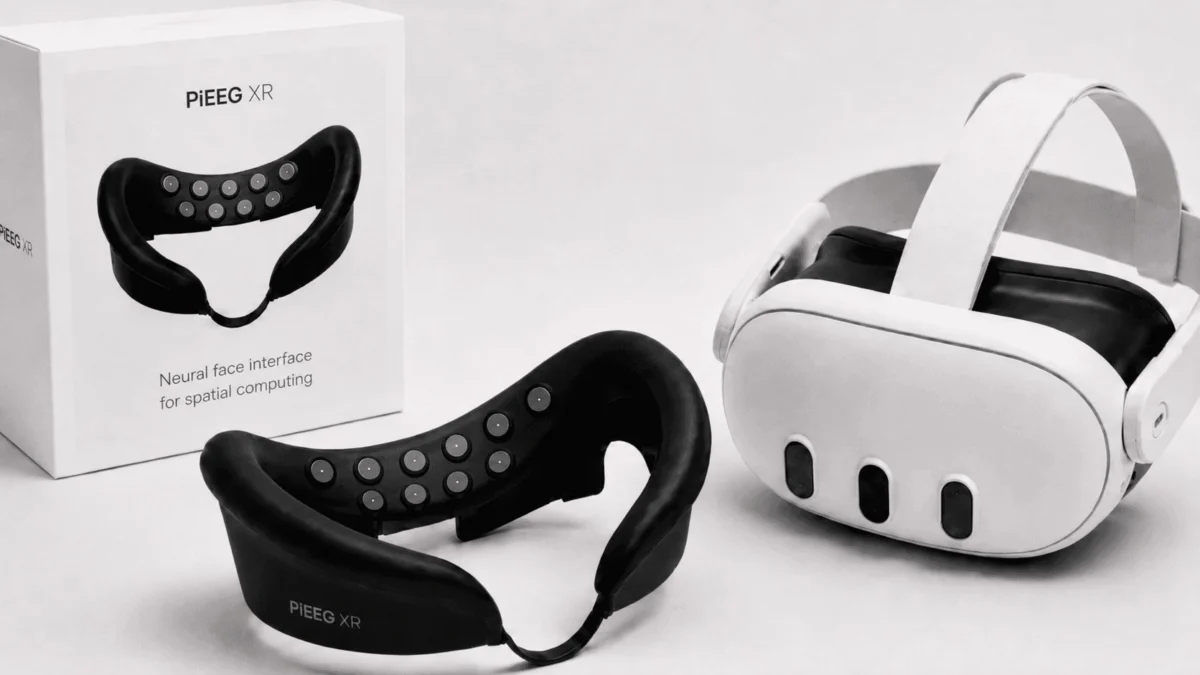
Enter the PiEEG XR, a bold, experimental hardware project that bypasses optical cameras entirely in favor of something more foundational: the electrical language of the body. By replacing the standard Quest 3 facial interface with a sensor-equipped frame, the PiEEG XR aims to turn the user’s facial muscles and neural signals into a sophisticated input controller.
Main Facts: A New Paradigm for Spatial Computing
PiEEG XR is not a consumer-grade peripheral designed for the casual gamer. It is an open-source neural face interface that utilizes biosignals—specifically Electromyography (EMG) and Electroencephalography (EEG) data—to map physical states to digital actions.
Unlike traditional face tracking, which uses internal cameras to watch for muscle movement, the PiEEG XR employs sensors embedded directly into the foam interface of the headset. These sensors rest against the skin around the forehead and cheeks, detecting the electrical impulses generated when a user smiles, frowns, or focuses. This data is then processed and streamed via software, allowing for a custom mapping between biological activity and virtual outcomes.
The device is the latest project from the team behind IronBCI, an 8-channel wearable brain-computer interface. By shifting this technology into the VR space, developer Ildar Rakhmatulin is creating an ecosystem where "intent" can be translated into "action" without the latency or privacy concerns associated with constant optical surveillance.
Chronology: From Lab Bench to VR Headset
The journey toward the PiEEG XR began with the maturation of open-source BCI (Brain-Computer Interface) hardware.
- The IronBCI Foundation: Before turning its gaze toward VR, the company developed the IronBCI, a versatile, multi-channel wearable device capable of capturing EEG (brain waves), EMG (muscle activity), and ECG (heart rate). This provided the technical bedrock for signal processing.
- The Quest 3 Integration: Recognizing the limitations of the Quest 3’s camera-less design, the team began prototyping a physical interface replacement. The objective was to maintain the comfort of the headset while integrating dry electrodes capable of picking up micro-volt signals from facial expressions.
- Proof of Concept: The first major milestone occurred with the "Smile Demo." By training the system on specific muscle activation patterns associated with smiling, Rakhmatulin demonstrated that the software could reliably trigger an avatar’s animation. This validated that the system wasn’t just "reading" raw data, but could be "trained" to recognize specific, user-defined expressions.
- The Public Reveal: Following a Reddit discussion that sparked significant interest from the VRChat and research communities, the project moved toward its current status: an invitation-only developer kit phase, allowing early adopters to integrate the hardware into their own custom applications.
Supporting Data: Understanding the Signal
To understand the efficacy of PiEEG XR, one must distinguish between optical tracking and biosignal sensing.
Optical tracking relies on computer vision algorithms to interpret pixels. It is prone to "occlusion," where the headset itself or poor lighting conditions can interfere with the tracking of the mouth or eyes. PiEEG XR, however, relies on the conduction of electricity through the skin.
Technical Specifications and Capabilities
- Signal Modalities: The hardware is capable of processing EMG signals (muscle movement) for facial expressions and potentially EEG signals (neural activity) for measuring cognitive load or focus states.
- Integration Methods: The system utilizes OSC (Open Sound Control) and WebSocket protocols. This is critical because it allows the data to be "injected" into almost any environment that supports these protocols, including Unity, Unreal Engine, and the highly popular social platform, VRChat.
- Calibration Requirements: Unlike "plug-and-play" consumer tech, PiEEG XR requires a calibration phase. Because every user’s muscle density and signal strength are unique, the user must perform a series of movements (a "training set") so the machine learning model can establish a baseline.
Implications: Beyond Avatars and Smiles
The potential applications for PiEEG XR extend far beyond making an avatar blink or grin. By tapping into the body’s electrical signals, the developers are opening doors to entirely new paradigms of interaction.
The "Third Arm" Experiment
In recent community discussions, users have proposed using the interface to control auxiliary limbs or tools. If a user can train the system to recognize a specific subtle twitch or a shift in focus, they could theoretically trigger complex, non-human movements in a virtual space—such as controlling a drone, managing a digital menu, or operating a third virtual arm—without moving their actual limbs.
Focus-to-Action
One of the most compelling aspects of the PiEEG XR is its ability to measure signal intensity. If the system detects a high level of "focus" (via EEG metrics), it can trigger environmental changes. Imagine a game where the intensity of a magical effect or the speed of a projectile is tied directly to the user’s cognitive concentration. This represents a shift from "input-driven" to "state-driven" gameplay.
Accessibility and Inclusion
For users with motor impairments, camera-based tracking can be difficult, particularly if they have tremors or involuntary movements. A neural-based interface can be calibrated to ignore "noise" and focus on specific, manageable signals, potentially offering a more reliable control scheme for individuals who find traditional controllers or hand tracking physically demanding.
Official Responses and Industry Context
The existence of the PiEEG XR places it in a curious position within the XR industry. While Meta’s CTO, Andrew Bosworth, has previously gone on record stating that adding eye or face tracking to the Quest 3 as an accessory is not "a credible path" due to the precision required for lenses and sensor placement, PiEEG XR is effectively an "end-around" that ignores the visual path entirely.
The Meta Stance vs. The Hacker Spirit
Meta is currently pursuing neural input through its own research, most notably the "Neural Band"—a wrist-worn device that interprets motor neuron signals sent to the fingers. Meta’s approach is about high-fidelity, high-speed input for the hands. PiEEG XR, conversely, is about "expressive and emotional" input via the face.
The two approaches are complementary rather than competitive. However, the industry remains skeptical about the scalability of facial interfaces. The primary hurdle for PiEEG XR will be the "Signal-to-Noise" ratio. Facial skin is constantly moving, and the contact pressure between the foam interface and the face changes every time the user shifts their headset. Ensuring that the device remains calibrated through a long VR session is a feat of engineering that has yet to be fully proven in a mass-market context.
The Future of the Platform
As the PiEEG XR moves from prototype to developer kit, its success will depend heavily on the software ecosystem. The hardware itself is only as good as the community’s ability to build plugins. If developers can create a library of "pre-trained" models that users can download, the barrier to entry will drop significantly.
Challenges Ahead
- Ergonomics: Replacing the stock facial interface with one that contains circuitry and electrodes could compromise the comfort of the Quest 3. If it’s too heavy or uncomfortable, users will not wear it for long periods.
- Privacy: While it avoids cameras, it introduces a new kind of data: neural and physiological signatures. How that data is processed—whether locally on the headset or streamed to an external PC—will be a major topic of discussion for privacy-conscious users.
- Standardization: For the technology to become truly useful, it needs to be adopted by game engines and platforms as a standard input device, similar to how HMD tracking or controller inputs are handled.
Conclusion
PiEEG XR represents the "hacker" side of VR—the part of the industry that refuses to wait for official support and instead builds the future in their basements and garages. By transforming the facial interface from a piece of passive foam into an active sensor suite, the project challenges our assumptions about how we interact with virtual worlds.
Whether or not it becomes a household name, PiEEG XR is a significant milestone. It proves that the "brain-computer interface" revolution isn’t just happening in clinical settings with massive, expensive equipment; it is happening on our faces, inside our headsets, and in the lines of open-source code that are currently being written by a small, dedicated group of pioneers.
For the researcher, the developer, and the curious tinkerer, the PiEEG XR is an invitation to stop looking at the screen and start listening to the body. As we look toward the next five years of spatial computing, these kinds of "neural hacks" may very well define the standard for true, intimate presence in the metaverse.

