

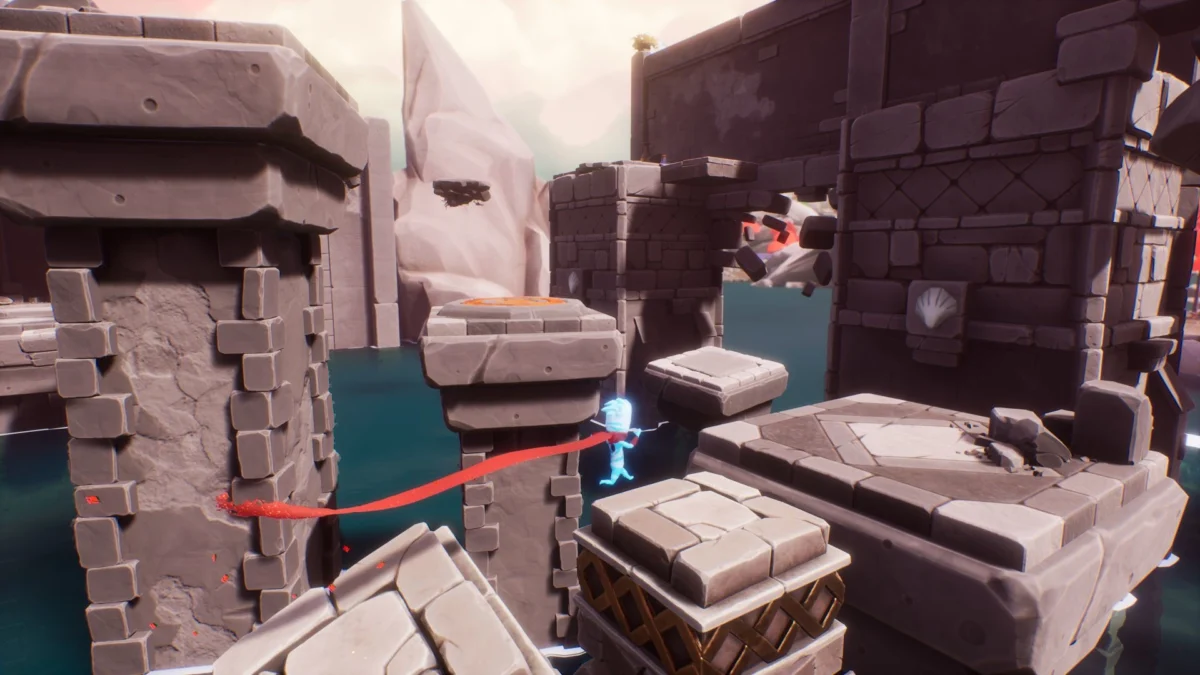
In the crowded landscape of modern indie gaming, few titles manage to capture the elusive "spirit of place" as effectively as Scarf. Released in late 2021, the game invites players into a vibrant, painterly universe where the act of movement is as meaningful as the destination. By drawing inspiration from the minimalist design philosophies of industry landmarks like Journey, Scarf crafts a meditative experience that prioritizes emotional resonance, environmental storytelling, and a unique, tactile relationship between the player and their companion.
Main Facts: A Partnership Beyond Words
At its core, Scarf is a third-person adventure platformer that centers on the symbiotic relationship between a lone nomad and a polymorphic, dragon-like scarf. The premise is deceptively simple: the nomad, an inhabitant of an ancient, fading world, must navigate various distinct biomes to recover fragments of a portal. These fragments serve as the key to reuniting the scarf with its mother, from whom it was forcibly severed.
Unlike many adventure games that rely on dialogue trees or complex quest logs, Scarf opts for visual and atmospheric storytelling. The player is never truly alone; the scarf acts as both a companion and a multi-purpose tool. Through its ability to shapeshift, the scarf provides the player with various traversal mechanics—transforming into a wing-like glider, a hook-shot, or a bridge-building mechanism. This mechanic serves a dual purpose: it facilitates gameplay progression and reinforces the bond between the two characters. When the scarf is absent, the player character is rendered effectively powerless, emphasizing the themes of reliance and mutual growth that drive the narrative forward.
Chronology of Development and Release
Scarf emerged from a development cycle that emphasized artistic cohesion over high-octane mechanical complexity.
- Initial Concept and Design Phase: The developers focused on creating a world that felt alive through color and sound rather than traditional exposition. The "matte vibrancy" of the art style was chosen specifically to ensure that players could spend hours in the world without experiencing visual fatigue.
- The Orchestral Integration: A critical development milestone was the creation of an adaptive, dynamic soundtrack. By tying musical swells to the player’s exploration, the team ensured that the score felt like a living entity, mirroring the vastness of the landscapes.
- December 2021 Launch: The game officially arrived on digital storefronts, positioning itself as a "chill-out" experience designed to be consumed in a single, immersive sitting.
- Post-Launch Reception: Following its release, the game garnered praise for its accessibility and artistic direction, though it faced critique regarding its reliance on traditional collect-a-thon tropes.
Supporting Data: The Mechanics of Exploration
While Scarf may appear simplistic at first glance, its mechanical framework is robustly designed to facilitate a specific type of flow state.

Platforming and Accessibility
The game’s platforming is intentionally forgiving. Controls are smooth and responsive, with a camera system that rarely obstructs the player’s field of vision. For those who find the "floaty" nature of the character movement a hurdle, the game’s generous checkpoint system—which resets players instantly upon falling—prevents the frustration often associated with the genre. This design choice signals that Scarf is not interested in testing the player’s reflexes, but rather in guiding them through an introspective journey.
Puzzle Complexity
The puzzles, which utilize standard genre elements such as weight-sensitive switches, crumbling platforms, and water physics, are designed for intuition. The developers implemented a system of "visual signposting," where light particles naturally guide the player toward objectives. This ensures that the player always feels they have agency, even if the solutions are rarely taxing.
The "Collect-a-Thon" Paradox
A recurring point of discussion regarding Scarf is its structure as a collect-a-thon. The world is densely populated with portal fragments, sigils, and orbs. This is further supplemented by hidden lore items, such as wood carvings and paintings. While this provides a high level of replayability for completionists, it also contributes to the game’s deliberate, slow-paced rhythm. Some players may find this structure repetitive, as the need to hunt for items to unlock progress can occasionally stall the narrative momentum.
Official Perspectives and Creative Intent
The development team behind Scarf has been vocal about their desire to create a game that exists in opposition to the "violent" trends of mainstream gaming. By completely omitting a combat system, the developers removed the need for enemies, conflict, or aggression.
In interviews, the creative leads highlighted that the decision to exclude combat was not just a design limitation, but a thematic necessity. The game’s story is rooted in themes of environmental stewardship and the trauma of separation. To include combat would have fundamentally undercut the message of the narrative, which posits that the world is a place to be understood and cared for, not conquered.

Furthermore, the "collectable cutscenes"—which are presented in the style of neolithic cave paintings—serve as the intellectual anchor of the game. The developers intended for these snippets of lore to be cryptic initially, forcing the player to piece together the history of the world through the interpretation of a solemn narrator. This approach encourages a level of engagement that transcends mere button-pressing.
Implications: A Deeper Social Commentary
Beyond the surface-level beauty and the charming scarf-petting animations, Scarf hides a surprisingly mature narrative. What begins as a quest to reunite a child with its mother eventually peels back layers of a much more sobering social commentary.
Environmental Stewardship
The world of Scarf is one that has been altered, perhaps damaged, by the actions of those who came before. The player’s journey through forests and deserts serves as a metaphor for the restoration of natural order. By gathering the portal fragments, the player is essentially healing the landscape, making the game a quiet meditation on ecology.
Freedom and Autonomy
The most profound narrative turn occurs in the game’s final act. The game forces the player to question their own role in the world. Are they the hero restoring a paradise, or are they a participant in a cycle of control? The narrative’s "heel turn" is expertly handled, providing a twist that is both shocking and deeply emotional. It challenges the player to consider the concepts of freedom—not just for the scarf, but for the world itself.
The Value of the "Short-Form" Game
Scarf serves as a poignant reminder of the value of shorter, high-quality experiences. In an era dominated by "live-service" games and 100-hour open-world slogs, Scarf offers a complete, self-contained story that respects the player’s time. Its ability to leave a lasting emotional impact in a single sitting is a testament to the power of focused game design.

Final Assessment: Why ‘Scarf’ Deserves Your Attention
To dismiss Scarf as "just another platformer" is to overlook the ambition simmering beneath its painterly aesthetic. While it does not revolutionize the mechanics of jumping or puzzle-solving, it excels in the synthesis of sound, visual design, and emotional storytelling.
It is a game for those who seek a reprieve from the noise of competitive titles. Whether you are gliding over a sprawling desert or interacting with your scarf companion, the game provides a sense of peace that is increasingly rare in the medium. By prioritizing the player’s internal journey over external conflict, Scarf secures its place as a beautiful, albeit slightly imperfect, piece of interactive art. It is a reminder that sometimes, the most profound adventures are those that ask us to stop, look at the world, and reach out a hand—or a piece of fabric—to someone else.

