

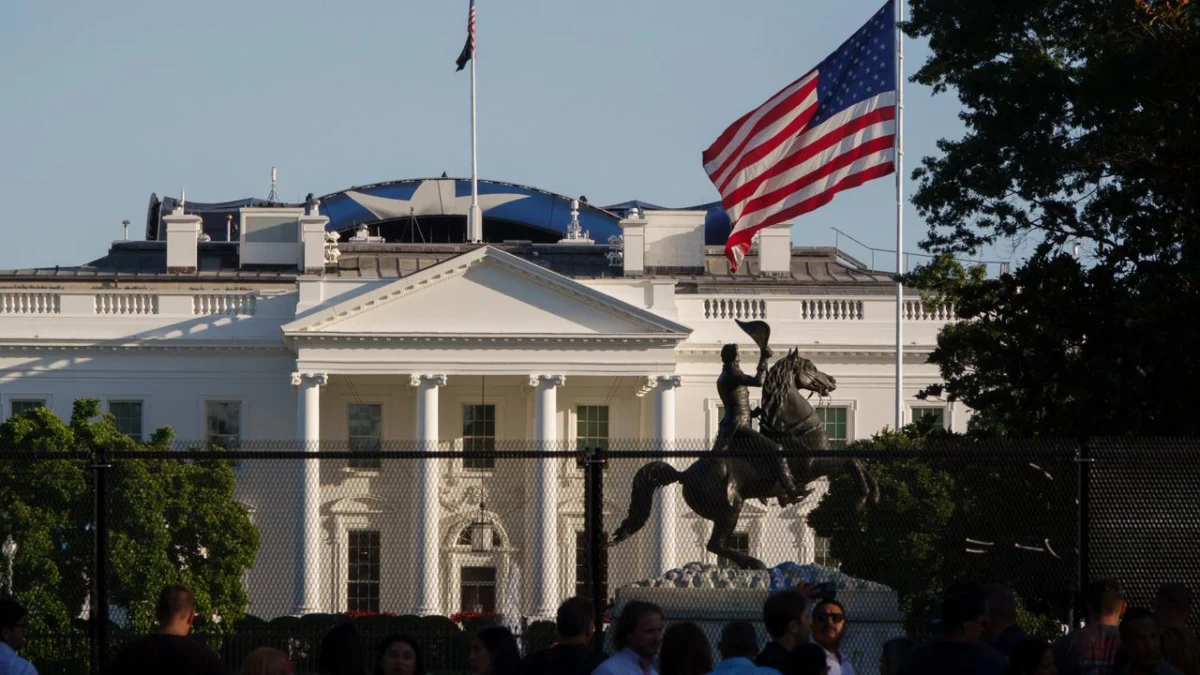
Washington D.C. – June 17, 2026 – In a significant diplomatic maneuver, the White House has reportedly opted to postpone the addition of Chinese artificial intelligence firm DeepSeek and memory manufacturer CXMT, alongside over a hundred other Chinese companies, to the Department of Commerce’s restrictive Entity List. This decision, as reported by Reuters, aims to de-escalate burgeoning trade tensions with Beijing, particularly in the critical lead-up to President Donald Trump’s anticipated three-day state visit to China. The deferral comes despite strong recommendations from an interagency committee and serious allegations of national security risks posed by these firms.
The potential blacklisting of DeepSeek and CXMT highlights the intricate and often contentious relationship between the United States and China, particularly concerning technological supremacy and national security. The U.S. has increasingly leveraged export controls and sanctions to curb China’s technological ambitions, especially in sectors deemed critical for military and intelligence capabilities. However, the current pause underscores the delicate balance the administration must strike between safeguarding national interests and avoiding a full-blown trade war that could have far-reaching global economic repercussions.
A Chronology of Escalating Tensions and Allegations
The journey towards potential blacklisting for DeepSeek and CXMT has been fraught with accusations and geopolitical maneuvering. Last year, an interagency committee reportedly put forward the recommendation to add these firms, among many others, to the Commerce Department’s Entity List. This list effectively prohibits American entities from conducting business with designated companies, cutting them off from crucial U.S. technology and markets.
The primary impetus for DeepSeek’s inclusion stemmed from a grave accusation by a senior U.S. State Department official, who asserted that the Chinese AI startup provided support for Chinese military and intelligence operations. Such allegations immediately elevate a company to a national security concern, triggering reviews and potential sanctions.
Beyond direct military ties, DeepSeek has also been embroiled in intellectual property disputes. American AI giant Anthropic publicly accused DeepSeek and two other prominent Chinese AI developers of "industrial-scale copying." Anthropic claimed that DeepSeek illicitly "distilled" its proprietary Claude model to enhance its own AI capabilities. This alleged distillation process reportedly involved a staggering 16 million exchanges conducted through 24,000 fraudulent accounts. Anthropic’s statement on X underscored the gravity of such actions: "Distillation can be legitimate: AI labs use it to create smaller, cheaper models for their customers. But foreign labs that illicitly distill American models can remove safeguards, feeding model capabilities into their own military, intelligence, and surveillance systems." This not only points to intellectual property theft but also reiterates the fear that advanced AI capabilities could be repurposed for nefarious ends by foreign adversaries.
Further compounding DeepSeek’s precarious position were reports suggesting the company employed shell companies to circumvent U.S. chip restrictions, allegedly procuring an unknown quantity of banned Nvidia H100 AI GPUs. While Nvidia has denied these specific claims, the allegations highlight the persistent challenges faced by the U.S. in enforcing its export controls and the lengths to which some Chinese firms may go to acquire critical technology.
CXMT, a Chinese memory maker, found itself similarly slated for the blacklist. While the specific allegations against CXMT were less detailed in the reports, its inclusion signifies the broader U.S. concern over China’s burgeoning semiconductor industry and its potential to reduce reliance on Western technology, which could have strategic implications for global supply chains and military applications.
The White House’s decision to delay these additions, therefore, represents a conscious choice to prioritize diplomatic stability over immediate enforcement of national security measures, at least temporarily. The looming state visit by President Trump provides a crucial window for high-level discussions, and the administration appears keen to avoid any actions that could prematurely sour the atmosphere or trigger immediate retaliatory measures from Beijing.
DeepSeek: A Nexus of Controversy and Innovation
DeepSeek’s trajectory exemplifies the complex challenges facing the global AI landscape, balancing rapid innovation with stringent ethical and national security considerations.
Allegations of Military and Intelligence Support
The accusation from a senior U.S. State Department official that DeepSeek supports Chinese military and intelligence operations is the most severe and potentially defining charge against the company. This claim positions DeepSeek squarely within the broader U.S. strategy to prevent China from leveraging advanced American technology to bolster its military modernization and surveillance capabilities. Dual-use technologies, which have both civilian and military applications, are a particular focus of U.S. export controls. If DeepSeek’s AI models are indeed being integrated or adapted for military command and control, intelligence gathering, or autonomous weapons systems, it would represent a direct threat to U.S. national security interests. The lack of transparency surrounding the direct evidence for these claims, typical in intelligence matters, nevertheless underscores the deep distrust and strategic competition between the two global powers in critical technological domains.
The Intellectual Property Battle: Anthropic’s Accusations
Anthropic’s public denouncement of DeepSeek for "industrial-scale copying" of its Claude model adds another layer of controversy. The practice of "distillation" involves training smaller, more efficient AI models by having them learn from the outputs of larger, more powerful "teacher" models. While a legitimate technique for optimizing AI, Anthropic’s allegation that DeepSeek used 24,000 fraudulent accounts and 16 million exchanges points to an illicit, systematic effort to extract proprietary knowledge. This isn’t merely a commercial dispute; Anthropic’s concern that such illicitly distilled models could have their safeguards removed and be "fed into their own military, intelligence, and surveillance systems" aligns perfectly with the broader U.S. national security anxieties. It highlights the vulnerability of advanced AI models to reverse-engineering or exploitation by state-backed actors, potentially compromising ethical guidelines or safety features embedded by the original developers.
Navigating Sanctions: The Nvidia Chip Conundrum
The reports of DeepSeek allegedly using shell companies to acquire banned Nvidia H100 AI GPUs further illustrate the cat-and-mouse game being played in the high-stakes world of semiconductor export controls. Nvidia’s H100 chips are considered state-of-the-art for AI training and development, and their restriction to China is a cornerstone of U.S. policy aimed at slowing Beijing’s progress in advanced AI. If DeepSeek, or any Chinese firm, successfully circumvents these controls, it undermines the efficacy of U.S. sanctions and demonstrates the porous nature of global supply chains. While Nvidia has denied the specific claim regarding DeepSeek, the mere allegation underscores the intense pressure on Chinese AI companies to secure the necessary hardware, regardless of restrictions, and the vigilance required from U.S. enforcement agencies.
The Paradox of Popularity: American Users Turn to DeepSeek
Despite these serious allegations and the looming threat of sanctions, DeepSeek is experiencing a peculiar surge in popularity among American users. This phenomenon is largely driven by economic factors: DeepSeek’s models are often significantly cheaper alternatives to the more expensive frontier models offered by U.S. companies like OpenAI and Anthropic. As AI costs continue to spike and subscription models hit pricing walls, individuals and smaller businesses are increasingly turning to open-source or more affordable Chinese Large Language Models (LLMs) to extend their budgets. This creates a challenging dilemma for U.S. policymakers: how to impose sanctions on companies deemed national security risks without inadvertently penalizing American users and businesses who rely on their products for cost-effectiveness and accessibility. The economic incentive to use DeepSeek’s offerings creates a potential loophole in the U.S. strategy, as American engagement indirectly supports the very firms the government seeks to isolate.
CXMT: The Memory Chip Battlefield
CXMT (ChangXin Memory Technologies) represents China’s ambitious drive to achieve self-sufficiency in the crucial semiconductor memory sector, a domain long dominated by South Korean and American giants.
Rising Influence in a Constrained Market
The global memory market, particularly for DRAM (Dynamic Random-Access Memory), is characterized by its cyclical nature, high capital expenditure, and the dominance of a few major players like Samsung, SK Hynix, and Micron. China’s efforts to establish its own robust memory industry, with CXMT at the forefront, are seen by the U.S. as a strategic move to reduce its reliance on foreign suppliers and potentially gain leverage in the global tech ecosystem. The U.S. concern about CXMT is less about direct military ties than about its role in building China’s foundational semiconductor independence, which could eventually support military and advanced computing applications without external controls. Blacklisting CXMT would aim to stifle its growth by cutting off access to U.S. technology, equipment, and intellectual property necessary for advanced manufacturing processes.
The Supply Chain Dilemma: Corsair’s Choice
CXMT’s growing traction among mainstream brands, exemplified by Corsair’s decision to source DRAM chips from the Chinese firm for its Vengeance DDR5 kits (at least for the Chinese market), highlights the practical implications of supply chain diversification. The global semiconductor industry has faced "crushing shortages" in recent years, driven by factors ranging from increased demand to geopolitical disruptions. In such an environment, companies like Corsair are compelled to seek alternative suppliers to maintain production and meet consumer demand. CXMT’s ability to provide a viable alternative to chips from Micron, Samsung, and SK Hynix demonstrates its increasing competitiveness and the desire of global brands to mitigate supply risks. If the U.S. were to blacklist CXMT, it would not only impact CXMT itself but also potentially disrupt the supply chains of American and international companies that have begun to integrate Chinese-made memory into their products, leading to higher costs or further shortages for consumers.
Official Responses and Diplomatic Maneuvers
The decision to defer blacklisting these companies encapsulates the complex interplay between national security imperatives and the pragmatic realities of international diplomacy and economic interdependence.
The U.S. Department of Commerce, guided by recommendations from an interagency committee and intelligence assessments, clearly views DeepSeek and CXMT as entities posing significant national security risks, whether through direct military support, intellectual property theft, or strategic industrial development. The State Department official’s explicit accusation against DeepSeek underscores the seriousness of these concerns within the U.S. intelligence community. The Entity List, in this context, serves as a powerful tool to enforce these concerns and prevent the flow of critical U.S. technology to perceived adversaries.
However, the White House’s rationale for holding off on updating the blacklist reveals a different calculus. The imminent state visit of President Donald Trump to China is a high-stakes diplomatic event. Such visits are typically preceded by efforts to de-escalate tensions and foster an environment conducive to productive dialogue. Adding over a hundred Chinese firms, including prominent ones like DeepSeek and CXMT, to a U.S. blacklist just before or during the visit would undoubtedly be perceived as a hostile act by Beijing. This could jeopardize the success of the visit, undermine any potential agreements, and trigger immediate and forceful retaliation from China, further destabilizing the already fragile U.S.-China relationship. The deferral, therefore, is a tactical move aimed at preserving diplomatic channels and potentially securing concessions or agreements through negotiation rather than confrontation.
While DeepSeek and CXMT have not issued public official responses to the specific blacklisting deferral, their past actions (such as DeepSeek’s alleged use of shell companies) suggest a determination to continue their operations and technological development despite U.S. pressure. The Chinese government, for its part, has consistently condemned U.S. sanctions and export controls as protectionist measures designed to stifle China’s economic and technological rise. Beijing possesses its own "aces up its sleeve," most notably its near-monopoly on rare-earth materials. These critical elements are indispensable for semiconductor manufacturing and various high-tech industries. China has previously demonstrated its willingness to use export controls on rare earths as a retaliatory measure, causing significant disruption and shortages for chipmakers globally. This potential for reciprocal escalation serves as a potent deterrent against aggressive U.S. blacklisting actions.
Broader Implications: The Perilous Path of Tech Decoupling
The saga of DeepSeek and CXMT is not merely about two companies; it is a microcosm of the broader U.S.-China technology competition and the accelerating trend towards economic and technological decoupling.
Economic Repercussions for American Businesses and Consumers
Should the U.S. proceed with blacklisting DeepSeek and CXMT, the economic fallout would extend beyond the targeted Chinese firms. American companies that rely on DeepSeek’s more affordable AI models or CXMT’s memory chips would face immediate disruptions. For instance, U.S. users who have adopted DeepSeek as a cost-effective alternative to domestic AI models would be forced to seek out more expensive options, potentially stifling innovation among smaller businesses or individual developers. Similarly, firms like Corsair, which have diversified their supply chains to include CXMT DRAM to combat shortages, would be forced to re-evaluate their sourcing, potentially leading to increased costs, production delays, and further strain on already tight global supply chains for memory. This highlights the inherent difficulty in isolating parts of a deeply interconnected global economy without causing collateral damage to one’s own domestic industries and consumers.
The Geopolitical Chessboard: Trade Wars and Tech Supremacy
The decision to defer blacklisting is a clear indicator of the geopolitical stakes involved. The U.S.-China rivalry is not just about trade balances; it is a contest for technological supremacy, which is increasingly seen as the foundation of future economic power and national security. The U.S. aims to maintain its lead in cutting-edge technologies like AI and advanced semiconductors, preventing China from achieving parity or dominance through means perceived as unfair or threatening. Conversely, China views these U.S. restrictions as an attempt to suppress its legitimate development and seeks to achieve technological self-reliance. The potential for a full-blown tech war, triggered by actions like extensive blacklisting, could lead to a fragmented global technology landscape, with parallel ecosystems, incompatible standards, and reduced innovation due to restricted collaboration.
The Future of Global Supply Chains
The ongoing tensions underscore the vulnerability of global supply chains, particularly in critical sectors like semiconductors and AI hardware. The U.S. strategy involves "friend-shoring" and promoting domestic production, while China aggressively pursues self-sufficiency. This bifurcating trend could lead to less efficient, more costly, and potentially less resilient supply chains in the long run. Companies caught in the middle are forced to navigate complex regulatory environments, assess geopolitical risks, and make difficult choices about where to source components and sell products. The case of CXMT and its role in supplying DRAM chips to international brands illustrates the immediate impact of these pressures on commercial decisions.
The Dilemma of "Open" AI and National Security
Anthropic’s concerns about illicit distillation feeding into military systems raise fundamental questions about the future of "open" AI development. While sharing models and research can accelerate innovation, the risk of misuse by state actors complicates the traditional ethos of open science. Governments and AI developers face the challenge of striking a balance between fostering an open, collaborative research environment and protecting national security interests, potentially leading to increased restrictions on AI model distribution and access.
Conclusion
The White House’s decision to delay the blacklisting of DeepSeek, CXMT, and over a hundred other Chinese firms is a testament to the complex and perilous tightrope walk that defines U.S.-China relations. It represents a tactical pause in the escalating tech war, prioritizing diplomatic engagement and the avoidance of immediate, disruptive retaliation ahead of a crucial presidential visit.
While the immediate crisis has been averted, the underlying tensions and accusations remain potent. DeepSeek’s alleged ties to China’s military, its intellectual property disputes, and its reported efforts to circumvent sanctions, coupled with CXMT’s strategic importance in memory manufacturing, ensure these companies will remain under intense scrutiny. The dilemma for the U.S. administration is profound: how to effectively curb perceived national security threats without inflicting undue harm on its own economy and global supply chains, and without triggering a full-scale economic confrontation that neither side can truly afford.
The outcome of President Trump’s visit to China will undoubtedly shape the immediate future of this tech rivalry. However, the broader trajectory points towards continued competition, strategic decoupling, and a redefinition of global technological interdependence. The world watches as these two global rivals navigate a path fraught with both opportunity and profound risk, with the fate of key industries and geopolitical stability hanging in the balance.

