

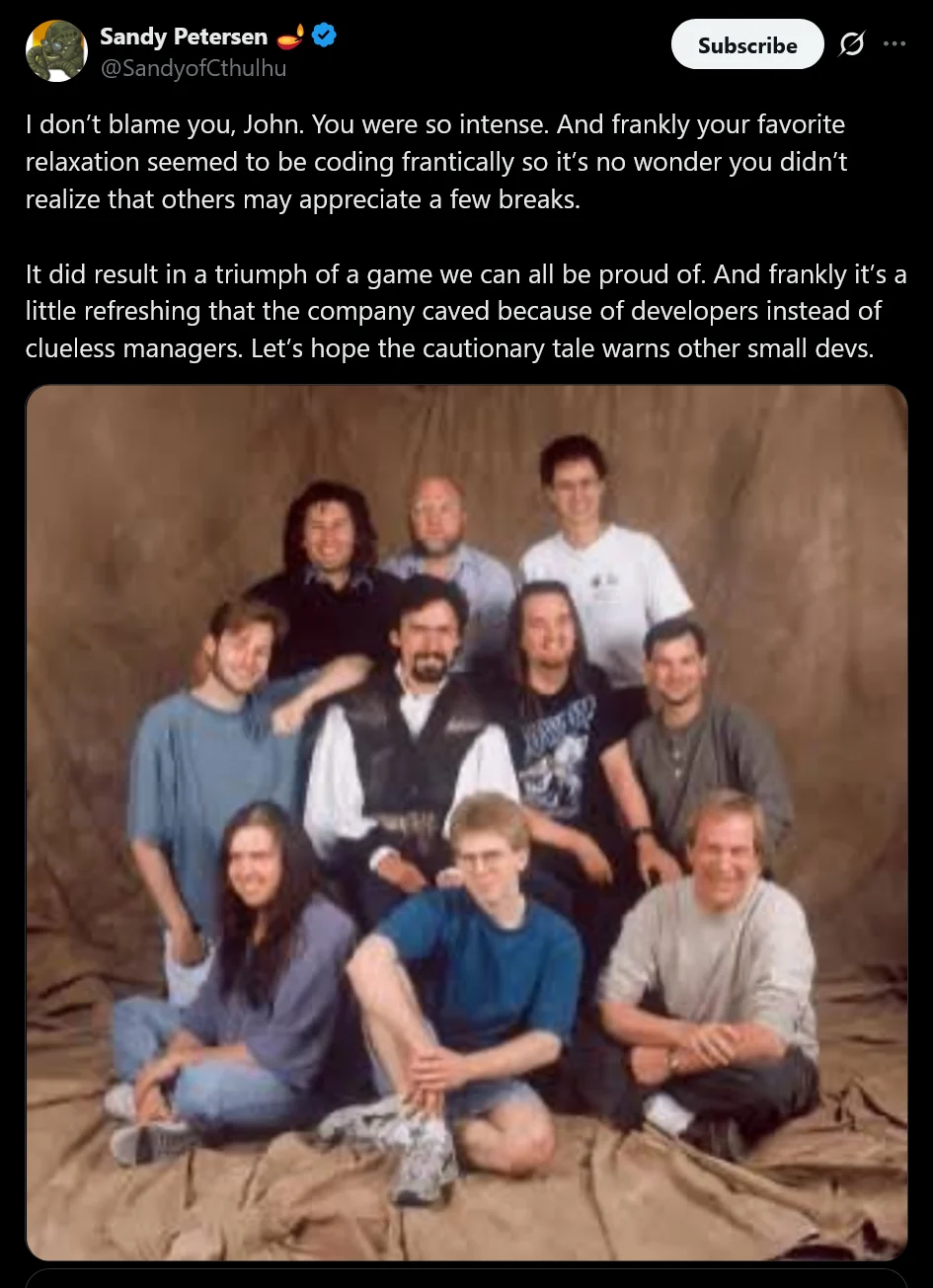
June 22, 2026, marked the 30th anniversary of Quake, a title that fundamentally reshaped the architecture of 3D gaming and defined the first-person shooter genre for a generation. While the industry celebrated the milestone with accolades, retrospectives, and technical deep-dives, the anniversary served as a catalyst for something far more raw: a public, emotional reckoning among the key architects of the game. The pioneers who built Quake—John Carmack, John Romero, and Sandy Petersen—used the occasion to pull back the curtain on the intense, and often painful, human cost behind one of gaming’s most legendary development cycles.
The Catalyst: "Quake Ruined id Software"
The discourse began with a candid, blunt assessment from Sandy Petersen, who joined id Software in 1993. On social media, Petersen offered a provocative thesis: "Quake ruined id Software."
While Petersen was quick to laud the technical and artistic brilliance of the game—and the dedication of the team that brought it to life—he painted a stark picture of the internal environment. He argued that the crushing, relentless pressure of the project served as a breaking point for the studio’s "dream team."

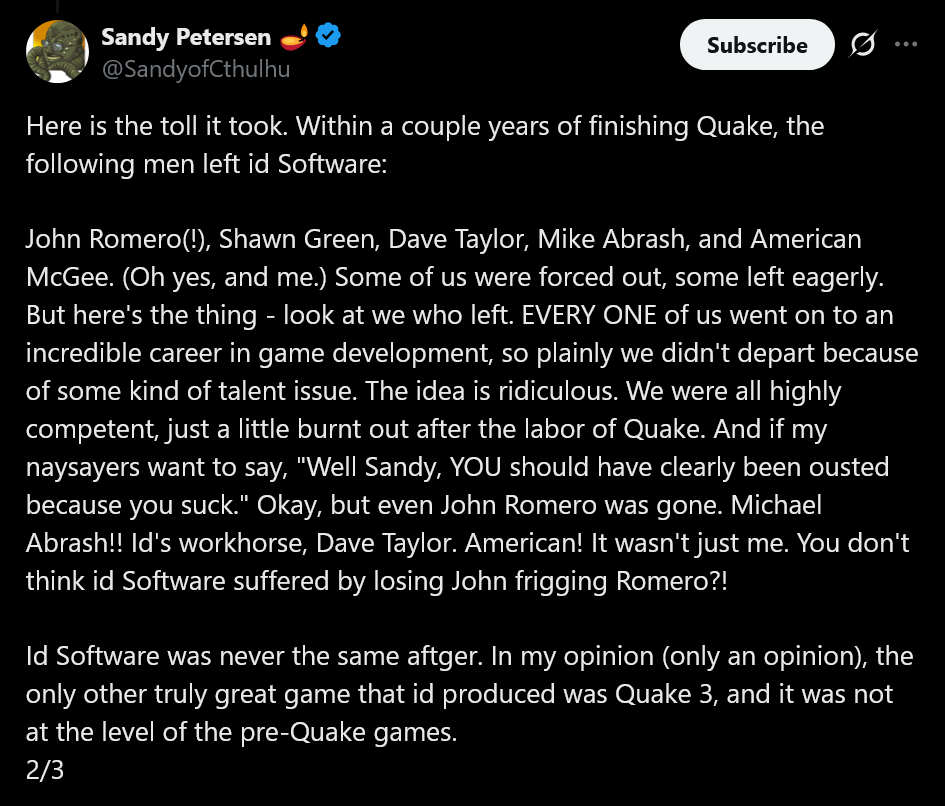
"It was an amazing feat of art, programming, and design," Petersen wrote, "but I think it broke us spiritually." To illustrate the point, he highlighted the mass exodus that followed the game’s completion. Within two years of Quake shipping, a significant portion of the studio’s core talent—including John Romero, Shawn Green, Dave Taylor, Mike Abrash, American McGee, and Petersen himself—had departed. Petersen emphasized that these were not departures born of incompetence; rather, they were the result of a collective, profound burnout that fundamentally altered the trajectory of the company.
A Chronology of the "Crunch"
The development of Quake is often cited as a masterclass in technological ambition, but as the participants have noted, it was also a period of immense professional instability.
The Pre-Quake Era
Before Quake, id Software was riding the momentum of Doom and Wolfenstein 3D. The company was a small, high-intensity startup where the lines between professional life and personal space were virtually non-existent. The team operated with a singular focus that allowed them to dominate the market, but that very success created a "startup intensity" that became unsustainable as the company grew and the projects became more technically complex.

The Quake Development Cycle
As development shifted toward a fully 3D engine—a monumental task for the mid-90s—the team found themselves in a state of constant flux. John Carmack, the engine’s architect, admitted that the project was "overly ambitious technically." The team was, in the words of John Romero, "building the road while also building the car driving on it."
The Aftermath
Following the release in 1996, the studio experienced a brain drain. The internal culture, which had been forged in the crucible of Doom’s success, struggled to adapt to the new, more complex requirements of 3D development. For many, the completion of Quake was not just the end of a project, but a signal that the "Golden Age" of the original id Software team had reached its natural, exhausted conclusion.
Supporting Data: The Human Toll
To understand the weight of Petersen’s comments, one must look at the specific organizational failures mentioned by the participants. The list of departures is not merely a list of names; it represents a loss of institutional knowledge that, according to Petersen, left id Software a shadow of its former self.
Key contributors identified the following structural issues:
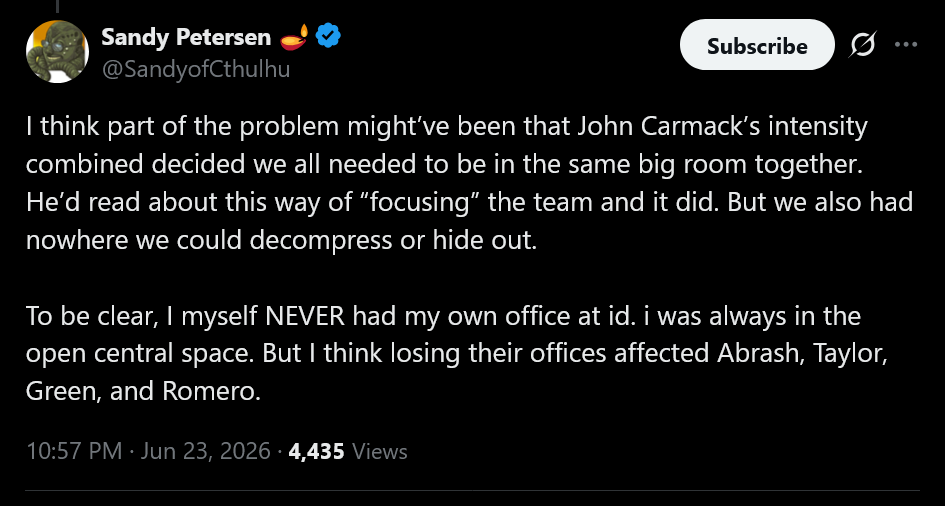
- The "Open Office" Experiment: In a bid to force collaboration, Carmack moved the entire team into a single, large room. While this increased focus, it removed the ability for developers to decompress or find privacy, leading to a stifling atmosphere.
- Stock and Ownership Issues: Carmack acknowledged that the original corporate structure and buy/sell agreements were a mistake. They failed to incentivize long-term retention through standard vesting models, which might have kept the team together during the difficult transition periods.
- Designer-Artist Friction: As the technology became more sophisticated, the gap between "pure" level design and "visual" design widened. Instead of pairing these roles effectively, the studio allowed for infighting, where designers with strong aesthetic sensibilities disparaged those who struggled with the new, more demanding graphical requirements.
Official Responses: Carmack and Romero’s Reconciliation
The most significant aspect of this 30th-anniversary reflection was the response from the "other" architects of the game. Rather than dismissing Petersen’s grievances, both John Carmack and John Romero engaged in a process of mutual reflection and, ultimately, reconciliation.
John Carmack’s Admission
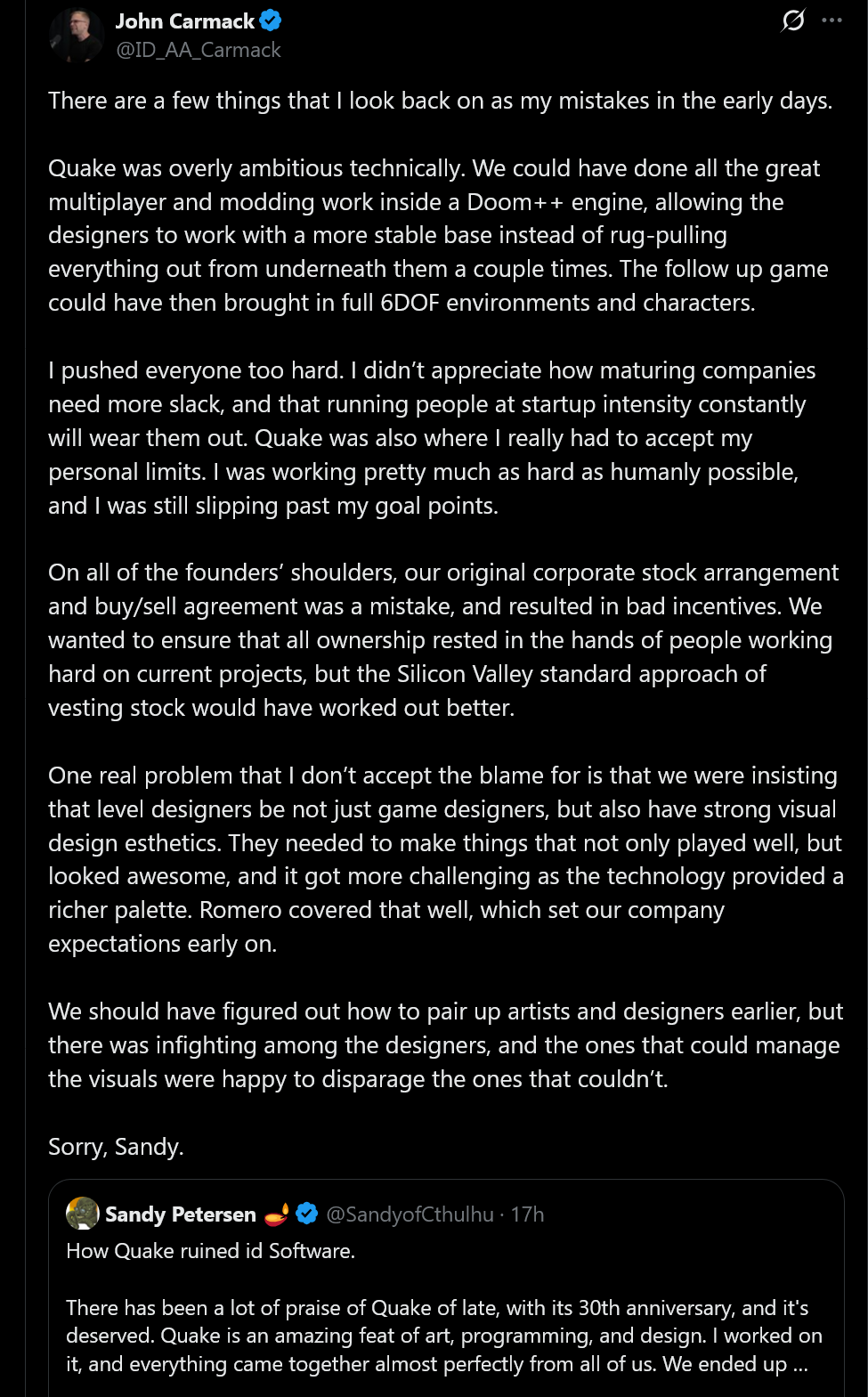
Carmack, often portrayed as the stoic, hyper-focused engineer, took a surprisingly vulnerable stance. He explicitly apologized to Petersen, stating, "I pushed everyone too hard. I didn’t appreciate how maturing companies need more slack." He acknowledged that he failed to recognize the limits of his team and that the "startup intensity" he fostered was a double-edged sword that ultimately caused the company’s internal fracture.
John Romero’s Perspective
John Romero, a legendary figure in the industry, corroborated the feelings of burnout. He noted that the team was "pushing ourselves past what was reasonable because that was how id had always worked." He expressed regret over the "media circus" that surrounded their development, noting that the external pressure amplified the internal strain. Yet, he also provided a sense of closure, noting that despite the turmoil, they had created something that would outlive their grievances.
Implications for Modern Game Development
The reflections on Quake serve as a potent cautionary tale for the modern gaming industry. The "crunch" culture that defined the 90s is still a subject of intense debate today, and the lessons learned by the id Software team remain highly relevant.
- Sustainable Growth: The transition from a "garage" startup to a mature studio requires more than just technical scaling; it requires a fundamental shift in how human capital is managed.
- The Limits of Ambition: The Quake team proved that even when you are "building the future," there is a point of diminishing returns where technical ambition outstrips human capacity.
- The Value of Institutional Memory: The mass departure of the Quake team shows how quickly a company can lose its identity. Retaining talent requires more than just a successful product; it requires a culture that respects the well-being and longevity of its creators.
Conclusion: A Legacy of Triumph and Trauma
Thirty years later, Quake remains a "titan of the gaming world." It pioneered true 3D environments, pushed the boundaries of hardware, and established a multiplayer foundation that the entire industry continues to build upon. However, the legacy of the game is now understood to be far more nuanced than just its technical achievements.
The conversation between Petersen, Carmack, and Romero offers a rare, humanizing look at history. It reminds us that behind every "game-changing" title are individuals who sacrificed their time, their health, and, in some cases, their professional relationships to achieve the impossible. As Romero poignantly concluded, "We did the best we could do at the time with what we knew." That statement serves as a fitting epitaph for the Quake era: a time of unprecedented innovation, fueled by passion, and tempered by the harsh, often unforgiving, realities of game development.

