

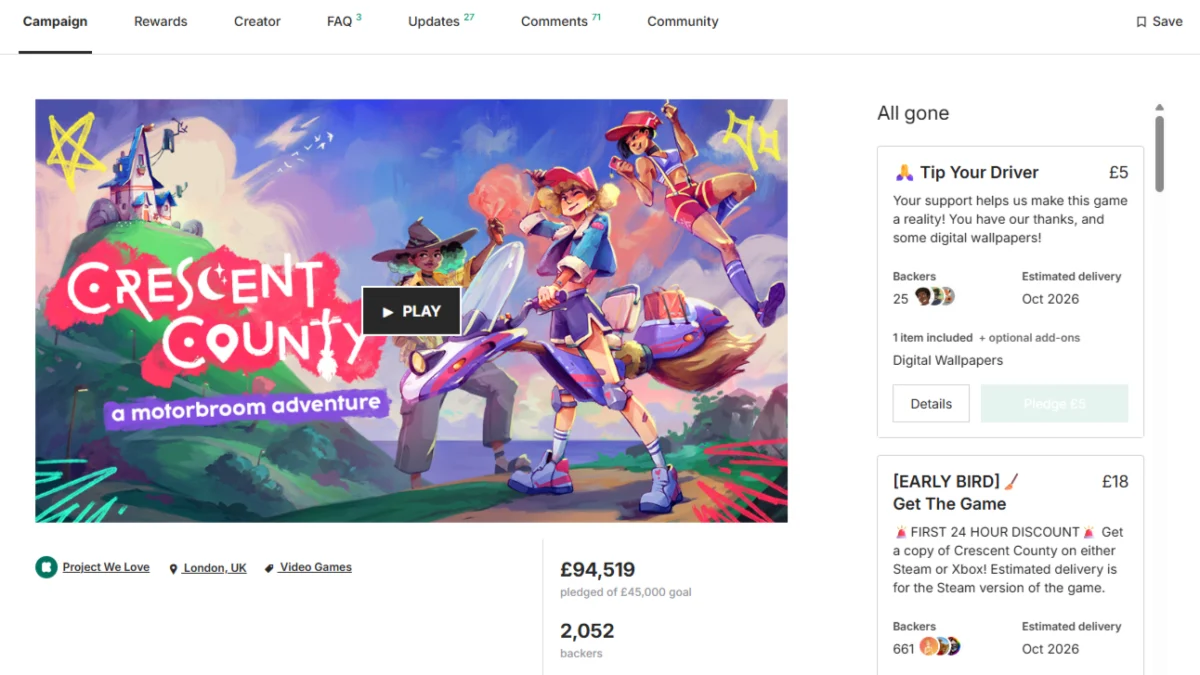
The golden age of Kickstarter—the era of multi-million dollar indie miracles and wild, unproven concepts—may be long behind us, but the platform remains a persistent, if demanding, fixture in the video game development ecosystem. As the industry faces ongoing economic headwinds and a tightening of traditional venture capital, crowdfunding has evolved from a “get rich quick” scheme for startups into a grueling, highly specialized marketing operation.
New research from Ico Partners’ Thomas Bidaux paints a picture of a mature, stable, and challenging landscape. In 2025, game companies successfully raised $26 million on Kickstarter, a figure that remains level with 2024 and marks one of the most successful years for the platform since the 2015 boom. Yet, this stability hides a fundamental shift in what it takes to succeed.
A Landscape of Steady Returns
The data from 2025 reveals that crowdfunding is no longer a gamble for the masses, but a calculated strategy for the prepared. Last year, 443 video game projects successfully hit their funding targets—a minor 4% decrease from the previous year. Of these, 55 projects crossed the $100,000 threshold, while 11 high-performers managed to raise over $500,000.
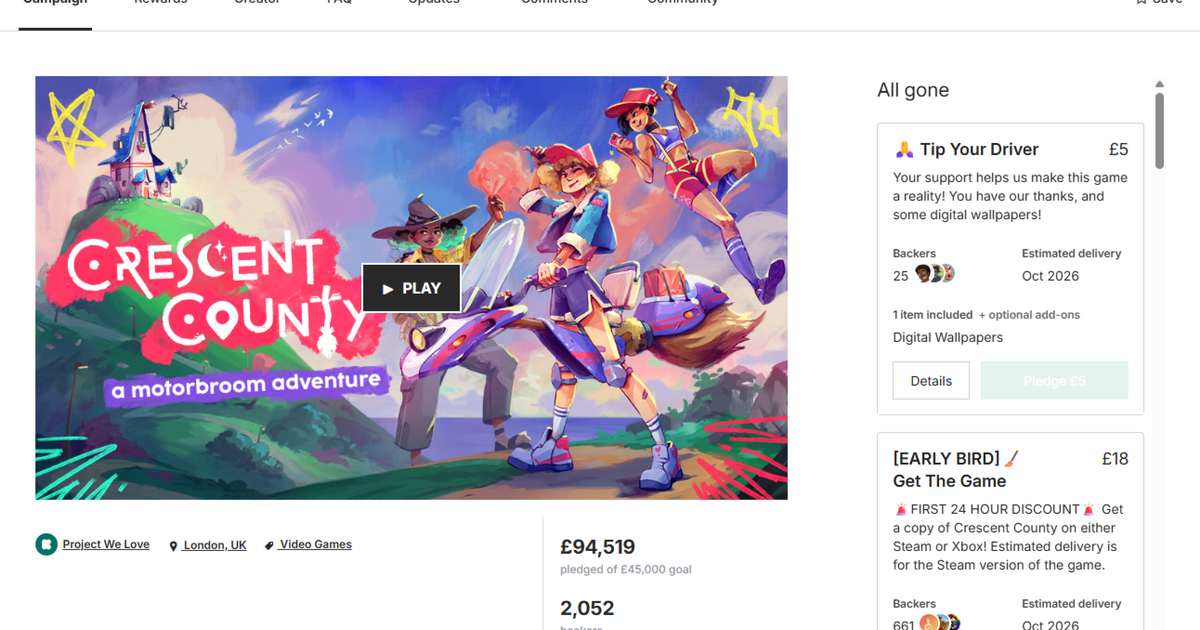
"The last time there were so many $500k-plus projects was in 2015," notes Bidaux. "There are early indicators that 2026 will be in line with the 2025 pace. Kickstarter is not funding the whole video games industry, but there are good opportunities for the projects going on the platform."
While these numbers provide a sense of comfort for indie developers, the barrier to entry has shifted dramatically. In the platform’s infancy, developers could pitch a napkin sketch and a dream. Today, that luxury is gone. The modern backer is discerning, and the platform has become a showcase for games that are already largely functional, polished, and ready for market.
The Evolution of the Pitch: From Concept to Polished Demo
The contrast between the early days of crowdfunding and the current landscape is stark. Consider Frontier Developments’ Elite: Dangerous, which in 2012 secured over £1.5 million with little more than a vision and a strong reputation. Today, that approach would almost certainly fail.

"You need to have the game in a state where you can capture release-quality footage, and it is even better if you can offer a demo," Bidaux explains. "Alongside that, you need to be quite advanced in your marketing effort. You need an audience already engaged and interested in the game."
This shift has profound implications for developers who are already struggling with cash flow. Kickstarter is no longer a rescue mission for a project that has run out of runway. It is a marketing exercise, requiring months of preparation, community building, and high-fidelity asset creation. If a studio is turning to Kickstarter because they are desperate for funds to make their project presentable, they are likely already too late.
Challenges in the Trenches: The Skyhook Games Experience
The path to a successful campaign is fraught with obstacles that extend far beyond the game itself. David Harper, Managing Director of Skyhook Games, recently navigated the treacherous waters of crowdfunding for Lawn Mowing Simulator 2. His experience highlights the "background challenges" that define the current era: market saturation, economic instability, and the rise of platform-based bad actors.

"Gamers can be paralyzed by choice," Harper says. "Marketing channels are flooded, curation is light, and the economy—both within the games industry and more generally—has been pretty tough."
During their campaign, Skyhook encountered a nightmare scenario: "bad actors" or scammers placing massive, fraudulent pledges. These accounts, which initially bolstered the campaign’s success, were eventually removed by Kickstarter. One such removal pushed the project below its funding target in the final 24 hours of the campaign.
"We’d been ‘funded’ for over three weeks, but the size of the withdrawn pledge meant that we were suddenly back below our campaign target," Harper recalls. While Kickstarter eventually granted an extension and the game was successfully funded, the experience left the team feeling that their control over the project’s destiny was being manipulated by unseen, external forces.

Harper suggests that the only real mitigation for such risks is to limit the size of top-tier pledges, though this creates a catch-22: by limiting high-tier support, you lose the opportunity for "super-backers" to push a project over the line.
The Skeptics’ View: Is Crowdfunding Worth the Risk?
Not everyone views Kickstarter as a viable path for the modern indie developer. Daniel Milo, indie director at Timeless Toucan (makers of Azoove), has been vocal about his reservations. His critique touches on the systemic issues inherent in the crowdfunding model.
Milo argues that because a "mostly finished" game is a prerequisite for success, many developers are essentially performing double-duty—building a full game while simultaneously running a full-time marketing firm. Furthermore, he points out that for games heading to Steam, the platform often punishes creators for selling keys via crowdfunding, as these external sales are not always reflected in the platform’s vital, visibility-driving review metrics.

"There are plenty of systemic problems with crowdfunding," Milo states. "Due to the nature of all-or-nothing funding and the culture of ‘funded in 35 seconds,’ studios are encouraged to place their target drastically below what they actually need to raise, risking a ‘funded’ game that can’t reach the release line."
Milo’s advice to struggling developers is to seek traditional funding through publishers, angel investors, or venture capital. "If you have a game of sufficient quality and ability to create a marketing campaign that would result in a successful campaign, you have the resources to show traction and quality to the investors," he argues.
The Strategy for Success: Community and Craft
For those who choose to proceed, the consensus among experts is clear: build your community before you build your page. Hrvoje Horvatek, CEO of Ironward, suggests a strict rule: "Do not launch unless you reach at least 500 followers."

This is not merely about raw numbers; it is about the quality of those followers. As Harper warns, paying marketing agencies for followers is a dangerous game. "While you can increase your campaign’s follower count… you also risk spending money to acquire fake accounts or bots," he says. "We chose not to use an agency… but another campaign launched around the same time suffered significantly. Although they had more followers than we did, virtually none of those converted into backing at launch."
The "Pop" Factor
Once the community is established, the campaign page itself must be a work of art. Anna Hollinrake, co-founder of Electric Saint, emphasizes the importance of visual communication. "GIFs. Oh my god, cover your page with gameplay GIFs. Put your art front and center," she advises.
Hollinrake also highlights a changing cultural expectation among backers. In an era dominated by AI-generated content, backers are increasingly craving authenticity. "People are much more excited to see your thought process. I absolutely recommend being vulnerable about it and being honest," she says. Showing early sketches, development logs, and the "why" behind the game helps build a genuine connection that can translate into long-term support.

Implications for the Future
Despite the criticisms and the operational hurdles, the data suggests that Kickstarter is not going anywhere. Bidaux believes there is "untapped potential" for developers who can master the intersection of community management and game production.
The future of crowdfunding in games appears to be moving away from the "wild west" of the early 2010s toward a more professionalized, marketing-heavy discipline. It is a tool, not a solution. For developers like David Harper and Anna Hollinrake, the experience of running a campaign—while stressful and fraught with technical and social challenges—provided invaluable lessons in marketing, audience engagement, and project management.
Ultimately, the takeaway for the industry is sobering but clear: if you are going to crowdfund, do not do it because you are looking for a shortcut. Do it because you have a product that is ready to be showcased, a community that is ready to be mobilized, and a team that is prepared to work as hard on the marketing as they did on the code.

As Bidaux concludes, "There are more opportunities with crowdfunding in the future for video games than ever before," but those opportunities will only belong to the developers who treat their backers with the same respect and rigor as their professional investors.

