

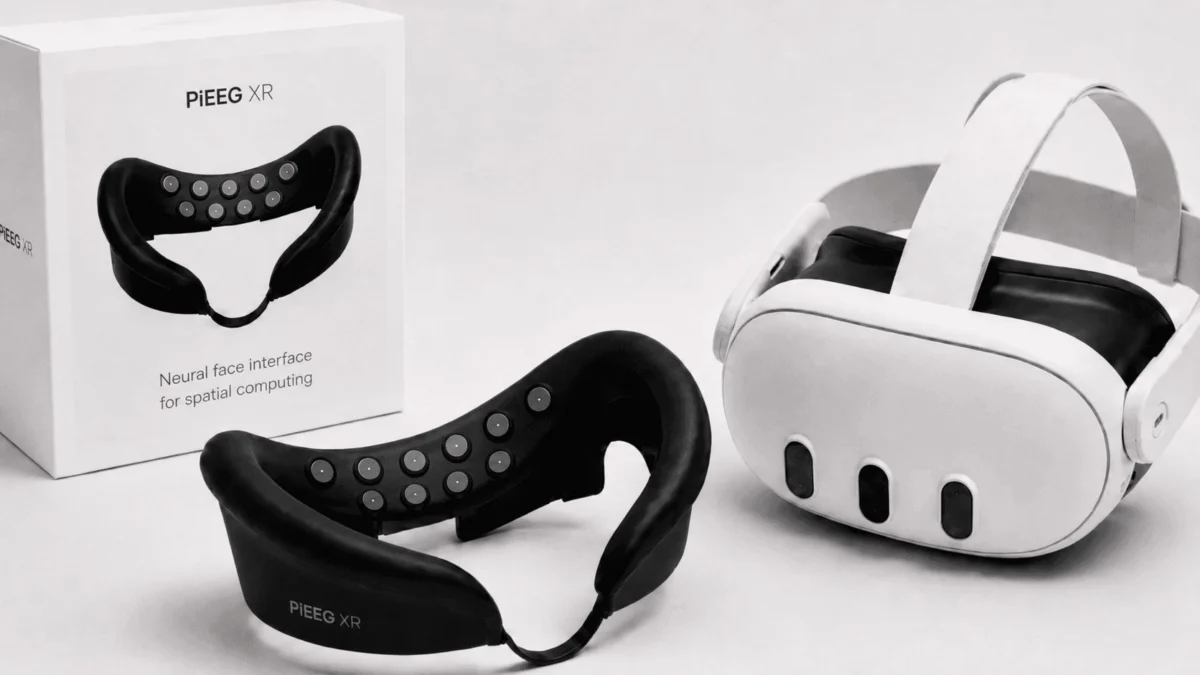
In the rapidly evolving landscape of spatial computing, the Meta Quest 3 stands as a benchmark for consumer-grade virtual reality. However, as the industry pushes toward deeper immersion, one hardware limitation remains glaring: the lack of native face and eye tracking. While the Quest Pro offered these features through a complex array of internal cameras, the Quest 3—and its successor, the Quest 3S—prioritize affordability and high-fidelity rendering, leaving out the biometric sensors necessary for lifelike social presence.
Enter the PiEEG XR, an innovative, sensor-equipped facial interface replacement that seeks to bridge this gap. By moving away from traditional camera-based tracking and embracing the frontier of biosignal processing, the developers behind PiEEG XR are proposing a new paradigm: controlling the virtual world not just through movement, but through the neural and muscular impulses of the human face.
Main Facts: What is PiEEG XR?
The PiEEG XR is an open-source neural face interface designed specifically for the Meta Quest 3. Unlike traditional tracking systems that use infrared cameras to visually map facial geometry, the PiEEG XR functions as a hardware "shell" that replaces the stock facial interface of the headset.
Embedded within this frame are advanced sensors designed to capture raw biosignals—electromyography (EMG) from facial muscles and, potentially, electroencephalography (EEG) from the forehead. These signals are then streamed into a software suite where they can be processed and mapped to specific outcomes.
It is critical to distinguish this from plug-and-play consumer electronics. PiEEG XR is currently a developer-focused kit. It does not ship with pre-trained AI that magically knows when a user is "sad" or "happy." Instead, it provides the raw data pipeline required for researchers, educators, and VRChat power users to train their own custom signal-to-action models. Through integrations like OSC (Open Sound Control) and WebSockets, users can calibrate the system to trigger specific avatar animations or mixed-reality environmental changes based on their unique physiological signatures.
Chronology of Development: From BCI to VR
The genesis of PiEEG XR lies in the broader work of developer Ildar Rakhmatulin, who has long been involved in the development of brain-computer interfaces (BCIs).
- The IronBCI Precursor: Before the XR interface, the team developed IronBCI, an 8-channel wearable device capable of recording EEG, EMG, and ECG signals. This established the technical foundation for reading the body’s electrical output.
- The Pivot to Spatial Computing: Recognizing that VR headsets offer a prime "real estate" opportunity for sensor placement, the team pivoted to the Quest 3. The challenge was to integrate these sensors into a form factor that didn’t compromise the comfort or weight distribution of the headset.
- The "Smile" Demo: The most significant milestone in the project’s timeline is the recent demonstration of "smile recognition." By placing sensors near the cheekbones and zygomatic muscles, Rakhmatulin demonstrated that the device could identify the distinct electrical "spike" associated with a smile. This signal was then mapped to an avatar’s facial rig, creating a seamless, real-time animation without a single camera being pointed at the user’s mouth.
- Current State: The device is currently transitioning from a research prototype to a developer kit, with an emphasis on open-source accessibility, allowing the community to iterate on the underlying algorithms.
Supporting Data: Why Biosignals Matter
To understand the implications of PiEEG XR, one must look at the technical limitations of current tracking methods. Camera-based tracking, while accurate, is data-intensive, privacy-sensitive, and prone to "occlusion"—the moment the headset shifts or the user wears accessories that block the camera’s view.
The Physics of Facial Tracking
- EMG vs. Vision: Facial expressions are driven by electrical impulses sent from the brain to muscle fibers. By the time a camera sees a smile, the muscle has already fired. By reading the electrical signal directly via contact sensors, the PiEEG XR potentially reduces latency, capturing the intent of an expression at the source.
- Privacy-First Architecture: Because the system operates on electrical pulses rather than high-resolution video feeds, it sidesteps the significant privacy concerns associated with "in-headset" cameras that capture images of the user’s home or face.
- Data Throughput: The system utilizes a multi-channel input, allowing for high-fidelity data collection. For developers, this means the ability to filter noise and focus on specific muscle groups, making the interface customizable for users with different facial structures or accessibility needs.
Implications: Beyond Avatar Expressions
The most exciting aspect of the PiEEG XR is not its ability to make an avatar smile, but its potential to act as a "neural input device" for spatial computing.
1. The Third Arm and Beyond
In a recent Reddit discussion, the prospect of using the interface to control a "third virtual arm" gained traction. Because the device is mapping signals rather than visual movements, it can be trained to recognize the "intent to grasp" or the "intent to reach," even if the user isn’t moving their physical arms. This is a game-changer for accessibility in VR.
2. Focus-to-Action Mechanics
The current prototype has shown success in "focus-to-action" demos. By measuring signal intensity—which can correlate with concentration or mental effort—the headset can trigger mixed-reality effects. Imagine a game where the brightness of a digital object increases as you concentrate, or an educational tool that highlights information only when the user is actively focused on a specific region of the virtual space.
3. Integration with Existing Ecosystems
By utilizing OSC (Open Sound Control), the PiEEG XR is immediately compatible with the most popular social VR platforms, such as VRChat. This allows power users to bypass the limitations of their hardware, injecting advanced, neural-driven expression into a space that has traditionally relied on manual button presses or expensive eye-tracking-equipped headsets.
Official Responses and Industry Context
The existence of the PiEEG XR puts it in direct dialogue with giants like Meta. Meta’s Chief Technology Officer, Andrew Bosworth, has previously gone on record stating that adding eye or face tracking to the Quest 3 via an accessory is not "credible" due to the precision required for camera placement and the lack of internal mounting points.
The PiEEG team has effectively bypassed this argument by refusing to use cameras entirely. This "biometric-first" approach is fundamentally different from Meta’s "Neural Band" project, which seeks to read wrist-based signals.
Industry analysts suggest that the PiEEG approach represents a "hackable" alternative to the highly proprietary paths taken by hardware manufacturers. While it lacks the polish of a first-party product, its open-source nature invites a level of experimentation that closed-loop ecosystems cannot support.
Challenges to Adoption
Despite the optimism, significant hurdles remain:
- Calibration and Fit: For a sensor-based system to work, it must maintain constant contact with the skin. If the facial interface is too loose or too tight, the signal-to-noise ratio drops, leading to "ghosting" or missed inputs.
- Software Complexity: Training a model to recognize an expression is not trivial for the average user. Until the software provides a "plug-and-play" calibration wizard, adoption will likely be limited to the developer and researcher communities.
- Social Acceptance: Wearing a device that reads one’s facial biosignals carries a psychological weight that camera-based tracking does not. The industry will need to navigate the ethics of "neural data" just as it has navigated the ethics of video data.
Conclusion: A New Frontier for VR
The PiEEG XR is more than just a mod for the Quest 3; it is an experiment in the future of human-computer interaction. By treating the human face as an input controller for the virtual world, the project is pushing the boundaries of what it means to be "present" in a digital space.
While it is currently a niche tool for those willing to get their hands dirty with signal processing and neural mapping, its trajectory is clear. As the technology matures, we may move away from the current era of "visual tracking" and into an era of "biometric integration," where our headsets don’t just see what we are doing, but sense how we are feeling and what we are intending to do.
For developers and researchers, the PiEEG XR provides an unprecedented sandbox. It challenges the status quo, proves that innovation doesn’t always require more cameras, and invites us to consider that the next great leap in VR won’t be found in better lenses or faster processors, but in the electrical signals pulsing just beneath our skin.

