

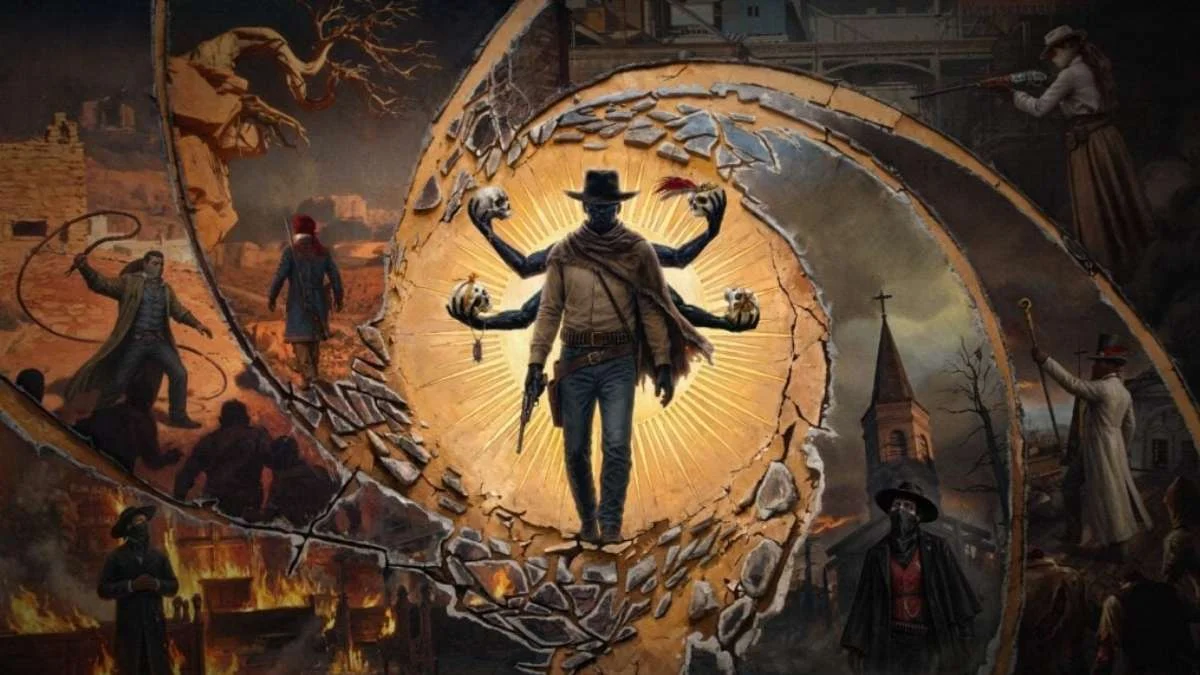
The landscape of the first-person shooter genre is undergoing a dramatic, atmospheric shift. As the industry moves away from hyper-kinetic arena shooters, a new, more deliberate sub-genre has begun to take root: the "Soulslike FPS." Leading the charge into this gritty, unforgiving territory is Guns of Eschaton, a newly announced title from publisher 4Divinity and developer Eschatology Entertainment. More than just a shooter, the game represents a profound historical milestone in the medium, serving as the final project associated with the legendary art director Viktor Antonov.
Main Facts: A Mystical Western in the Shadow of Apocalypse
Guns of Eschaton is poised to transport players to an apocalyptic version of the American Old West—a world defined by its desolation, occult horror, and uncompromising brutality. Unlike the standard "cowboy" tropes seen in titles like Red Dead Redemption, Guns of Eschaton leans heavily into a surrealist, mystical aesthetic. The developers describe it as a world of "dust, blood, false saints, and broken history," where the environment itself feels like a character participating in the player’s demise.
The game is a first-person shooter at its core, but it adopts the punishing, methodical design philosophy of the Soulslike genre. This means every encounter is a tactical puzzle. Players are warned to "study your enemies" and "count your bullets"—a departure from the "run-and-gun" mechanics prevalent in most contemporary shooters. Whether playing solo or venturing through the wasteland in cooperative mode, the player must navigate a landscape where survival is not guaranteed.
The title will be launching on PlayStation 5, Xbox Series X|S, and PC via Steam. While an official release date has yet to be finalized, the buzz surrounding the announcement trailer has already established the game as one of the most anticipated indie-to-AA projects on the horizon.
The Legacy of Viktor Antonov: A Chronology of Influence
To understand the weight behind Guns of Eschaton, one must look at the career of Viktor Antonov. The late visionary, who passed away last year, was a titan of environmental storytelling. His influence on the visual language of video games is nearly unparalleled.
The Architect of Dystopia
Antonov’s career path serves as a roadmap for the evolution of modern game design:
- The Half-Life 2 Era (2004): Antonov became a household name in the industry as the art director for Half-Life 2. His design of City 17 remains a masterclass in visual storytelling, where the architecture itself communicated the oppressive nature of the Combine regime.
- The Dishonored Vision (2012): As a key visual architect for Arkane Studios, Antonov helped craft the world of Dunwall. His work here introduced a "painterly" aesthetic that prioritized atmosphere and cultural history over hyper-realism.
- The Later Years (2015-2023): Through his work on titles like Fallout 4, Prey, and Wolfenstein: The New Order, Antonov continued to refine the concept of "environmental narrative"—the idea that a player should be able to read the history of a world just by looking at its debris.
Guns of Eschaton is being heralded as the final title worked on by Antonov. For fans of his specific brand of atmospheric gloom, this game serves as a final, haunting postcard from a mind that defined how we perceive virtual spaces. The project is a testament to his ability to blend the grounded with the supernatural.
Supporting Data: The Mechanics of the Frontier
Eschatology Entertainment has provided a glimpse into the systems that will define Guns of Eschaton. Far from a simple twitch-shooter, the game aims to provide a robust RPG-lite experience that rewards preparation and build-crafting.
Weaponry and Customization
The game promises a deep arsenal consisting of over 20 unique firearms, all themed around 19th-century ballistics. However, the depth of the game lies in its customization suite. Players will be able to modify:
- Munitions: Since resources are scarce, the type of bullet used can be the difference between victory and death.
- Armor Sets: Players must balance mobility with protection, likely drawing inspiration from the poise systems found in Soulslike titles.
- Consumables: These items appear to go beyond simple health packs, potentially offering tactical advantages or temporary buffs against the "occult horrors" mentioned in the game’s lore.
The "Soulslike" tag implies that the game will feature a stamina-management system or a high-stakes death penalty, forcing players to commit to their playstyle. By allowing for cooperative play, the developers are also introducing a layer of social strategy, where players must coordinate their builds to cover each other’s weaknesses in the desolate West.
Official Responses and Creative Vision
The mission statement from the development team at Eschatology Entertainment is clear: they are not trying to recreate the West, but to reinterpret it as a purgatory.
"The road to salvation is narrow and paved with spent shells and bodies that remember your name," the official press release notes. This evocative language highlights the developers’ commitment to tone. The game isn’t just about shooting; it is about the weight of violence. By focusing on a "mystical Western," the studio has freed itself from the constraints of historical accuracy, allowing for the inclusion of cosmic horror elements that likely bridge the gap between the traditional Western and the eldritch dread associated with Antonov’s previous work in Prey.
While the publisher, 4Divinity, has been careful not to commit to a release date, their commitment to the title suggests a long-term support plan. The decision to launch simultaneously on current-gen consoles and PC suggests that the game is built on a modern engine capable of rendering the dense, atmospheric detail that Antonov’s art style requires.
Implications: The Future of the Soulslike FPS
The emergence of Guns of Eschaton signals a broader trend in the video game industry: the "genre-blending" of the FPS. For years, shooters were categorized by their speed—the Call of Duty style or the DOOM style. However, titles like Hunt: Showdown and now Guns of Eschaton are proving that players are hungry for a slower, more methodical experience.
Why the "Mystical Western" Matters
The Western genre has often struggled to find a foothold in the FPS space beyond standard cowboy archetypes. By injecting "occult horror" and "apocalyptic" stakes, Guns of Eschaton differentiates itself. It turns the vast, empty plains of the frontier into a site of claustrophobic tension.
Furthermore, the game’s reliance on the "Soulslike" tag—a term that has evolved from a descriptor of difficulty to a descriptor of design philosophy—implies a shift in player expectations. Players are increasingly looking for games that demand mastery of systems rather than just reflexes. If Guns of Eschaton succeeds, it could set a new benchmark for how environmental storytelling (the Antonov legacy) meets systemic complexity.
The Challenge of Legacy
The greatest challenge facing the team at Eschatology Entertainment is honoring the shadow cast by Viktor Antonov. When a title is associated with such a legendary figure, the pressure to deliver a cohesive visual experience is immense. The trailer reveals a world of deep shadows, muted palettes, and unsettling architectural geometry—all hallmarks of Antonov’s work.
If the developers can balance the brutal, repetitive nature of a Soulslike with the rich, narrative-heavy world-building expected of an Antonov project, Guns of Eschaton could become a cult classic. It stands as a dark, final tribute to a man who taught gamers how to look at the world through the lens of history, decay, and beauty.
Conclusion
As we look toward the future of the PlayStation 5 and the broader gaming landscape, Guns of Eschaton stands out as a beacon of artistic intent. It is a game that is not afraid to be slow, not afraid to be difficult, and certainly not afraid to be strange. By blending the tactical intensity of a Soulslike with the evocative atmosphere of an apocalyptic Western, it promises an experience that is as much a mood piece as it is a challenge.
While we wait for further details—a release date, deeper gameplay dives, and perhaps a look at the "false saints" that inhabit this world—one thing is certain: the legacy of Viktor Antonov is in no danger of fading. In the dusty, blood-soaked plains of this new frontier, his vision will live on, one spent shell at a time. Go West, gunslinger, and see what remains when the world ends.

