

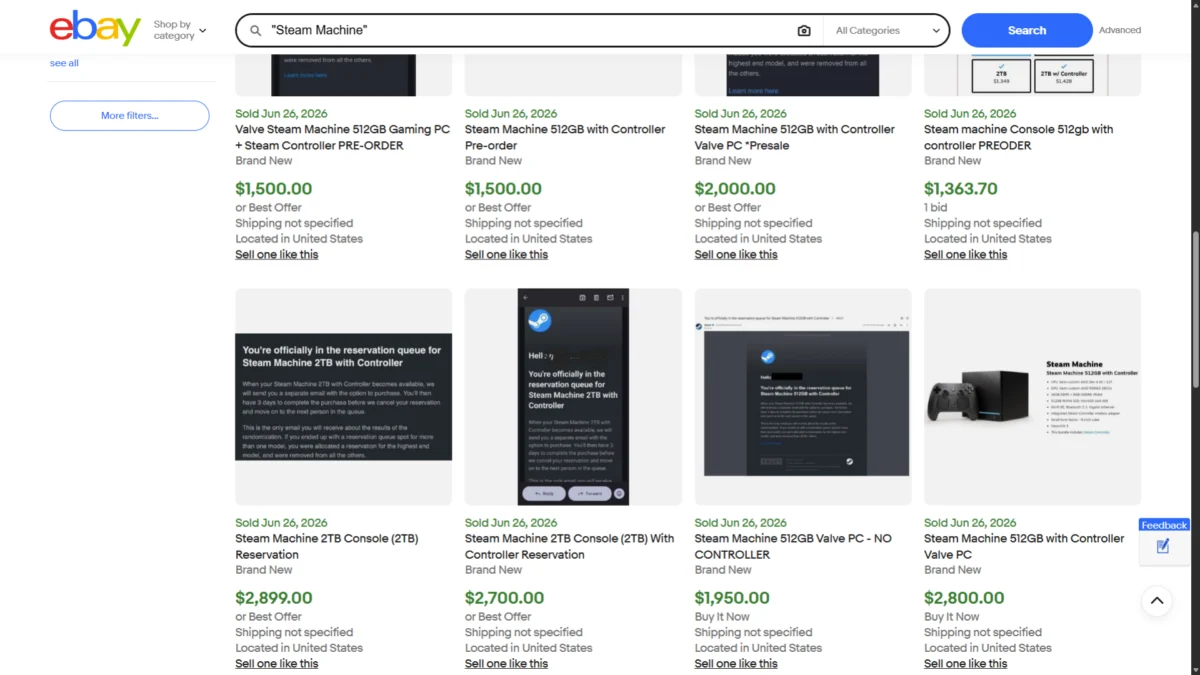
London, UK – [Date of publication] – The highly anticipated Steam Machine, Valve’s innovative handheld gaming PC, is falling victim to the persistent scourge of product scalping, despite the company’s meticulous efforts to ensure fair distribution. Opportunistic sellers are capitalizing on the device’s limited initial supply, listing pre-order reservation slots on platforms like eBay at exorbitant premiums, ranging from 30% to a staggering 167% above Valve’s official retail prices. This development casts a shadow over Valve’s carefully constructed randomized reservation system, designed specifically to thwart professional resellers and make the Steam Machine accessible to genuine enthusiasts.
The Steam Machine, a groundbreaking portable gaming device running SteamOS, has generated immense excitement since its announcement. Its promise of PC-grade gaming on the go has created a fervent demand, inevitably attracting the attention of scalpers who thrive on supply-demand imbalances. While Valve had proactively implemented a robust system to combat this, the emergence of these inflated listings indicates that some individuals are finding ways to circumvent even the most stringent safeguards, trading their hard-won reservation slots for significant profit. This scenario echoes the chaotic launches of other high-demand electronics, such as the PlayStation 5 and recent Nvidia GeForce RTX graphics cards, where legitimate consumers often found themselves outmaneuvered by automated bots and reseller networks.
Current Market Situation: Exorbitant Markups on Reservation Slots
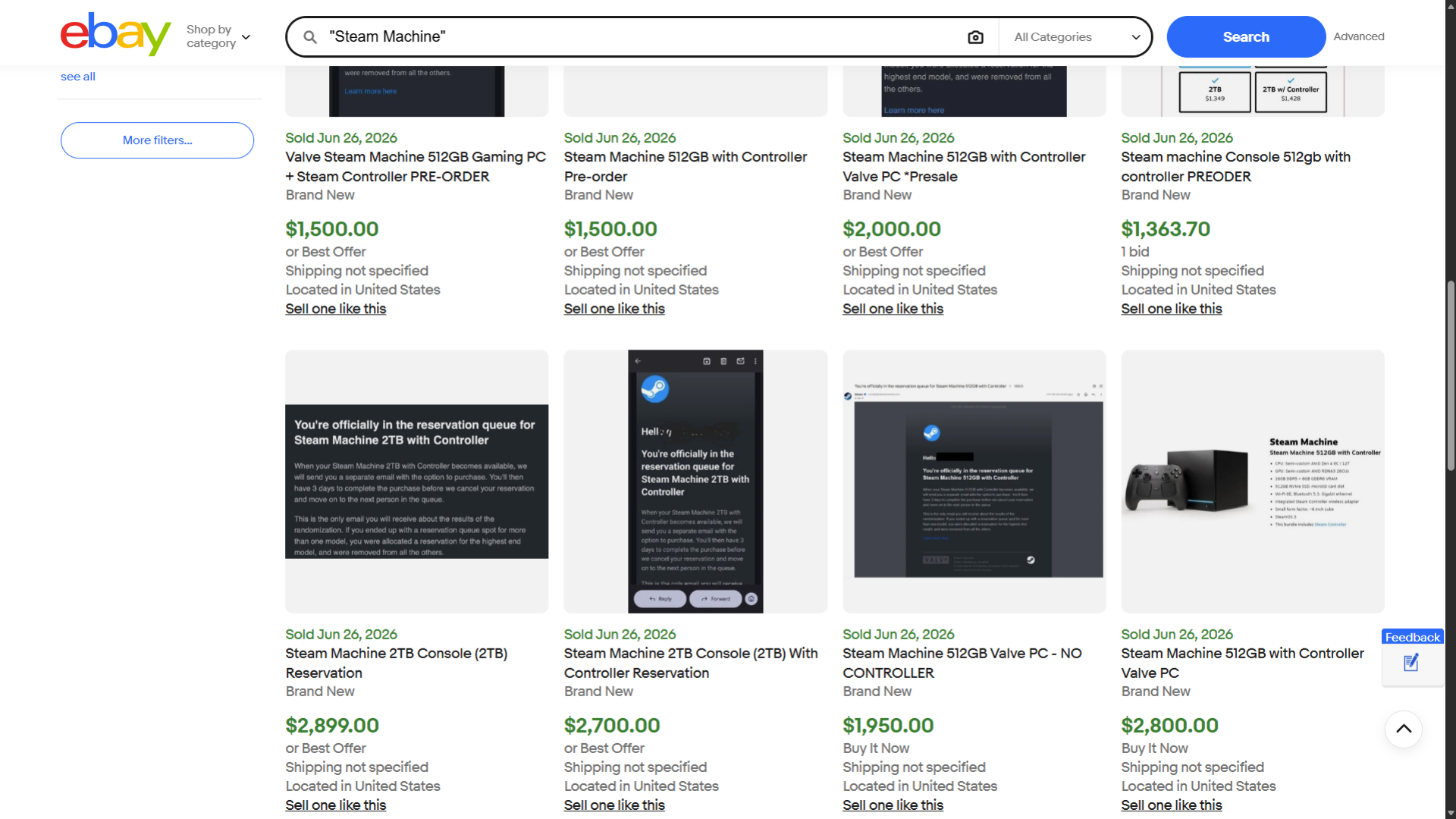
A simple search on online marketplaces like eBay reveals a stark reality: the Steam Machine, or rather the right to purchase one, is being resold at prices far exceeding its official cost. For the 512GB version, originally priced at $1,049, listings have been observed selling between $1,363.70 and $2,800. This represents a markup ranging from a noticeable 30% to an astounding 167%.
The situation for the higher-capacity 2TB version is even more egregious. With official pricing significantly higher, scalpers are demanding between $2,399 and $2,899 for these slots. This translates to a premium of 93% to 140% over the direct purchase price from the Steam Store. These figures highlight the significant profit margins scalpers are extracting, effectively denying many genuine gamers the chance to acquire the device at its intended price. The practice not only inflates prices but also creates a frustrating and often unfair buying experience for the majority of the gaming community.
Chronology of Anticipation and Anti-Scalping Measures
The journey of the Steam Machine from concept to a highly coveted device has been marked by both immense anticipation and Valve’s strategic attempts to manage its rollout ethically.
The Genesis of the Steam Machine and Surging Demand
The idea of a powerful, portable PC gaming device from Valve, a company renowned for its Steam platform and iconic games, ignited the gaming world from its initial whispers. The promise of playing a vast library of PC games on a handheld console, seamlessly integrated with the Steam ecosystem, resonated deeply with gamers. This unique value proposition — bridging the gap between traditional console gaming and the expansive world of PC titles — quickly established the Steam Machine as one of the most eagerly awaited tech products in recent memory. The early trailers and developer insights showcased a device designed for serious gaming, fueling a speculative fervor around its potential.
Valve’s Proactive Approach: The Randomized Reservation System
Anticipating the inevitable surge in demand and the predatory practices of scalpers, Valve announced a sophisticated reservation system well in advance of the Steam Machine’s availability. Their goal was clear: to democratize access and prevent a repeat of past product launches marred by bot-driven purchases and immediate resales at inflated prices.
Valve explicitly outlined their strategy on the Steam Machine FAQ section, stating, "A launch that starts at a specific day and time tends to reward bots, people with fast internet connections, talented gaming fingers for quick F5/refresh reactions, and those who can schedule their life around that moment. By accepting reservation signups over the course of a few days, without any incentive to be first, we’re hoping to take away some of that friction." This approach aimed to level the playing field, making success less about speed and more about luck in a randomized draw.
Implementation of Strict Eligibility Criteria
To further fortify their anti-scalping defenses, Valve imposed stringent requirements for potential Steam Machine purchasers. These criteria were designed to filter out newly created accounts intended solely for scalping and to ensure that reservations went to established members of the Steam community. The requirements included:
- A Steam account in good standing: This stipulation aimed to exclude accounts with a history of fraudulent activity or policy violations.
- A Steam purchase on or before April 27, 2026: (Note: The original article states April 27, 2026, which is a future date. This is highly likely a typo in the source material and was intended to be a date prior to the reservation system opening, such as April 27, 2021, or similar, to ensure an established account history. The intent of this rule was clearly to prevent individuals from creating new accounts en masse specifically to enter the lottery.) This criterion was crucial for identifying genuine, long-term Steam users rather than newly registered accounts created by scalpers.
- Only one Steam Machine reservation per household: This direct measure aimed to prevent individuals or small groups from acquiring multiple units for resale, directly targeting bulk purchasing strategies commonly employed by scalpers.
The Emergence of the Secondary Market for Reservations
Despite these elaborate precautions, the current situation on eBay indicates that the system, while effective at preventing direct bulk purchases of physical units, has a loophole. Individuals who genuinely won a reservation slot through Valve’s lottery are now choosing to monetize that privilege by selling the slot itself for cash. These listings began to surface shortly after the initial reservation winners were notified, demonstrating the immediate financial incentive for those who secured a coveted position in Valve’s queue. This shift in scalping tactics from selling the product to selling the opportunity to buy the product presents a new challenge for manufacturers attempting to control their distribution channels.
Supporting Data and Broader Industry Context
The Steam Machine scalping phenomenon is not an isolated incident but rather a symptom of broader market dynamics and the persistent challenge of managing demand for highly desirable technology.
The Economics of Scarcity: High Demand Meets Limited Supply
The core of the scalping problem lies in the fundamental economic principle of supply and demand. When a product, especially a cutting-edge piece of technology like the Steam Machine, generates immense hype and demand far exceeding its initial production capacity, a vacuum is created. This scarcity drives up perceived value, making it ripe for exploitation by individuals or groups looking to profit from the imbalance. Manufacturers often face constraints in ramping up production quickly, whether due to component shortages, complex manufacturing processes, or a cautious approach to gauging market longevity. This deliberate or unavoidable limitation in initial supply provides the perfect environment for a secondary market to flourish.
The Steam Machine’s Unique Appeal Fuels Demand
The Steam Machine isn’t just another gadget; it represents a significant step in portable gaming. Its ability to run a vast library of PC games, many of which are graphically intensive, on a compact, handheld form factor is a game-changer. Features like its custom SteamOS, robust hardware specifications, and the sheer convenience of gaming on the go contribute to its immense desirability. Gamers are keen to experience this new frontier, and this collective eagerness translates into fierce competition for available units, further emboldening scalpers.
A Recurring Nightmare: PS5, Nvidia GPUs, and the Scalping Epidemic
The struggles Valve faces with Steam Machine scalping are eerily familiar. The launch of Sony’s PlayStation 5 in late 2020 was notoriously plagued by scalpers, with consoles being resold at double or even triple their retail price for months. Similarly, every new generation of Nvidia GeForce RTX graphics cards since the 30 series has seen unprecedented demand and widespread scalping, exacerbated by cryptocurrency mining booms and global chip shortages.
These incidents highlight a systemic issue:
- Bots and Automated Software: Professional scalpers often employ sophisticated bots that can automatically detect when stock becomes available, add items to carts, and complete purchases far faster than any human.
- Global Supply Chain Issues: Recent years have seen unprecedented disruptions in global supply chains, making it harder for manufacturers to produce enough units to meet demand, thus prolonging periods of scarcity.
- Economic Incentives: The potential for quick, significant profit acts as a powerful motivator for individuals and organized groups to engage in scalping.
- Impact on Consumers: The consequence is immense frustration for legitimate buyers, who are forced to either pay exorbitant markups, endure long waits, or miss out entirely. This erodes brand loyalty and creates a sense of unfairness.
Valve’s Measures: A Detailed Look at the Defense
Valve’s reservation system was an admirable attempt to counter these established scalping tactics.
- Randomized Queue: By making the "winning" of a reservation a lottery over several days, Valve aimed to nullify the advantage of "fast fingers" and bots that typically dominate instant-release sales. This method distributes the chance more evenly across the eligible applicant pool.
- Account Verification (Good Standing & Purchase History): The requirement for a "Steam account in good standing" and a "Steam purchase on or before April 27, 2026" (assuming the typo is corrected to a past date) was a crucial layer of defense. It acts as a barrier to entry for newly created "burner" accounts that scalpers might otherwise generate en masse. By requiring a history of engagement and legitimate purchases, Valve sought to prioritize its existing community.
- One Per Household: This straightforward rule is perhaps the most direct attack on bulk scalping. It aims to prevent a single entity from acquiring multiple units, thereby limiting the volume of devices that can be diverted to the secondary market.
Despite these layered defenses, the current eBay listings demonstrate the ingenuity and persistence of those determined to profit. By selling the reservation slot itself rather than the physical device, these individuals are circumventing Valve’s controls on the point of sale. The reservation is tied to a specific, verified Steam account, and the transaction on eBay essentially involves transferring the right to use that account’s reservation. This creates a gray area that is difficult for Valve to police effectively without potentially infringing on legitimate users’ rights or creating overly complex verification hurdles.
Official Responses and Broader Industry Perspective
Valve’s proactive stance in explaining their reservation system showcased an awareness of the scalping problem, but the specific issue of reservation slot resales presents a new challenge.
Valve’s Explicit Anti-Scalping Philosophy
As quoted in their FAQ, Valve’s intention was to foster fairness: "The longer timeframe also allows us to do some extra validation on the signups to make sure they’re real accounts, with only one per household." This statement underscores their commitment to combating fraudulent purchases and ensuring legitimate consumers had a chance. Their philosophy was built on transparency and a desire to avoid the pitfalls seen with other product launches.
The Silence on Reservation Slot Resales
As of the time of this report, Valve has not issued specific statements addressing the phenomenon of reservation slots being sold on secondary markets. Their existing anti-scalping measures primarily focus on preventing multiple purchases by single entities and ensuring the initial buyer is a legitimate user. The act of a legitimate winner then choosing to sell their right to purchase is a more complex issue. It raises questions about account transfer policies, the enforceability of "one per household" once the right has been granted, and how companies can truly prevent individuals from monetizing a unique opportunity.
Lessons from Other Industry Giants
The challenges faced by Valve are not unique. Sony, for instance, has continuously struggled with PS5 scalping. While they’ve implemented various digital queues and direct-to-consumer sales, a complete eradication of scalping has proven elusive. Nvidia has also experimented with different sales models, including Founders Edition sales directly from their website and stricter retailer guidelines, yet GPU prices on the secondary market remain elevated.
The consensus within the industry is that as long as demand significantly outstrips supply, and there’s a substantial profit margin, scalping will persist. Companies can implement deterrents, but completely sealing off all avenues for resale is incredibly difficult, especially when the "product" being resold is an intangible right or a pre-order rather than a physical item.
Consumer Protection and Marketplace Policies
Marketplaces like eBay typically have policies against the sale of pre-orders or reservations that are not transferable or whose fulfillment date is too far in the future. However, enforcing these policies for a "reservation slot" tied to a personal account can be complex. Consumer protection agencies often advise extreme caution when purchasing high-value items from unverified third-party sellers, especially when the item is in high demand and being sold significantly above retail price. The inherent risks of fraud, misrepresentation, and non-delivery are amplified in such transactions.
Implications and Recommendations for Consumers
The emergence of Steam Machine reservation scalping carries significant implications for eager consumers and highlights the need for cautious decision-making.
The Perilous Path of Purchasing from Scalpers
For those who missed out on a legitimate reservation, the temptation to buy from a scalper on eBay can be strong. However, this path is fraught with considerable risks:
- Risk of Fraud and Scams: The most immediate danger is outright fraud. While a seller might boast a 100% positive rating, it’s relatively easy for unscrupulous individuals to manipulate feedback systems. A buyer might pay a substantial sum only to receive nothing, or a non-existent reservation. Since the transaction is for an intangible "slot" tied to someone else’s account, verification can be incredibly difficult.
- Uncertainty of Transfer: How exactly does one "transfer" a reservation slot tied to a specific Steam account, validated with specific user history? This process is murky at best. Valve’s "one per household" policy could lead to the cancellation of the original order if they detect an unauthorized transfer or a mismatch between the reservation holder and the eventual shipping address/payment method. The buyer could lose both their money to the scalper and the opportunity to purchase the Steam Machine.
- No Buyer Protection (Potentially): While platforms like eBay offer buyer protection, the nature of selling an intangible "reservation" can complicate claims. If Valve cancels the order, is the original seller liable, or is the platform? The legal and practical recourse for the buyer could be limited.
- Warranty and Support Issues: Even if a physical Steam Machine is eventually acquired through a scalped reservation, the warranty and customer support might be tied to the original account holder. This could lead to significant headaches if the device experiences issues down the line.
The Allure of FOMO (Fear Of Missing Out)
The current climate of high demand and limited supply for the Steam Machine creates a powerful psychological effect: FOMO. The fear of being left behind while others enjoy the latest tech often drives impulsive and financially unsound decisions. Consumers might feel pressured to pay exorbitant prices now, believing it’s their only chance to get the device. It’s crucial for buyers to resist this urge and make rational, informed choices. Patience often pays off in the long run.
Technical Considerations: Why Waiting Might Be Better
Beyond the financial and fraud risks, there’s a compelling technical reason why waiting for later batches of the Steam Machine could be a superior strategy:
- Single-Channel RAM Limitation: The initial batch of Steam Machines will reportedly ship with a single 16GB stick of RAM. While 16GB is a decent amount of memory, running in a single-channel configuration can significantly impact performance, particularly in integrated graphics scenarios typical of handheld devices. Dual-channel memory, achieved with two 8GB sticks, offers a wider memory bandwidth, which can lead to noticeable improvements in frame rates and overall system responsiveness in games.
- Valve’s Promise of Potential Change: Valve has indicated that while the first batch is limited to single-channel memory, this configuration "may change" in future releases. This strongly suggests that later production runs could potentially feature a dual-channel setup (e.g., two 8GB sticks). Opting for a later batch could therefore mean acquiring a technically superior device without paying a scalper’s premium.
- Software and Firmware Optimizations: Early adopters often act as beta testers. Subsequent batches typically benefit from critical firmware updates, driver optimizations, and software refinements that address initial bugs and enhance performance. Waiting allows Valve to iron out any kinks and deliver a more polished product.
- Potential for Hardware Revisions: While not guaranteed, later production runs of any popular electronic device often see minor hardware revisions or improvements based on user feedback and manufacturing efficiencies.
Long-Term Market Outlook
Historically, prices for high-demand electronics tend to stabilize once supply begins to catch up with demand. As Valve ramps up production and fulfills more reservations, the scarcity premium will naturally diminish. While the initial wave of scalping is frustrating, it is likely a temporary phase. Consumers who exercise patience can expect to purchase the Steam Machine directly from Valve at its intended retail price, potentially even with improved hardware configurations.
In conclusion, while the Steam Machine represents an exciting leap in portable gaming, the current landscape of scalped reservation slots presents a perilous environment for eager consumers. Valve’s efforts to create a fair distribution system are commendable, but the ingenuity of scalpers in exploiting loopholes continues to challenge the industry. For prospective buyers, the smartest move is to resist the allure of immediate gratification, avoid risky secondary market purchases, and consider the tangible benefits of waiting for later, potentially improved, batches directly from Valve. In the dynamic world of tech launches, patience remains a virtue.

