


By Gaming Industry Desk
October 2026
The video game industry is mourning the loss of one of its most innovative and beloved pioneers. Richard B. Gray, universally known to players and developers alike as "Levelord," has passed away at the age of 68.
Gray’s iconic handle was more than just a clever pseudonym; it was an earned title. As a master mapmaker and level designer during the golden age of the first-person shooter, Gray helped shape the physical spaces of virtual worlds that defined an entire generation of gaming. From the chaotic streets of Los Angeles in Duke Nukem 3D to the gritty, sci-fi corridors of SiN and Quake, Gray’s architectural sensibilities left an indelible footprint on the medium.
News of his passing was broken by Apogee Entertainment on social media, sparking an immediate and heartfelt outpouring of tributes from across the global gaming community, honoring not only his stellar design work but his humility, wit, and mentorship.
Main Facts: The Passing of a Legend
Richard B. Gray passed away following a recurring battle with cancer, according to long-time friend and colleague Joe Siegler, who noted that the news was shared by Gray’s wife, Olga. He was born on November 15, 1957.
Though he entered the professional games industry later in life than most—taking his first professional gig in his late 30s—Gray quickly established himself as an indispensable creative force. His portfolio boasts credits on some of the most influential PC shooters of the late 20th and early 21st centuries. He is remembered for pushing engines past their intended limitations, crafting legendary Easter eggs, and serving as a welcoming mentor to a generation of aspiring designers who looked up to his technical ingenuity and warm personality.

Chronology: A Late Bloomer Who Built an Empire of Maps
Gray’s entry into the video game industry is the stuff of folklore. While many developers begin coding or mapping in their teens or early twenties, Gray came to game development as a mature adult.
The Mod Scene Beginnings
In a 2016 interview with Duke64Nukem.com, Gray revealed that he was 35 years old when he built his very first Doom level. Self-effacingly calling himself "a late bloomer with games," Gray spent his free time diving headfirst into the vibrant Doom modding community. His custom maps quickly caught the attention of industry insiders due to their complex architecture, clever spatial puzzles, and aggressive pushing of engine limits.
The Apogee Era and Duke Nukem 3D (1994–1996)
In 1994, Apogee founder Scott Miller discovered Gray’s impressive Doom mod work and hired him straight out of the community. Moving to Dallas, Texas, Gray integrated seamlessly into the studio’s offices.
When Duke Nukem 3D launched in 1996, it was a watershed moment for the first-person shooter genre. While id Software’s Doom and Quake focused heavily on abstract, demonic geometry, Duke Nukem 3D grounded its gameplay in hyper-detailed, recognizable real-world environments—movie theaters, strip clubs, banks, and alien-infested cities. Gray was a principal architect of this vision, designing iconic maps that challenged players to interact with their surroundings in unprecedented ways.
Ritual Entertainment and Beyond
Shortly after the completion of Duke Nukem 3D, Gray left 3D Realms alongside other developers to co-found Hipnotic Interactive, which was later renamed Ritual Entertainment.
At Ritual, Gray’s creative output exploded. He worked on a sprawling roster of critically acclaimed titles that defined the late ’90s and 2000s PC gaming landscape:

- Quake: Scourge of Armagon (1997): Expanding id Software’s masterpiece with intricate, puzzle-box level design.
- SiN (1998): Crafting the futuristic, cyberpunk streets of Freeport.
- Star Trek: Elite Force II (2003): Bringing cinematic pacing to sci-fi corridors.
- Counter-Strike: Condition Zero (2004): Contributing to tactical shooter design.
- 25 to Life (2005): Exploring urban action dynamics.
Supporting Data & Technical Innovation: Pushing the Engine’s Limits
What separated Levelord from many of his contemporaries was his obsessive dedication to squeezing every drop of performance and visual fidelity out of aging software frameworks.
Working primarily within the constraints of the Build engine for Duke Nukem 3D—an engine famed for its 2.5D limitations—Gray routinely found clever workarounds to create three-dimensional illusions that engine creators thought impossible.
The Portal Trick
Scott Miller recalled to PC Gamer how Gray utilized portal-rendering techniques to create spatial anomalies and looping rooms that blew players’ minds. "Richard loved to push the engine to its limits and he came up with a lot of fun level design tricks… that our other level designers learned from," Miller said.
The Ultimate Easter Egg
Beyond his structural wizardry, Gray cemented his place in pop culture history through humor. He engineered one of the most famous and sought-after Easter eggs in gaming history. Accessible only by executing specific cheats to breach boundary walls, players who ventured into unauthorized map zones would be greeted by a floating text sign declaring:
"You’re not supposed to be here! — Levelord"
It was a masterclass in winking meta-humor that rewarded exploration, subverted expectations, and established his persona as the undisputed lord of the map grid.
Official Responses and Tributes
Following the announcement of his passing, figures from across the video game industry took to social media to share their grief, memories, and appreciation for Gray’s contributions.
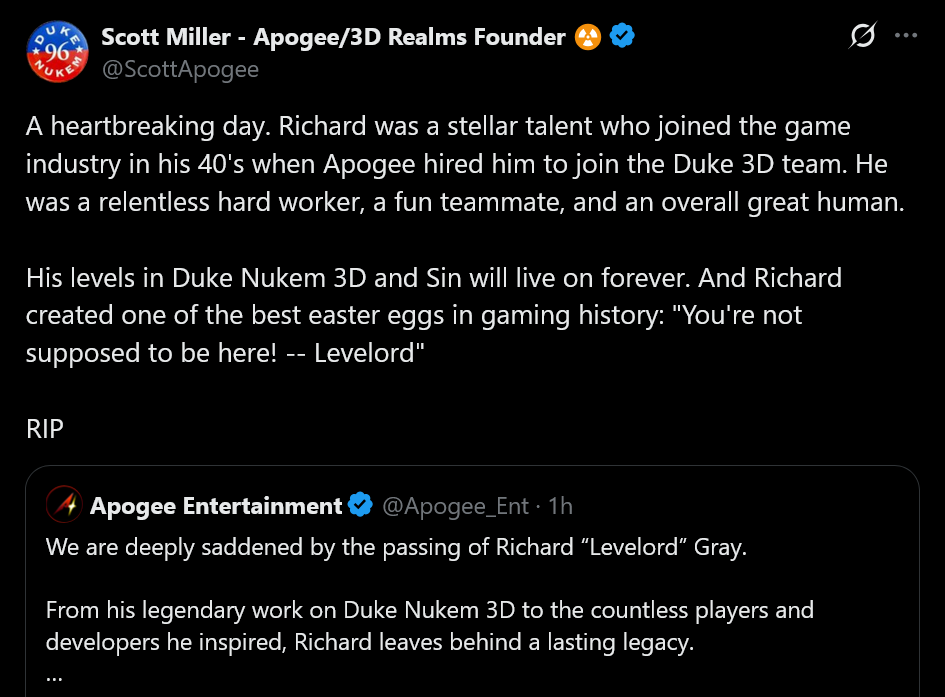
- Apogee Entertainment: In a statement posted to Bluesky, the studio wrote: "We are deeply saddened by the passing of Richard ‘Levelord’ Gray. From his legendary work on Duke Nukem 3D to the countless players and developers he inspired, Richard leaves behind a lasting legacy. Rest in peace, Levelord."
- Scott Miller (Apogee Founder): Reflecting on hiring Gray in the mid-90s, Miller noted: "He was a relentless hard worker, a fun teammate, and an overall great human. His levels in Duke Nukem 3D and SiN will live on forever."
- John Romero (Doom co-creator): Shared deeply felt sentiments, noting: "Devastating news today. Richard ‘Levelord’ Gray was such a great guy… He was full of life, a gentle soul, and an excellent level designer. He was called ‘Levelord’ for a reason." Romero also highlighted Gray’s specific contributions to the later episodes of Duke Nukem 3D, praising their distinctive visual identity.
- Cliff Bleszinski (Gears of War creator): Paid homage via X: "RIP Richard ‘Levelord’ Gray. You broke the mold, fella. Guy paved the way for so many level/environment designers."
- Frederik Schreiber (Slipgate Ironworkers CEO): Emphasized Gray’s humility: "Richard was, without a doubt, one of the kindest people I’ve ever met in the games industry. Incredibly humble, remarkably intelligent, endlessly creative… Despite everything he had accomplished… he never carried himself as anything other than a genuinely good human being."
- Andrew Hulshult (Composer): Recalled his time with Gray: "Richard Gray was one of those industry vets I always looked forward to hanging out with… He was VERY smart and I always felt like I learned something just from hanging out with him."
Implications: The Enduring Blueprint of Level Design
Richard Gray’s passing marks the quiet closure of an era when individual level designers could achieve rock-star status purely through the brilliance of their spatial layouts.
In the modern gaming landscape, level design is often a massive, industrialized undertaking split across large teams of environment artists, technical artists, systems designers, and lighting specialists. However, the foundational rules of spatial flow, pacing, verticality, and player manipulation that Gray pioneered in the 1990s remain core tenets of modern game development.
Levelord proved that a video game level is not merely a static arena for combat, but a character in its own right—a storyteller communicating through texture, lighting, architecture, and hidden secrets.
For the millions of players who navigated his sprawling maps, hunted down his cheeky Easter eggs, or found inspiration to enter the game industry themselves, Richard Gray’s work will live on forever. Though we were "not supposed to be there" in his secret developer zones, the gaming world is immeasurably richer because Richard Gray invited us in. Rest in peace, Levelord.

