

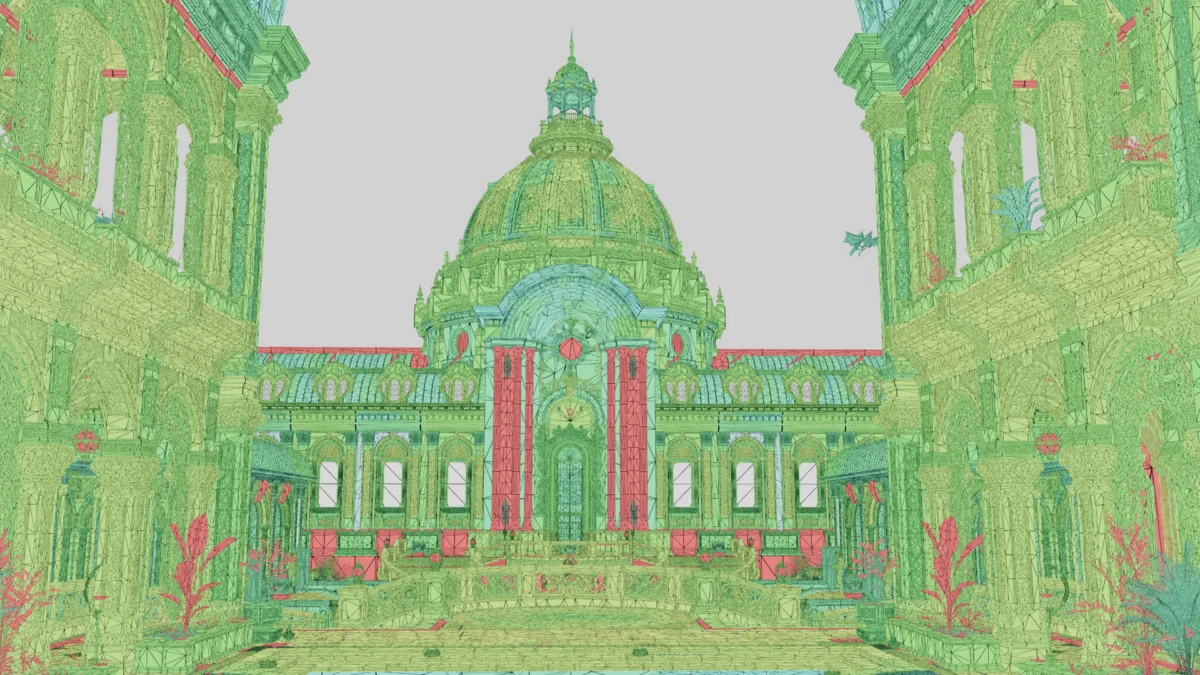
SANTA CLARA, Calif. — In a significant leap forward for real-time rendering technology, graphics processing giant Nvidia has officially released version 2.0 of its RTX Mega Geometry Software Development Kit (SDK). Unveiled via a comprehensive developer blog post, the updated SDK introduces robust streaming support for continuous level-of-detail (LoD) clusters designed to effortlessly manage astronomical polygon counts.
According to Nvidia, this capability allows game engines to handle ultra-dense meshes and expansive virtualized geometric landscapes that vastly exceed the physical Video RAM (VRAM) budgets of modern consumer hardware. The rollout coincides with the debut of RTX Kit 2026.3, a broader ecosystem update aimed at equipping developers with next-generation tools for advanced ray tracing and neural rendering.
The timing of the release has also intensified speculation across the gaming industry, arriving just ahead of the anticipated launch of Gears of War: E-Day, a title confirmed to leverage Nvidia’s RTX Mega Geometry technology. While Nvidia has not explicitly disclosed which iteration of the SDK the title utilizes, the convergence of these developments underscores a paradigm shift in how game developers approach asset streaming, memory management, and visual fidelity.
Main Facts
The core of the RTX Mega Geometry 2.0 update centers on the systemic handling of ultra-high-density geometry in real-time environments. Historically, rendering cinematic-quality assets in video games has been bottlenecked by hardware memory constraints. As developers strive for photorealism, individual asset meshes—ranging from intricate rock formations to hyper-detailed architectural ruins—have ballooned into millions of polygons. Loading these assets simultaneously has traditionally resulted in severe stuttering, memory overflow, and severe performance degradation.
RTX Mega Geometry 2.0 addresses this bottleneck through several key architectural advancements:
- Continuous Level-of-Detail (LoD) Clusters: Unlike traditional discrete LoD systems that swap entire models at arbitrary distances, the 2.0 SDK utilizes continuous geometric clustering. This allows meshes to dynamically adjust their geometric resolution fluidly and seamlessly across the camera’s field of view without visible "popping" artifacts.
- On-Demand VRAM Streaming: The SDK features a modernized streaming architecture capable of paging geometry data in and out of the GPU’s VRAM on the fly. Nvidia asserts that scenes significantly larger than the available VRAM budget can now be rendered smoothly, as only the requisite geometric detail for the immediate viewport is resident in memory.
- Ecosystem Integration: Mega Geometry 2.0 arrives as a core component alongside the release of RTX Kit 2026.3, integrating natively with other proprietary Nvidia technologies, including DLSS (Deep Learning Super Sampling) pipelines, RTX Neural Rendering tools, and Nvidia ACE (Avatar Cloud Engine) frameworks.
Chronology of Geometric Virtualization
To understand the significance of RTX Mega Geometry 2.0, it is essential to examine the chronological evolution of real-time geometry handling over the past decade. For years, polygon budgets were strictly guarded by developers, requiring meticulous manual optimization, normal mapping tricks, and aggressive culling to maintain frame rates.
The Pre-Virtualization Era (Pre-2020)
Before the mainstream adoption of hardware-accelerated ray tracing and dedicated geometric virtualization APIs, game engines relied heavily on traditional rasterization pipelines. Artists created distinct LoD models (LoD 0, LoD 1, LoD 2, etc.) for every asset in a scene. The engine would swap these models based on a distance threshold from the player camera. This method frequently caused noticeable visual pops and consumed substantial manual labor hours from asset artists.
The Rise of Hardware Acceleration (2020–2023)
With the launch of the Nvidia RTX architectural lineup and competing hardware solutions, real-time ray tracing transformed lighting and reflections. However, geometry processing remained largely traditional until engine developers began exploring virtualized geometry concepts—most notably popularized by Unreal Engine’s Nanite technology in 2021. Recognizing the need for low-level GPU control and vendor-agnostic or optimized proprietary solutions, Nvidia began developing its own dedicated toolsets to bridge the gap between heavy geometry and ray-tracing pipelines.
The Introduction of RTX Mega Geometry (2024–2025)
Nvidia initially rolled out its RTX Mega Geometry framework to give developers low-level access to advanced mesh shading and BVH (Bounding Volume Hierarchy) management for ray-traced scenes. Early adopters began experimenting with the tech to bypass traditional memory walls. However, these early versions still faced limitations when dealing with hyper-dense, open-world environments where entire landscapes needed to be streamed dynamically.
The Arrival of Version 2.0 (2026)
With the release of RTX Mega Geometry 2.0 and RTX Kit 2026.3, Nvidia has transitioned from experimental geometric management to production-ready, ultra-scale streaming. The update effectively solves the memory wall for massive open worlds, allowing developers to treat geometry with the same streaming efficiency previously reserved for high-resolution textures.
Supporting Data and Technical Metrics
While Nvidia’s developer blog focuses primarily on functional capabilities, industry analysts and early developer notes highlight the profound technical implications of Mega Geometry 2.0 on system performance.
| Feature / Metric | Traditional Rendering | RTX Mega Geometry 1.0 | RTX Mega Geometry 2.0 |
|---|---|---|---|
| Mesh Density Handling | Low to Moderate (Manual LoDs) | High (Static BVH management) | Ultra-High (Continuous LoD Clusters) |
| VRAM Dependency | Strict (Assets must fit in memory) | Moderate (Optimized culling) | Flexible (Streaming beyond VRAM budget) |
| LoD Transition | Discrete "Popping" | Smoothed transitions | Continuous, artifact-free scaling |
| Ray Tracing Synergy | Requires heavy simplification | Native BVH generation | Streamed geometry with real-time BVH updates |
The ability to stream geometry data that exceeds the physical VRAM capacity relies heavily on the high-speed throughput of modern PCIe Gen 5 interfaces and DirectStorage-equivalent pipelines. By offloading non-active geometric clusters to system memory or high-speed NVMe storage and fetching them precisely when needed by the shader pipeline, the GPU maintains a lean, highly efficient working set. This prevents the catastrophic frame drops traditionally associated with VRAM exhaustion, where the operating system is forced to swap memory pages across the motherboard bus.
Furthermore, continuous LoD clustering drastically reduces the geometric payload sent to the rasterizer and ray-tracing units. By dynamically reducing triangle counts for distant or obscured portions of a mesh to sub-pixel sizes, the GPU wastes fewer cycles processing fragments that contribute negligibly to the final pixel output.
Official Responses and Industry Reception
Nvidia’s engineering teams have positioned the RTX Mega Geometry 2.0 update as a foundational pillar for the next generation of video game development. In the accompanying developer documentation, Nvidia engineers emphasized that the modern player’s expectation for seamless, expansive open worlds cannot be met with legacy geometry pipelines.
"As virtual worlds grow increasingly complex and photorealistic, the traditional constraints of VRAM and manual asset optimization have become major bottlenecks for creative freedom," Nvidia noted in its official developer communication. "With RTX Mega Geometry 2.0 and the continuous LoD streaming architecture, we are empowering creators to build without compromise, ensuring that hardware limitations no longer dictate artistic vision."
Third-party game developers have echoed these sentiments, pointing to upcoming titles as proof of concept. The intersection of this technology with high-profile releases like The Coalition’s Gears of War: E-Day has generated immense chatter within the development community. Although The Coalition and Nvidia have kept specific implementation details under wraps regarding E-Day, industry insiders suggest that the game’s gritty, highly detailed destruction mechanics and sprawling urban environments serve as an ideal testbed for advanced geometric virtualization.
Engine architects from various studios have also praised the inclusion of Mega Geometry within the broader RTX Kit 2026.3 release. By streamlining the integration process between graphics APIs and Nvidia’s proprietary SDKs, development studios can reduce the engineering overhead required to implement custom streaming solutions from scratch.
Implications for the Future of Gaming and Hardware
The deployment of RTX Mega Geometry 2.0 carries far-reaching implications for both game development studios and hardware manufacturers.
1. The Death of Manual Asset Optimization
For decades, artists and technical directors spent countless hours building multiple versions of every asset to manage performance. With automated continuous LoD streaming capable of handling high-density source meshes directly, the workflow shifts dramatically. Artists can now import film-quality asset scans directly into game engines, trusting the runtime SDK to handle the degradation, clustering, and streaming dynamically. This promises to drastically shorten production cycles and lower development costs.
2. Evolving Hardware Demands
Paradoxically, while RTX Mega Geometry 2.0 allows systems to render scenes larger than their VRAM budgets, it places a premium on memory bandwidth and storage speed. As GPUs increasingly rely on streaming data directly from system RAM and high-speed storage via technologies like Microsoft DirectStorage and Nvidia RTX IO, the speed of the storage subsystem becomes a critical performance metric. Consumers may find that future-proofing a PC for next-generation gaming requires not only a powerful GPU and ample VRAM, but also top-tier NVMe SSD speeds to facilitate seamless geometry paging.
3. Raising the Bar for Visual Fidelity
As tools like RTX Mega Geometry 2.0 become industry standards, player expectations for visual density will rise accordingly. The days of blocky terrain, repetitive asset tiling, and abrupt pop-in will increasingly look archaic. Titles utilizing these advanced SDKs will set a new baseline for immersion, blurring the line between pre-rendered cinematic content and real-time interactive experiences.
Conclusion
Nvidia’s release of RTX Mega Geometry 2.0 marks another milestone in the ongoing evolution of real-time computer graphics. By solving one of the most persistent bottlenecks in modern game development—managing massive geometric density under strict hardware constraints—Nvidia has given developers a powerful instrument to shape the virtual worlds of tomorrow. As titles like Gears of War: E-Day begin to showcase the practical applications of these technologies, the gaming industry stands on the precipice of a new era defined by infinite scale and uncompromising detail.

