

By: Tech & Hardware News Desk
Published: February 2026
When consumers invest hard-earned money into high-end technology, they do so with a reasonable and legally backed expectation: that the product will function as advertised, and should it fail through no fault of the user, the manufacturer will honor its warranty. In the realm of PC gaming and enthusiast computing, this expectation scales proportionally with price.
Today, flagship graphics cards command prices that rival entire used automobiles, frequently clearing the multi-thousand-dollar threshold. When you drop thousands of dollars on a top-tier GPU like NVIDIA’s GeForce RTX 5090, you expect not just raw performance, but a safety net of exceptional customer service and robust warranty protection.
Instead, one unfortunate enthusiast claims he received a blunt, writing-confirmed rejection after his flagship hardware catastrophically self-destructed. The incident, shared broadly across the PC enthusiast community, has sparked a fresh wave of anxiety over high-wattage power connectors, hardware liability, and the willingness of major manufacturers to stand behind their ultra-expensive products.
Main Facts
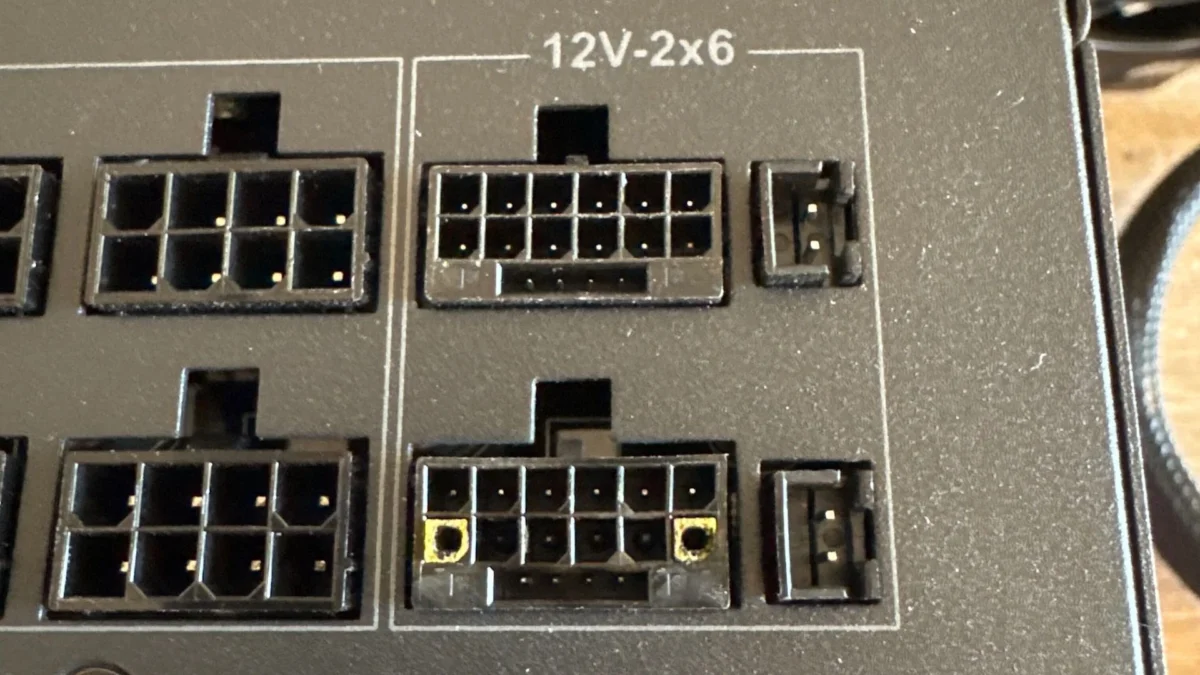
The controversy centers around a viral post on the popular Reddit community r/pcmasterrace, published by user /u/Melodic_Initial_1767. According to the user, his newly acquired, ultra-premium NVIDIA GeForce RTX 5090 graphics card suffered a catastrophic hardware failure. The root cause? The notoriously controversial 12V-2×6 high-power connectors melted on both ends of the modular power cable.
Crucially, the cable in question was not an aftermarket braided extension or a sketchy third-party adapter; it was the stock cable supplied directly out of the box with a high-capacity 1600-watt ASRock power supply—specifically, the ASRock PG-1600G Phantom Gaming PSU.
Despite operating the system under conservative conditions—reportedly running the stock BIOS with zero overclocking, utilizing a manually reduced power limit, and experiencing the failure while the system was sitting idle—the hardware was rendered completely inoperable.
Hoping to utilize the standard manufacturer return merchandise authorization (RMA) process to rectify the situation, the user opened a support ticket with the graphics card’s vendor, PNY. In an astonishingly short turnaround time—reportedly just one day later—PNY allegedly issued a definitive, in-writing denial of the warranty claim, leaving the consumer on the hook for a multi-thousand-dollar paperweight.
Chronology of Events
To understand how a routine hardware failure turned into a consumer relations crisis, it is vital to trace the timeline of the incident as reported by the affected user and observed by the broader tech community:
Phase 1: The Build and Configuration
Weeks prior to the incident, the user assembled a high-end enthusiast rig anchored by an ASRock PG-1600G 1600W power supply and an NVIDIA GeForce RTX 5090 graphics card manufactured by PNY. Recognizing the immense power draw and thermal output associated with modern flagship GPUs, the user took proactive measures to ensure stability. According to their statement, the card ran on its stock BIOS without any manual overclocks. Furthermore, the user actively engaged a manually reduced power limit to keep thermal and electrical stress well within safe nominal parameters.
Phase 2: The Catastrophic Failure
Despite the conservative operational profile, disaster struck. The user reported that the system failed while sitting idle. Upon inspecting the internals of the PC case, the user discovered severe thermal damage. The high-power 12V-2×6 connectors on both ends of the modular cable—plugged into both the ASRock power supply and the PNY graphics card—had melted, fusing the plastic housings and heavily damaging the terminal pins.
Phase 3: The RMA Submission and Rapid Denial
Recognizing that the hardware was irreparably damaged through a structural power delivery failure, the user packaged the components and filed an official RMA (Return Merchandise Authorization) claim with PNY. The expectation was standard: the manufacturer would inspect the unit, evaluate the thermal damage, and determine whether to repair or replace the card under standard warranty terms.
However, the process was abruptly cut short. Just one day after opening the support ticket, the user received a formal response from PNY denying the warranty claim in writing. The speed of the rejection—combined with the lack of a detailed public explanation from the vendor regarding root-cause analysis—immediately triggered widespread outrage across enthusiast forums.
Supporting Data and Technical Context
The melting of high-power graphics card connectors is not an entirely new phenomenon, but its migration to the RTX 50-series generation raises profound engineering and safety concerns.
The 12V-2×6 Connector Legacy
The 12V-2×6 connector (and its predecessor, the 12VHPWR connector) was introduced to supply the massive electrical currents demanded by modern high-end GPUs over a single, streamlined cable. While space-saving and capable of delivering up to 600 watts of power to a single card, these connectors have faced intense scrutiny from day one.
Industry data shows that these connections are exceptionally sensitive to user error—specifically, incomplete seating. If a user fails to push the connector in completely until the physical latch clicks, microscopic air gaps create high electrical resistance. Under heavy load, current passing through these high-resistance points generates intense localized heat, causing the plastic housing to melt and potentially destroying the terminal pins on both the cable and the GPU.
The ASRock PG-1600G Power Supply
The power supply unit involved in this incident is the ASRock PG-1600G Phantom Gaming 1600W PSU. When hardware reviewers evaluated the PG-1600G, they generally praised its robust electrical performance, high efficiency, and massive headroom capable of handling transient power spikes typical of top-tier hardware.
However, the fact that both ends of the cable melted—the PSU end and the GPU end—complicates the traditional narrative. Typically, melt-downs attributed to user error occur exclusively at the GPU receptacle due to improper insertion. When a proprietary modular cable melts at the power supply terminal as well, it shifts the analytical focus toward potential systemic issues, such as excessive pin resistance, cable gauge limitations, or faulty terminal crimping during manufacturing.
Official Responses and Industry Standpoints
As of this writing, the situation remains fluid, and the tech community is watching closely to see how the involved corporate entities respond to the mounting public relations pressure.
The Vendor Silence
PNY’s initial handling of the RMA—characterized by a rapid, written denial—has drawn sharp criticism from consumer advocacy groups and tech commentators. Manufacturers typically reserve warranty denials for cases involving clear user abuse, unauthorized modifications (such as shunt mods or liquid cooling installations), or external environmental damage (like liquid spills or power surges from lightning strikes).
When a user claims factory-stock operation, reduced power limits, and a failure occurring at idle while using bundled stock cables, an outright denial without a transparent technical explanation places the burden of proof squarely on the manufacturer. At present, PNY has not released a formal public statement addressing the specifics of /u/Melodic_Initial_1767’s case, leaving consumers to wonder if the company has adopted a blanket policy of rejecting melted-connector RMAs.
ASRock’s Position
Similarly, ASRock—the manufacturer of the power supply and the provider of the melted modular cable—has yet to issue a direct comment on this specific incident. Because the failure involved both a PNY graphics card and an ASRock power supply cable, determining liability becomes a jurisdictional grey area. Is the fault with the graphics card’s power receptacle design, the power supply’s cable manufacturing, or the industry-wide specification of the 12V-2×6 standard itself? Without inter-company cooperation and transparent RMA investigations, the consumer is left trapped in regulatory purgatory.
Implications for the PC Enthusiast Community
The fallout from this single Reddit post extends far beyond one individual’s ruined weekend or financial loss. It strikes at the heart of consumer confidence in the PC hardware market.
1. The Financial Risk of Flagship Ownership
With flagship graphics cards routinely clearing $2,000 to $3,000 USD, buying top-tier hardware is no longer just a hobbyist indulgence; it is a significant financial investment. If manufacturers can unilaterally deny warranty coverage when standardized power connectors fail—even when users take precautionary steps like lowering power limits—the financial risk of PC building escalates dramatically. Consumers are left questioning whether they are effectively self-insuring their own hardware against systemic design flaws.
2. Finger-Pointing and the "RMA Blame Game"
When multi-vendor ecosystems fail, consumers often find themselves caught in a frustrating game of corporate ping-pong. The graphics card vendor may blame the power supply manufacturer, claiming out-of-spec voltage or faulty cabling caused the melt. Conversely, the power supply manufacturer may point the finger at the GPU’s power draw characteristics or terminal design. Until industry standards establish clear accountability frameworks for modular power delivery components, consumers will continue to suffer the consequences.
3. Calls for Structural Reform and Accountability
The viral nature of this incident has amplified calls for regulatory and industry-wide reform. Enthusiasts are demanding that manufacturers be legally required to provide transparent, forensic-level evidence before denying warranty claims related to thermal connector failures. Furthermore, hardware reviewers and consumer advocates are pressing standards bodies to re-evaluate the long-term safety and mechanical durability of high-wattage power delivery connectors before pushing even higher power loads onto future generations of silicon.
Conclusion
The case of /u/Melodic_Initial_1767 and his melted PNY GeForce RTX 5090 serves as a cautionary tale for the modern PC building era. It highlights the precarious intersection of extreme hardware performance, complex multi-vendor power delivery systems, and corporate warranty policies that often favor the bottom line over customer satisfaction.
As the story continues to develop across digital forums and tech news outlets, the pressure is mounting on PNY, ASRock, and the wider industry to provide clarity. Until manufacturers step up to offer transparent investigations, fair warranty protections, and definitive answers regarding the reliability of high-power connectors, the cloud of uncertainty hanging over ultra-enthusiast PC building will only continue to grow.

