

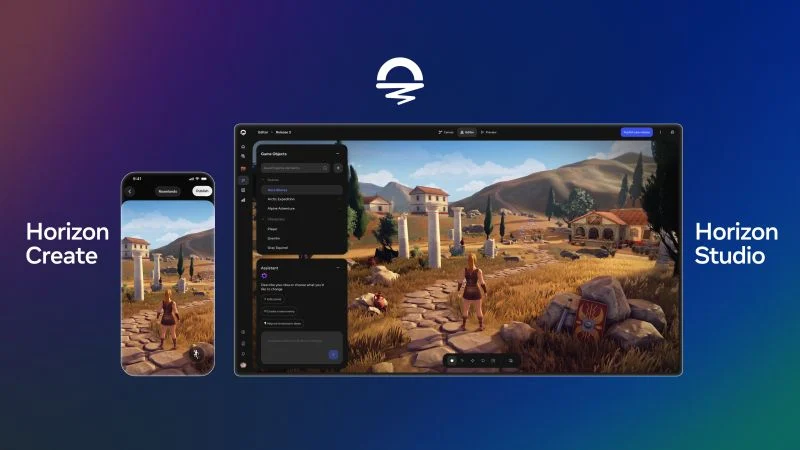
In a bold move to reshape the landscape of digital creation, Meta has officially unveiled its latest suite of AI-powered tools: Horizon Create and Horizon Studio. Announced during the highly anticipated Meta Connect conference, these platforms represent a fundamental shift in how interactive entertainment is conceived, built, and distributed. By leveraging the advanced "agentic" capabilities of the Meta Horizon Engine, the company aims to dismantle the technical gatekeeping that has long characterized the gaming industry, allowing users to transform simple text prompts into fully playable 2D and 3D experiences.
The Main Facts: Bridging the Gap Between Concept and Code
At the core of Meta’s announcement is a vision of "democratized development." Traditionally, game creation has been the domain of specialists, requiring years of experience in complex engines like Unity or Unreal, alongside expensive hardware and a deep understanding of C# or C++.
Meta’s new solution, consisting of Horizon Create (mobile-optimized) and Horizon Studio (browser-optimized), seeks to bypass these hurdles. The two tools share a common backend, ensuring that assets, game systems, and iterative project histories sync seamlessly across devices. Whether a creator starts a project on a smartphone during a commute or refines the mechanics on a desktop browser, the environment remains consistent.
The workflow is deceptively simple: users input natural language prompts—such as "create a platformer set in a neon-lit city where the player controls a robot"—and the Meta Horizon Engine interprets these instructions to generate a functional, playable game. Once satisfied with the result, creators can publish their work directly to the Facebook and Instagram ecosystems, tapping into a massive, built-in audience without needing to navigate the traditional hurdles of app store distribution.
A Chronological Progression: From Roblox to Meta’s Vision
The industry’s pivot toward AI-assisted development has been swift, and Meta’s announcement follows a clear trajectory of technological evolution.
- Early 2024: The industry sees a surge in "agentic" AI—AI systems capable of completing multi-step tasks autonomously. Major platforms begin exploring how these agents can assist with asset generation and code debugging.
- Mid-2024: Roblox Corp. makes headlines by integrating agentic AI into Roblox Studio. This tool allowed creators to generate game design documents and implement basic mechanics through text prompts, setting a new benchmark for "low-code" creation.
- September 2024 (Meta Connect): Meta pivots to a dual-pronged strategy. They announce Horizon Create and Horizon Studio, signaling their intent to move game development out of specialized software suites and into the social media feed itself. Simultaneously, they unveil their high-end VR Glasses, signaling a hardware-software synergy that positions Meta as a complete ecosystem provider.
- Future Roadmap (2025-2027): Meta confirms a gradual rollout of Horizon Create and Studio, starting with a select group of creators funded by the Meta Horizon Creator Fund, with a wider public release and monetization features to follow.
Supporting Data: Technical Specifications and Hardware Integration
The technical backbone of this launch is the Meta Horizon Engine, which has been refined to process complex logic requests generated by Large Language Models (LLMs). By moving the compute-heavy tasks to the cloud, Meta allows mobile devices with limited processing power to act as sophisticated game design studios.
The VR Glasses Hardware
Complementing the software suite is the announcement of Meta’s new VR Glasses, which represent a massive leap in wearable technology. Key specifications include:
- Form Factor: Five times lighter than the current Meta Quest 3, removing the need for bulky straps.
- Display: 5K infinite display utilizing micro-OLED panel technology.
- Ecosystem: Full support for Unity 6.6 via OpenXR, ensuring that existing Quest projects are forward-compatible.
- Launch Window: Spring 2027 at a retail price point of $1,299.99.
The integration of the XR Interaction (XRI) Toolkit and XRI Simulator ensures that developers have a professional-grade sandbox to test their creations before deployment. Studios such as Schell Games, Within, and Soul Assembly are already iterating on early builds, proving that while the barrier to entry is lowering for novices, the ceiling for professional-grade content remains high.
Official Responses and Industry Perspectives
Meta’s official stance, as articulated during the conference, focuses on the removal of friction. "Traditional game development demands months of work, expensive hardware, and specialised skills," a spokesperson noted. "Horizon Create and Horizon Studio remove these barriers: they make it easier to turn your ideas into playable 2D and 3D games."
Industry analysts have responded with cautious optimism. While some emphasize the risk of market oversaturation with low-quality, AI-generated content, others point to the massive potential for viral engagement. The involvement of the Meta Horizon Creator Fund suggests that the company is taking a proactive approach to quality control, ensuring that early titles serve as a "proof of concept" for the platform’s capabilities.
Furthermore, the collaboration with industry giants like Unity demonstrates that Meta is not trying to replace professional game engines but rather to create a "top-of-funnel" experience where casual users can graduate into more complex development environments as their skills evolve.
Implications: The Future of Digital Creation
The implications of these tools are profound, extending far beyond the walls of the Meta ecosystem.
1. The Death of the "Blank Canvas"
The greatest challenge in creative work is often starting. By providing a generative AI interface, Meta is essentially eliminating the "blank canvas" syndrome. Creators no longer need to know how to texture a 3D model or write a collision script; they simply need to be effective at describing their intent. This shifts the value of a developer from "technical implementer" to "creative director."
2. Social Media as a Game Distribution Hub
For decades, game distribution has been siloed on platforms like Steam, the App Store, or the PlayStation Store. By allowing creators to publish directly to Facebook and Instagram, Meta is turning the world’s largest social networks into the world’s largest game discovery engines. This could effectively turn every Facebook user into a potential game developer and every social feed into an interactive arcade.
3. Hardware Convergence
The synergy between the new VR Glasses and the Horizon creation tools suggests a future where the distinction between "playing a game" and "building a game" is blurred. With the VR Glasses’ 5K display and lightweight design, Meta is positioning itself to be the primary interface for the "Spatial Web." If developers can create a 3D game on their phone and immediately play it in immersive VR on the new glasses, the friction of development disappears entirely.
4. Economic Challenges and Monetization
While the tools are revolutionary, the business model remains the primary question for the community. Meta has promised more details on in-game monetization, but the success of the platform will hinge on whether creators can generate sustainable revenue. If the platform becomes a hub for short-lived, low-quality "prompts," it may struggle to attract top-tier talent. However, if Meta implements robust ad-revenue sharing or in-app purchase systems, it could spark a new gold rush in the creator economy.
Conclusion
Meta’s introduction of Horizon Create and Horizon Studio is a declaration of intent: the company believes that the future of the internet is not just consumed, but constructed by its users. By marrying the simplicity of text-to-code generation with the ubiquity of social media, Meta is attempting to create a new paradigm for digital creativity. Whether this will lead to a new golden age of user-generated content or a flooded market of mediocre experiences remains to be seen. Regardless, the tools of 2027 are set to be vastly different from those of today, and the "democratization of development" is no longer just a buzzword—it is the next frontier of the digital age.

