

By [Author Name]
Technology & Gaming Correspondent
Main Facts
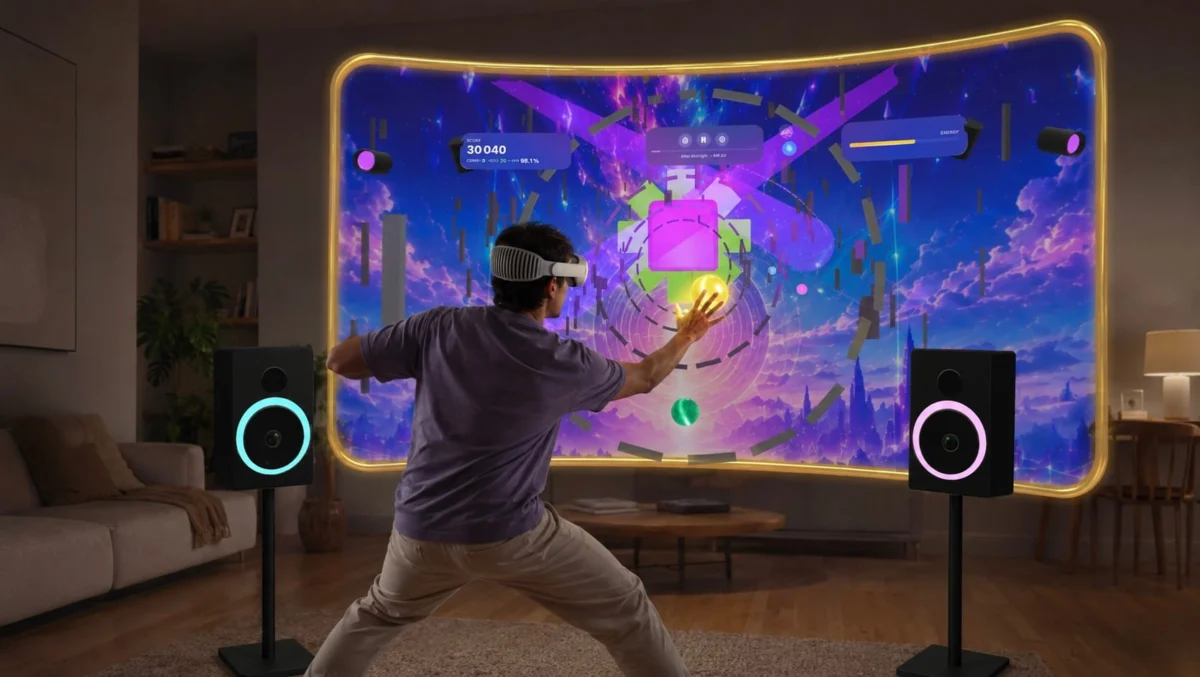
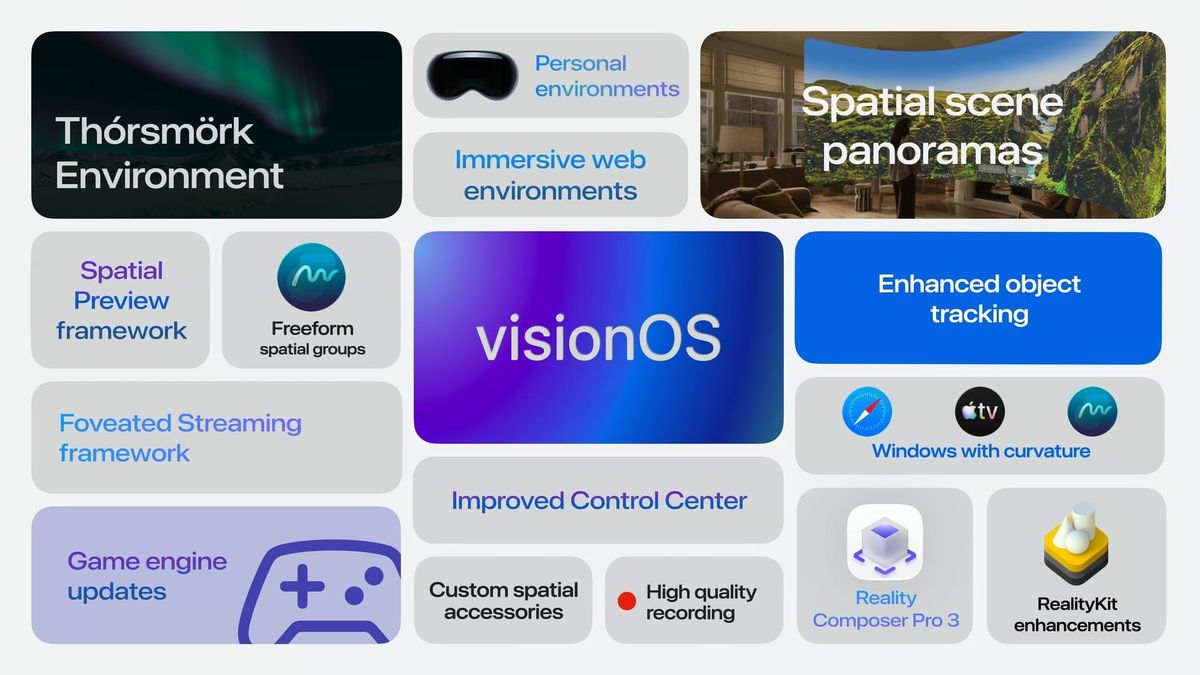
The landscape of spatial computing and mixed reality gaming took a significant leap forward this week with the simultaneous launch of visionOS 27 and a marquee software title designed to showcase its underlying capabilities: Flow Chaser. Available exclusively on the Apple Vision Pro for $14.99, Flow Chaser is a cutting-edge spatial rhythm game that leverages Apple’s newly introduced, on-device music intelligence framework.
Unlike traditional rhythm titles that rely exclusively on hand-crafted maps and licensed tracklists, Flow Chaser dynamically analyzes the structural anatomy of audio files in real time. It uses this intelligence to automatically generate bespoke, synchronized gameplay levels.
Out of the box, the title ships with an expansive library of 140 original tracks spanning multiple genres, translating to upwards of 7.5 hours of curated gameplay. However, its standout feature is its native support for user-imported, DRM-free audio files. Players can feed their personal music collections directly into the application, watching—and playing—as the spatial engine instantly synthesizes custom levels tailored to the rhythmic nuances, tempo shifts, and dynamic peaks of the uploaded songs.
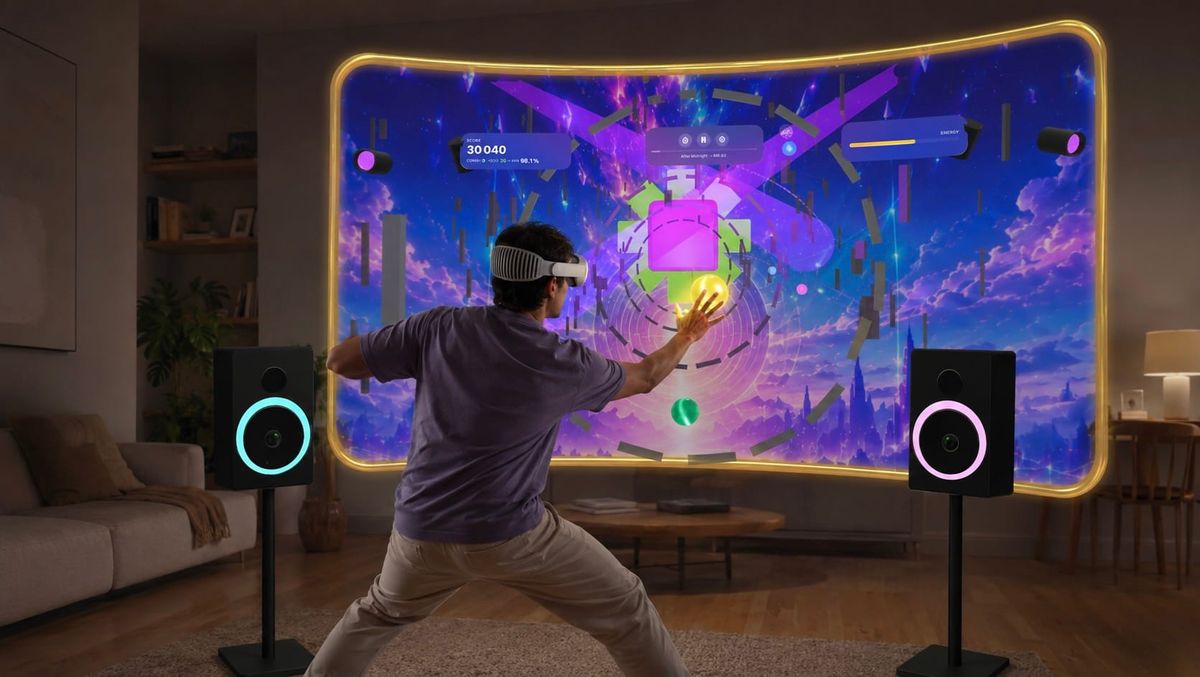
Gameplay takes place along a spectrum of spatial immersion. Users can choose to overlay the rhythmic action directly into their physical living spaces via mixed reality, or transport themselves into fully rendered, isolated virtual environments. The mechanics will feel instantly intuitive to veterans of the genre—drawing clear stylistic and functional inspiration from modern classics like Beat Saber. Players slice blocks and strike incoming orbs that fly toward them along predetermined spatial vectors, perfectly synced to the beat of the soundtrack.
Chronology: The Evolution of Procedural Rhythm Gaming
To fully appreciate the technological leap represented by Flow Chaser, it is essential to contextualize it within the broader history of interactive music entertainment. The dream of a video game capable of instantly parsing any piece of music and building a playable level on the fly is not new; it is a holy grail of game design that has taken nearly three decades to fully realize.
The Late 1990s: Masaya Matsuura and the Genesis of Vib Ribbon
The conceptual foundation of procedural rhythm gaming was laid in the late 1990s by legendary game creator Masaya Matsuura, best known for pioneering the rhythm genre with titles like PaRappa the Rapper. Working with his studio, NanaOn-sha, Matsuura conceptualized a game where the boundaries of the soundtrack were entirely boundless.
1999: The Sony PlayStation Breakthrough
This vision materialized in 1999 with the release of Vib Ribbon for the original Sony PlayStation. The game achieved technical wizardry by allowing players to pop out the game disc mid-session, insert virtually any audio CD of their choice, and play a procedurally generated vector-graphics platformer. Through inventive data interpretation and audio-buffering code, the PlayStation hardware analyzed the disc’s audio tracks, mapping out obstacles and rhythm cues based on frequency peaks and tempo markers.
So profound was this innovation—and the clever software engineering required to run it on primitive 32-bit hardware—that Sony secured a formal patent for the procedural music-analysis technique.
The 2010s: The Rise of Hand-Crafted VR Rhythms
As the video game industry transitioned into the era of virtual reality in the mid-2010s, rhythm games experienced a massive resurgence. Titles like Beat Saber dominated the market, proving the unmatched visceral thrill of swinging weapons in three-dimensional space to the beat of music. However, these modern hits largely abandoned the procedural generation of Vib Ribbon in favor of meticulously hand-charted levels. While hand-mapping produced superior, highly polished gameplay experiences, it severely bottlenecked content creation, making custom songs difficult to integrate legally or efficiently.

September 2026: visionOS 27 and Flow Chaser
Fast forward to the present day. Apple’s rollout of visionOS 27 introduces advanced, system-level on-device machine learning and audio processing capabilities. Seizing upon this operating system milestone, modern developers have finally resurrected and modernized the core philosophy of Vib Ribbon. Flow Chaser bridges the 27-year gap between Matsuura’s late-90s vision and modern spatial computing, leveraging neural engines powerful enough to instantly deconstruct complex audio files and map them into three-dimensional space without perceptible latency.
Supporting Data and Technical Architecture
The technical underpinnings of Flow Chaser rely heavily on the deep hardware-software integration unique to Apple’s ecosystem. Analyzing the hardware requirements, track distribution, and pricing reveals a carefully calculated product strategy tailored to early adopters of high-end spatial hardware.
Audio Library and File Support Breakdown
- Pre-bundled Content: 140 original tracks spanning electronic, rock, ambient, and hyperpop genres.
- Total Playtime: Over 7.5 hours of professionally composed background music.
- User Import Formats: Support for standard DRM-free audio files (such as MP3, AAC, and WAV).
- Analysis Engine: Utilizes visionOS 27’s native on-device music intelligence to process transient peaks, tempo maps, and frequency distribution.
Pricing and Accessibility
- Platform: Apple Vision Pro (Exclusive to visionOS 27 and later).
- Launch Price: $14.99 USD.
- Distribution Channel: Apple App Store for visionOS.
Unlike cloud-dependent applications that require server-side processing to analyze music tracks, Flow Chaser performs its audio parsing entirely on the Apple Vision Pro’s local silicon. This local processing ensures that user-imported tracks remain private, secure, and immune to cloud latency issues. The M-series chips inside the headset handle the heavy lifting of spatial audio positioning, environment rendering, and real-time level geometry generation simultaneously, maintaining the high framerates required to prevent motion sickness in mixed reality.
Official Responses and Industry Implications
The release of Flow Chaser alongside visionOS 27 has sparked widespread discussion across both the spatial computing and traditional gaming sectors. While Apple has long positioned the Vision Pro as a productivity and media consumption device, third-party software like Flow Chaser underscores the platform’s viability as an elite gaming platform.
Developer and Platform Perspectives
Industry analysts note that Apple’s intentional inclusion of system-level tools—such as advanced audio intelligence frameworks in visionOS 27—signals a clear shift toward empowering third-party developers. By providing standardized machine learning and audio analysis tools at the operating system level, Apple reduces the engineering burden on indie studios, allowing them to focus on unique spatial interactions rather than writing low-level parsing algorithms from scratch.
Early reviews from spatial computing specialists highlight the seamless transition between mixed reality and fully immersive modes. By allowing users to anchor the rhythm track to their actual living room furniture or escape into hyper-stylized digital universes, the game demonstrates the versatility of the Vision Pro’s passthrough and display technologies.
Cultural and Historical Repercussions
For veterans of the gaming industry, Flow Chaser represents a vindication of Masaya Matsuura’s decades-old philosophy. For years, the industry leaned away from procedural generation in music games due to the algorithmic challenge of making machine-generated levels feel organic and fun rather than erratic and random.
Modern machine learning models, however, have bridged the gap. By understanding musical phrasing, drop structures, and vocal cues rather than simply reacting to raw volume spikes, Flow Chaser manages to evoke the spirit of Vib Ribbon while delivering a modern, high-fidelity spatial experience.
Conclusion: The Future of Spatial Music Games
Flow Chaser is more than just a $14.99 rhythm game for a niche headset; it is a technological milestone that closes a loop nearly three decades in the making. By taking the procedural audio-mapping dreams of Vib Ribbon and supercharging them with the on-device intelligence of visionOS 27, developers have unlocked a new paradigm for interactive music.
As the Apple Vision Pro ecosystem matures and developers continue to push the boundaries of what spatial operating systems can achieve, applications like Flow Chaser prove that the future of gaming in mixed reality will be defined not just by what developers build for us, but by how seamlessly our own personal digital lives can be woven directly into the virtual fabric.

