

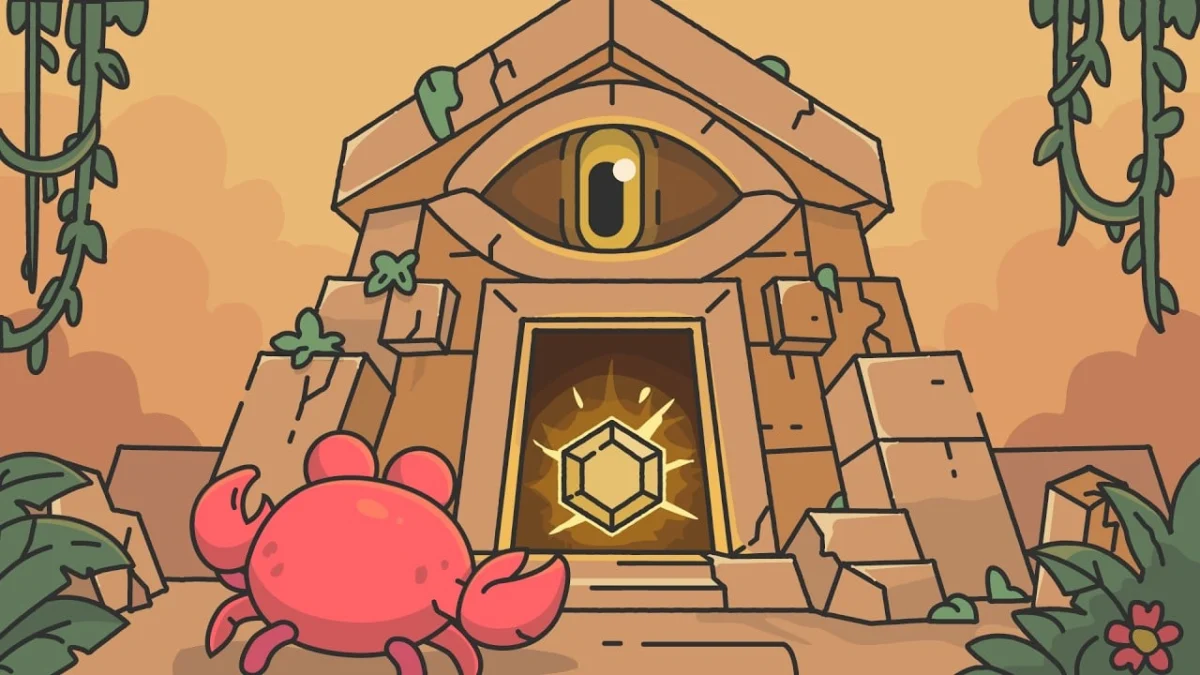
In an era dominated by live-service giants, endless advertisements, and aggressive microtransactions, the arrival of Grabby Crab—the latest title from solo developer Tepes Ovidiu—serves as a refreshing testament to the enduring appeal of pure, mechanics-driven puzzle design. Launched today on mobile platforms, Grabby Crab is a sophisticated path-planning adventure that demands patience, spatial reasoning, and a sharp eye for detail. By blending the grid-based complexity of classics like Stephen’s Sausage Roll with an charming, thematic veneer, Ovidiu has crafted an experience that challenges the intellect without the need for intrusive monetization.
Main Facts: The Anatomy of a Mobile Puzzle Challenge
Grabby Crab places players in the role of an ambitious crustacean whose primary motivation is the acquisition of shimmering gemstones hidden deep within cursed, ancient temples. While the premise is simple—navigate a grid-based chamber, claim the treasure, and reach the exit portal—the execution is anything but.
The core gameplay loop centers on the fragility of the environment. The temple floors are inherently unstable; tiles may crack under pressure, shatter upon contact, or vanish entirely, effectively sealing off routes that were previously viable. Players must meticulously calculate their pathing, as a single ill-considered move can lead to being stranded in an inescapable corner of the chamber.
Key features of the game include:
- Grid-Based Complexity: A scaling difficulty curve that introduces new mechanics as the player advances.
- Environmental Hazards: Ancient guardians that actively obstruct, mark, or destroy parts of the playing field.
- Curse and Relic Systems: Gem curses introduce rule-bending variables, while relics provide the player with tools to manipulate or restore the environment.
- Premium Integrity: A strictly ad-free, offline-capable experience that respects the player’s time and immersion.
Chronology: The Long Road from Conception to Release
The development cycle of Grabby Crab was a marathon, not a sprint. For a solo developer, the transition from concept to final product is often a journey of attrition, and for Ovidiu, this project represented one of his most significant technical hurdles to date.
Early Development and Ideation
The project began as an exploration of path-planning mechanics. Ovidiu, whose portfolio includes titles such as Almost Out of Mana, Is This Yours?, and the acclaimed Cessabit: a memory game, sought to move away from his previous work and into the realm of "hard-logic" puzzles. Unlike Cessabit, which focused on cognitive retention and pattern recognition, Grabby Crab was designed to be a spatial exercise.
The Challenge of Level Design
In interviews regarding his development philosophy, Ovidiu has frequently cited level design as the "greatest bottleneck" in his creative process. While the coding of game logic—the way tiles break or guardians move—is a task of mathematical precision, designing levels that feel fair while remaining challenging proved to be an exhaustive endeavor. Each level had to be iterated upon dozens of times to ensure that the solution was logical and satisfying, rather than frustratingly obtuse. This iterative process required months of internal testing to strip away "dead ends" that were not intended by the design, ensuring that every failure feels like a learning opportunity rather than a design flaw.
Supporting Data: Why Path-Planning Matters
To understand the appeal of Grabby Crab, one must look at the lineage of the "path-planning" genre. Historically, this sub-genre of puzzle games relies on the concept of "consequence-heavy movement." In games like Stephen’s Sausage Roll or the legendary Sokoban series, the player is essentially participating in a conversation with the designer. The designer places a trap; the player finds a way around it.
Grabby Crab elevates this by introducing dynamic hazards. Data gathered from the early access phases of the game suggests that players spend an average of six to eight minutes per puzzle in the mid-to-late game stages. This high "dwell time" indicates that the game successfully avoids the trap of mindless tapping, instead forcing the player into a state of "flow" where they must mentally simulate the result of every move before executing it.
Furthermore, the lack of a timer is a deliberate design choice supported by the developer’s intent to foster a "meditative state." By removing the artificial pressure of a countdown, the game invites the player to treat each level as a discrete logical problem, enhancing the sense of accomplishment once the exit portal is reached.
Official Responses and Developer Philosophy
In communication regarding the launch, Tepes Ovidiu has been clear about his stance on the state of the mobile gaming market. "The goal was to create something that stands on its own," Ovidiu noted. "Too many mobile games today are designed around retention metrics and ad-revenue loops. With Grabby Crab, I wanted to return to the idea of a ‘product’—a complete, finished experience that you buy once and own forever."
This philosophy explains the decision to bypass the "Free-to-Play" (F2P) model entirely. By opting for a premium price point of $2.99, Ovidiu is signaling to his audience that the game’s value lies in its quality and craftsmanship, not in its ability to generate micro-transactions. This is a bold move in an industry that often views premium mobile titles as a dying breed. However, Ovidiu’s track record with Cessabit suggests that there is a significant, loyal audience willing to pay for premium puzzle experiences that offer high-quality art and sound design without the intrusion of third-party tracking.
Implications: A Shift in the Mobile Paradigm?
The launch of Grabby Crab comes at a pivotal time for mobile gaming. As users grow increasingly fatigued by "freemium" models and predatory psychological manipulation in games, titles like Grabby Crab are finding a niche as "palate cleansers."
The Return of the Premium Indie
If Grabby Crab succeeds commercially, it serves as a data point for other independent developers that premium, offline-first games are still a viable path to profitability. The game’s design choices—offline play, zero tracking, and a one-time purchase—are not just moral stances; they are competitive advantages for a specific demographic of gamers who travel, have limited data, or simply prefer to play games without the constant noise of the modern internet.
Future Challenges for Solo Developers
Despite the promise of this model, the challenge for developers like Ovidiu remains discoverability. Without the massive marketing budgets of large corporations, premium titles often struggle to gain visibility on the Google Play Store. The success of Grabby Crab will likely depend on word-of-mouth, critical reviews, and the strength of the developer’s established fan base.
Conclusion: Is Grabby Crab Worth the Plunder?
For those who find themselves missing the golden age of puzzle gaming, or for anyone who enjoys a game that respects their intellect, Grabby Crab is an essential download. It is a tight, well-constructed experience that turns the mundane act of moving a crab across a grid into a high-stakes tactical mission.
The game is currently available on the Google Play Store for $2.99. Whether you are a fan of the developer’s previous works or simply someone looking for a new mental challenge for your morning commute, Grabby Crab offers a level of polish and intentionality that is rarely seen in the current mobile landscape.
As the developer continues to support the title, it will be fascinating to see if further updates introduce even more complex mechanics or if the current suite of temple curses and relics is enough to satisfy the community. Regardless, for now, the crab has stolen the gem, and the path to the exit is open. The question remains: do you have the patience to guide it home?
If you’ve taken the plunge into the ancient temples of Grabby Crab, let us know your thoughts in the comments below. Which level proved to be the most frustrating? We are eager to hear about your experience. Stay tuned for our next feature, where we will be covering the pre-registration details for the highly anticipated CookieRun: Crumble.

