

By Francesco Cacciatore
Published October 3, 2026
Main Facts
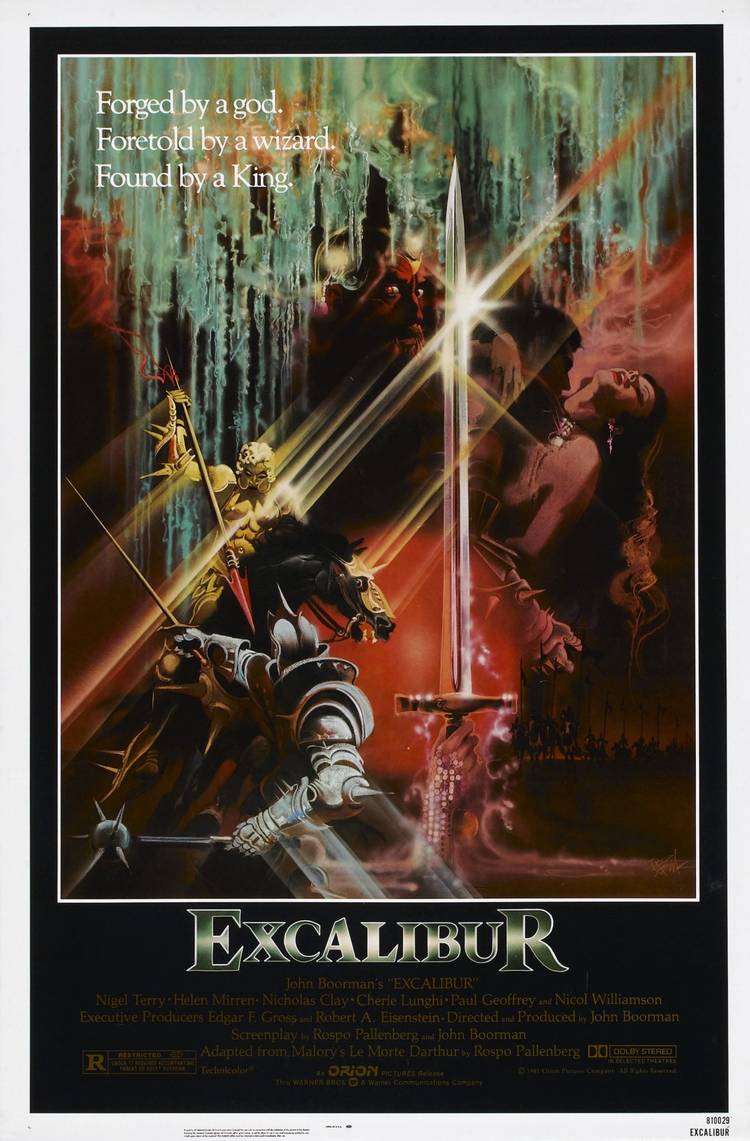
Released by Warner Bros. Pictures, British director John Boorman’s Excalibur remains a monumental achievement in fantasy and historical filmmaking. Over four decades after its 1981 theatrical debut, the film is celebrated not merely as a retelling of the Arthurian legend, but as a rare cinematic triumph: a motion picture that successfully translates raw, ancient mythology into a visual medium without modernizing, diluting, or watering down its primordial roots.
Drawn primarily from Thomas Malory’s late-15th-century compilation of chivalric romance and folklore, Le Morte d’Arthur, the film rejects conventional, linear narrative pacing. Instead, Excalibur operates as a sequence of grand theatrical tableaus. It embraces the disjointed flow, symbolic character transformations, and stark time jumps characteristic of epic poetry like Homer’s Iliad and Odyssey.
Far from being a standard sword-and-sorcery adventure, the film’s conceptual foundation lies deeply embedded in comparative mythology. It draws heavily on James George Frazer’s seminal anthropological study The Golden Bough, interweaving the archetype of the Sacred King with the Arthurian Fisher King. In Boorman’s vision, when King Arthur falls sick or loses his way, the very land withers and weeps in sympathetic resonance.
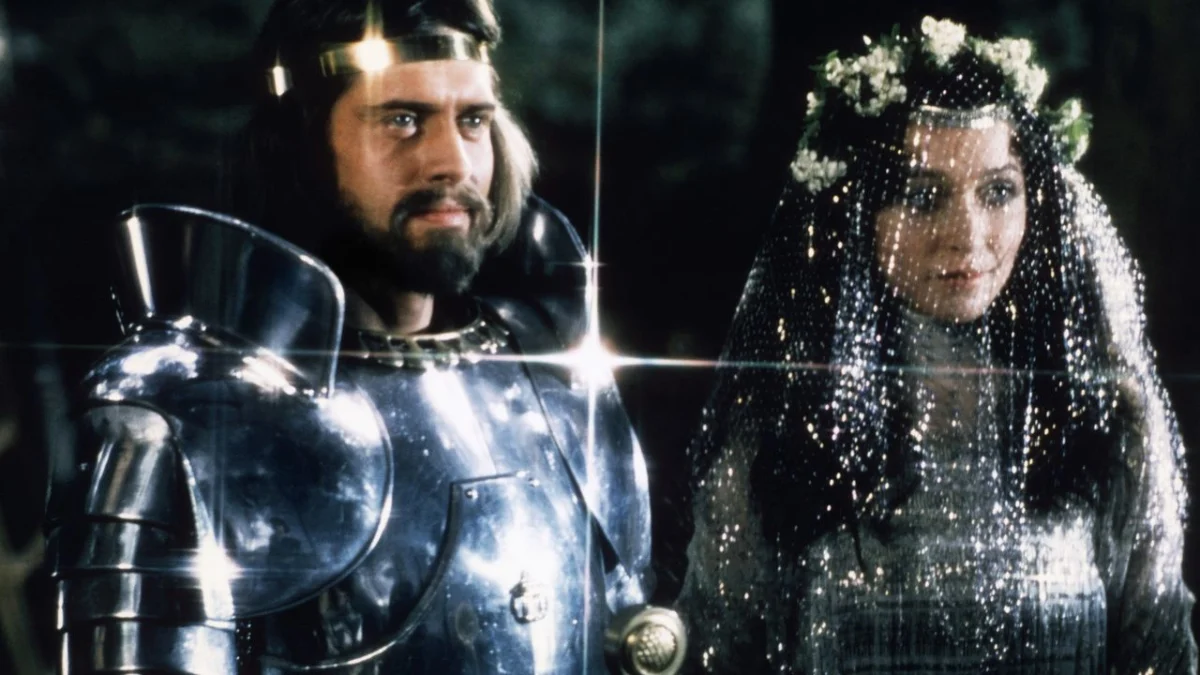
Today, Excalibur is studied as much by art historians and theologians as it is by cinephiles. Its striking visual grammar—characterized by Pre-Raphaelite aesthetics, gleaming green-lit armor, and heavy reliance on the spiritual and dramatic properties of natural light—has cemented its legacy as an uncompromising auteur-driven masterwork.
Chronology: From Middle-earth Ambitions to Arthurian Reality
The genesis of Excalibur is one of the most fascinating trivia points in modern cinema history, stretching from a canceled blockbuster pitch to the resurrection of a filmmaker’s long-dormant passion project.

- The Pre-Production Phase (Mid-1970s): Initially, director John Boorman and co-writer Rospo Pallenberg were contracted by United Artists to adapt J.R.R. Tolkien’s monumental high-fantasy epic, The Lord of the Rings. The duo spent months laboring over an exhaustive, ambitious script designed to pack Tolkien’s dense mythology into a single cinematic event.
- The Cancellation: United Artists ultimately scrapped Boorman’s Lord of the Rings adaptation, deeming the projected budget and technical requirements far too high for the era’s cinematic landscape. (The property later found life in Ralph Bakshi’s 1978 animated adaptation).
- The Pivot to Merlin and Arthur: Refusing to let his creative output go to waste, Boorman salvaged the expansive world-building, design philosophies, and mythological motifs he had conceived for Middle-earth. He channeled them into an older, personal ambition: a feature film centered around Merlin and the legends of King Arthur.
- April 1981: Excalibur officially premieres in theaters courtesy of Warner Bros. Pictures. Featuring a cast that included Nigel Terry as Arthur, Cherie Lunghi as Guenevere, Helen Mirren as Morgan le Fay, and a breakout role for Liam Neeson as Sir Gawain, the film polarized contemporary critics upon arrival.
- The Decades Following (1981–2026): While initial critical reception noted uneven pacing and theatrical dialogue, the film steadily grew in stature over the decades. It established a flourishing sub-genre of medieval fantasy while carving out a unique space as an academic and artistic touchstone.
Supporting Data and Production Insights
To understand Excalibur is to understand Boorman’s distinct philosophy regarding historical versus mythical truth. In a 1981 interview with journalist Harlan Kennedy, Boorman articulated his core objective:
"The film has to do with mythical truth, not historical truth."
Discussing the world-building carried over from his aborted Tolkien project, Boorman added:
"What I’m doing is setting it in a world, a period, of the imagination. I’m trying to suggest a kind of Middle-earth, in Tolkien terms… It’s a contiguous world. It’s like ours but different. I want it to have a primal clarity, a sense that things are happening for the first time. Landscape and nature and human emotions are all fresh."
Art historian Jean-Marc Elsholz, in a detailed analysis of the film’s visual motifs, explored Excalibur through the lens of a "theology of light." According to Elsholz, the shimmering, iridescent green light cast across the knights’ armor—as well as the eerie glow emanating from the Lady of the Lake—is not mere stylistic flair. Instead, it serves as a visual reflection of a higher spiritual frequency.
However, Boorman notably secularized and synthesized various traditions. While traditional Arthurian lore maps the Holy Grail onto the Christianization of Britain, Boorman collapses the Sacred King, the Fisher King, and the Holy Grail into the singular, tragic figure of King Arthur. When Perceval finally achieves the Quest and understands the secret of the Grail, the traditional Christian chalice image gives way to the image of the King himself—shifting the symbol from religious piety to absolute political authority and sovereignty.

Official Responses and Critical Reception
When Excalibur debuted in the spring of 1981, it met with a complex array of reviews from prominent critics of the era, showcasing the sharp divide between traditional narrative expectations and Boorman’s avant-garde mythological approach.
Renowned critic Roger Ebert noted that the film could easily disorient spectators, pointing out its idiosyncratic rhythm and stylized, almost operatic dialogue. Similarly, reviewers at publications like The New Yorker criticized the production for frequent time jumps that created character inconsistencies and a perceived lack of sustained dramatic intensity.
Yet, time has validated Boorman’s choices. What contemporary reviewers viewed as disjointed plotting is now recognized as a deliberate effort to mimic the episodic, oral-tradition structure of folklore.
Furthermore, political and cultural commentators of the 1980s quickly latched onto the film’s themes of leadership, land degradation, and the restoration of order. Because Arthur’s authority becomes inextricably linked to the vitality of the state—and because the restoration of spring coincides with the final, militaristic charge of the remaining knights—Excalibur has frequently been subjected to socio-political analysis, with some critics viewing it through the lens of Thatcher-era conservative philosophy, while others view it as a pure eco-mythological tragedy.
Implications for Modern Fantasy and Cinematic Legacy
Forty-five years after its theatrical release, Excalibur casts a long and unmistakable shadow over contemporary media, television, and film.
1. Breaking the Mold of Modern Screenwriting
Modern fantasy cinema, heavily influenced by serialized television (Game of Thrones, The Lord of the Rings: The Rings of Power) and cinematic universes, relies on hyper-rationalized world-building, extensive exposition, and psychological realism. Excalibur takes the exact opposite approach. By prioritizing visceral imagery, symbolic weight, and poetic cadence over step-by-step logic, Boorman proved that audiences can emotionally connect with a story even when its narrative logic mirrors a waking dream.
2. Redefining Visual Storytelling
The film’s iconic set pieces remain masterclasses in cinematic composition. Moments such as King Arthur discovering Lancelot and Guinevere sleeping chastely in the forest with Excalibur driven into the earth between them—or the breathtaking final charge of the Knights of the Round Table set to the thunderous, apocalyptic orchestration of Carl Orff’s Carmina Burana—have been referenced, homaged, and studied by generations of filmmakers.
3. The Bridge Between Academia and Cinema
Few genre films achieve the rare distinction of being standard viewing material in both film schools and university departments of comparative literature and medieval studies. By treating its source material not as a disposable adventure plot, but as a living, breathing cultural artifact, Excalibur demonstrated that cinematic fantasy could achieve high art status without sacrificing visceral entertainment value.
As modern audiences continue to revisit the film—currently available for rental on digital platforms like Prime Video and Apple TV—Excalibur stands resilient against the passage of time. It remains a testament to what can be achieved when a singular director dares to bring uncompromised myth directly to the silver screen, allowing the primal clarity of legend to live on for new generations.

