

Main Facts
Running combat encounters in Dungeons & Dragons has long been a double-edged sword for Dungeon Masters (DMs). While crafting a compelling narrative and building immersive worlds come naturally to many storytellers, orchestrating satisfying, balanced combat remains one of the toughest hurdles in the hobby. Official rulebooks and Challenge Rating (CR) guidelines frequently fall short when attempting to challenge modern adventuring parties without devolving into either trivial skirmishes or agonizing slogs.
To mark the October 6 release of Remonstered! The Monsters Know What They’re Doing—the expanded and revised edition of Keith Ammann’s seminal guide to tactical monster behavior—Polygon partnered with the ENnie Award-winning designer for an exclusive project. Ammann was tasked with engineering a brand-new, bespoke Dungeons & Dragons fifth-edition (5e and 5.5e) monster tailored specifically to challenge a custom, close-range-focused level 5 party in a high-concept homebrew setting.
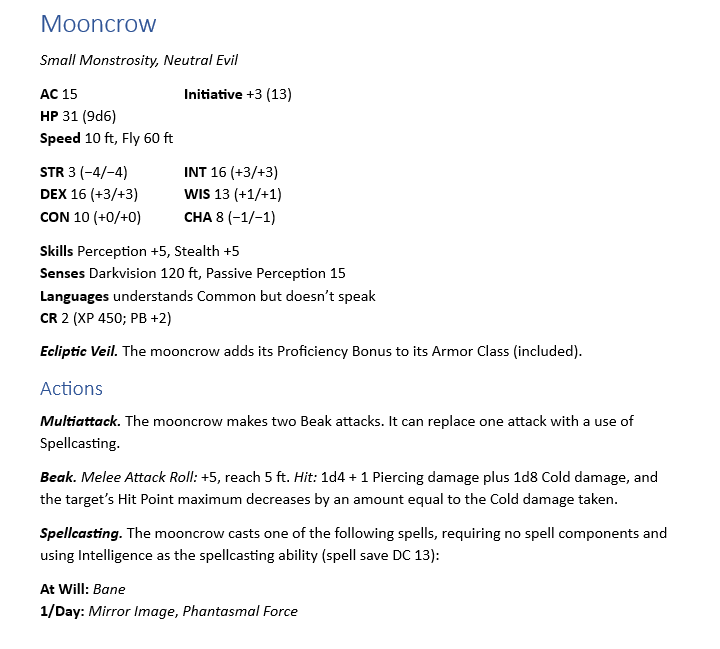
The result of this collaboration is the Mooncrow, a terrifying, eerie fusion of avian predator, illusion magic, and atmospheric dread. Designed to exploit player weaknesses while pushing a tactical party to its absolute limits, the Mooncrow represents a masterclass in modern tabletop roleplaying game (TTRPG) encounter design.
Chronology: The Anatomy of an Exclusive Monster
The creation of the Mooncrow followed a rigorous design pipeline, merging the atmospheric realities of a unique setting with granular mechanical balance.
Step 1: Establishing the Setting and Party Composition
The homebrew campaign world provided to Ammann features a permanent, supernatural solar eclipse. In this bleak setting, sunlight and warmth are vanishingly scarce, nature mutates unpredictably, and intelligent species survive in a state of constant war against hostile wilderness horrors.
The player character (PC) party consists of four level 5 adventurers:
- A Path of the World Tree Barbarian
- A Battlemaster Fighter
- A Way of Shadow Monk
- A Support-focused Custom Bard
Ammann quickly identified the party’s critical vulnerability: a heavy specialization in close-quarters physical combat combined with a distinct lack of ranged options and spellcasting versatility. Furthermore, based on typical player optimization trends, he correctly assumed that Intelligence served as their collective "dump stat," making them prime targets for illusions and psychological warfare.
Step 2: Ideation and Mechanics
Drawing inspiration from classic entities like the Cloaker, Ammann conceptualized the Mooncrow as a flying monstrosity with feathers the color of inky twilight, allowing it to blend seamlessly into the permanently eclipsed sky.

To fit the CR 2 framework appropriate for groups of level 5 characters (according to updated guidelines in the 2024 Dungeon Master’s Guide), Ammann made specific mechanical adjustments:
- The Ecliptic Veil: Rather than burdening players with an excessively high Armor Class (AC) that causes combat frustration, he set the AC to a moderate 15 using a special thematic feature while keeping its hit points lean, mirroring a lower CR creature to avoid combat drags.
- Cold-Sapping Strikes: Each multi-attack round deals physical damage paired with biting cold damage, simulating the chilling drop in temperature associated with real-world solar eclipses. Crucially, this environmental cold damage bypasses the Barbarian’s standard Rage damage resistances.
- Innate Spellcasting: To counter close-range melee specialists, the Mooncrow possesses a curated suite of spells. Bane (1st level) systematically lowers enemy attack rolls by 1d4. Mirror Image (2nd level, non-concentration) creates multiple duplicates, drastically increasing survivability without bloating health pools. Phantasmal Force (2nd level) targets the party’s vulnerable Intelligence scores directly.
Supporting Data: Encounter Mathematics and Resource Management
Designing monsters requires an intimate understanding of encounter-building math. According to modern Dungeons & Dragons encounter design metrics for a party of four level 5 characters, a moderate-difficulty challenge spans a total Experience Point (XP) budget between 2,000 and 3,000 XP.
Using The Lazy DM’s Forge of Foes by Teos Abadia, Scott Fitzgerald Gray, and Mike Shea as a reference point for statistical benchmarks, Ammann targeted a Challenge Rating (CR) of 2 for the Mooncrow.
- A CR 2 creature yields roughly 450 XP.
- Deploying a flock of five to six Mooncrows hits the sweet spot of the moderate XP threshold.
- This approach avoids the administrative nightmare of managing 10 to 15 lower-CR creatures while delivering a multi-target tactical threat.
When deployed in actual play, the mathematical synergy of the flock became immediately apparent. The use of Mirror Image multiplied the perceived threat on the battlefield, making a flock of five monsters look and feel like an overwhelming cloud of twenty entities.
The aftermath of the playtest encounter underscored the precise calibration of the design:
- Both the Barbarian and the Bard were knocked unconscious multiple times.
- The Fighter relied on high base AC to endure the onslaught.
- The Monk utilized high mobility and the Darkness spell to mitigate incoming damage.
- By the end of the combat, the party’s healing potions and spell slots were entirely exhausted, forcing a high-stakes tactical dilemma: risk a dangerous wilderness Long Rest or push forward with a vulnerable Short Rest.
Official Responses and Expert Insights
Keith Ammann’s work has long been celebrated within the TTRPG community for demystifying monster psychology. Speaking on the philosophy behind Remonstered! and his previous title Making Enemies—which guides DMs through custom monster design—Ammann emphasizes that monsters should never act as mindless bags of hit points for players to chop through.
"Ammann’s essential book The Monsters Know What They’re Doing has helped countless DMs prepare combat encounters more effectively by helping DMs understand their monster’s approach to combat and develop battle plans before the session begins," notes the critical consensus surrounding his pedagogical approach to game mastering.
By shifting the focus from arbitrary mathematical scaling to ecological behavior, tactical doctrines, and environmental synergy, Ammann provides DMs with actionable mental frameworks. His step-by-step monster creation methodology instructs creators to view creatures not merely as obstacles, but as narrative catalysts designed to let player characters showcase their unique mechanical strengths.
Implications for the Future of Dungeon Mastering
The release of Remonstered! The Monsters Know What They’re Doing on October 6 arrives at a crucial inflection point for the Dungeons & Dragons ecosystem. As the community transitions between fifth edition and its modern 5.5 updates, DMs continually voice frustrations regarding official adventure modules and sourcebooks that lack robust tactical instructions for running adversaries effectively.
The enthusiastic reception of custom creations like the Mooncrow highlights a broader industry trend: independent creators and third-party designers are increasingly stepping in to provide the operational toolkits that official rulebooks omit. For both novice game masters struggling to balance challenge ratings and veteran DMs seeking to inject fresh tactical depth into their campaigns, resources focused on monster intent and behavioral logic are no longer optional luxuries—they are essential components of modern campaign preparation.
As demonstrated by the psychological warfare of the Mooncrow’s illusion magic and the chilling reality of its environmental damage, intelligent encounter design transforms standard dice-rolling into memorable, narrative-driven experiences that players discuss long after the session has ended.

