

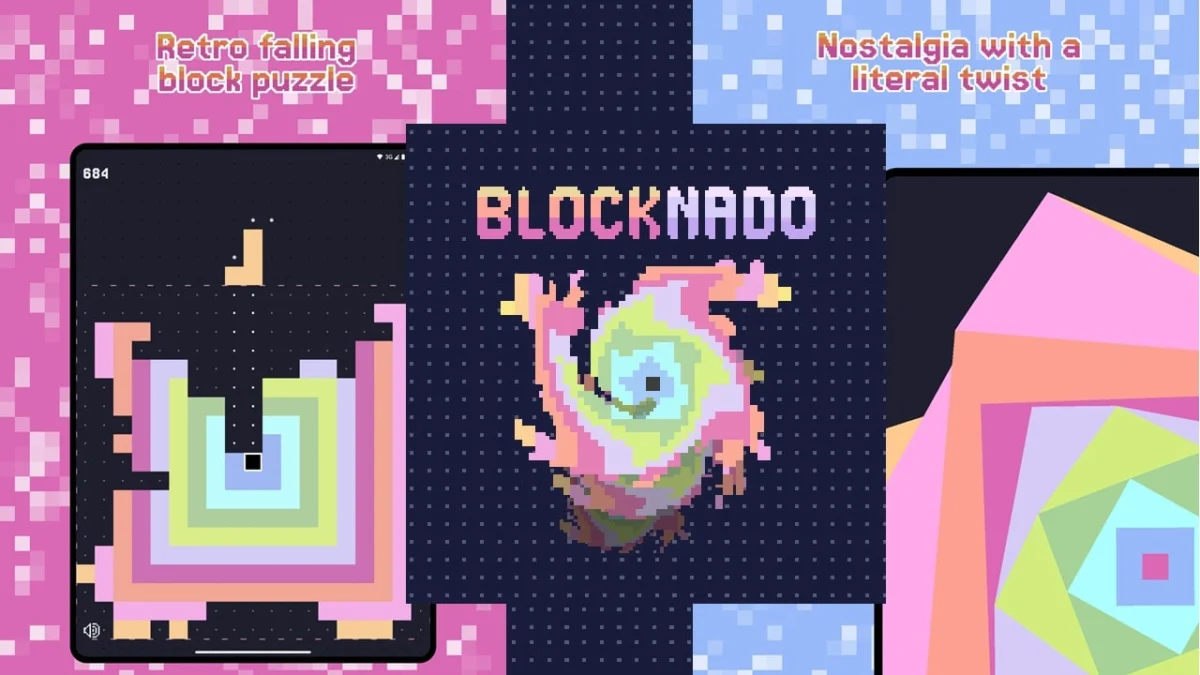
In the saturated landscape of mobile puzzle games, the "falling block" genre has remained largely static since the mid-1980s. While countless iterations of Tetris have graced app stores, few developers have dared to fundamentally alter the core mechanics of the formula. Reto Apps, an emerging developer in the mobile space, has recently disrupted this stagnation with the release of Blocknado: Retro Block Puzzle. Moving away from the linear, bottom-to-top stacking conventions, Blocknado introduces a centrifugal, physics-based approach to puzzle-solving that demands both spatial awareness and tactical momentum management.
Main Facts: A New Axis for Puzzle Enthusiasts
Blocknado: Retro Block Puzzle is an innovative title that reimagines the classic brick-stacking paradigm. Instead of maneuvering blocks into a rectangular well, players work toward a centralized square core. The goal is to construct concentric rings around this core; once a full perimeter is completed, the ring collapses, pulling the outer layers inward and potentially triggering chain reactions.
The game’s primary differentiator is its kinetic engine. Players manipulate blocks via a gesture-based interface—dragging pieces across the board, tapping to rotate them, and flicking them toward the core. The title is currently available on the Google Play Store, operating on a free-to-play model with a singular in-app purchase option available for users who wish to permanently remove advertisements. Notably, the game supports offline play, catering to commuters and players without consistent data access.
Chronology of Development and Design Philosophy
The development of Blocknado by Reto Apps follows a trend of "minimalist complexity" seen in modern indie mobile gaming. The design philosophy was centered on the concept of "momentum-based puzzle solving."
The Evolution of the Core Loop
During the initial design phase, the team at Reto Apps identified a common frustration in traditional block puzzlers: the lack of agency once a piece is placed. In Blocknado, the development team focused on the "fling" mechanic. By mapping the force of a player’s swipe to the physical state of the board, the game transformed from a static stacking simulation into a dynamic environment.
The Launch Phase
Upon its release, the game garnered immediate attention for its unique "rotating floor" mechanic. Unlike traditional puzzle games where the board is fixed, Blocknado allows for a 90-degree rotation of the floor if a piece is thrown with sufficient velocity. This forced players to rethink their strategy, moving from simple pattern recognition to predictive physics.
Supporting Data: Understanding the Mechanics
To excel in Blocknado, players must master the relationship between movement, momentum, and spatial geometry. The game offers a nuanced system that rewards deliberate play over frantic action.
The Physics of the "Flick"
The core mechanic of the game revolves around the distinction between a "drop" and a "flick."
- Passive Placement: When a player drops a piece gently, it settles into the nearest available slot without impacting the orientation of the board. This is the tactical choice for players building specific patterns on one side of the core.
- Kinetic Rotation: A forceful flick triggers the game’s "Blocknado" effect. If the input exceeds a certain velocity threshold, the board rotates 90 degrees upon the piece’s impact. This allows players to shift the entire weight of their build-up to a different quadrant, which is essential for clearing obstacles or completing rings that were previously out of reach.
Scoring and Progression
The game utilizes a tiered scoring system that accounts for efficiency and risk-taking. Players can discard unwanted pieces by flicking them off the edge, though this incurs a penalty to their score. This creates a high-stakes environment where every move must be weighed against the potential for a catastrophic misalignment.
Game Modes: Classic vs. Puzzle
Reto Apps has structured the content to cater to both casual players and those seeking a more structured, cerebral challenge.
The Classic Experience
The "Classic" mode is a nod to the arcade roots of the genre. It is an endless, score-chasing mode that increases in speed and complexity as the player’s score climbs. The inclusion of a global leaderboard on the home screen adds a layer of competitive intensity, encouraging players to refine their strategies to reach the top ten rankings.
Puzzle Mode and Difficulty Bands
For those who prefer a more curated experience, the "Puzzle" mode offers authored levels designed to test specific skills. These levels are categorized into four distinct bands:
- Easy: Introduces the core concepts of ring building.
- Medium: Requires basic knowledge of floor rotation.
- Hard: Challenges players with limited space and restricted piece types.
- Wild: A high-difficulty tier that forces players to utilize every mechanic, including complex chain reactions.
Progression in this mode is measured via stars. While one or two stars are awarded for meeting basic goals, the elusive three-star rating requires an "identical match"—a perfect execution of the level’s intended solution.
Official Responses and Developer Intent
In correspondence regarding the release, representatives from Reto Apps highlighted that their goal was not to "replace" classic titles, but to provide a modern, tactile alternative. "We wanted the player to feel the weight of the blocks," the development team noted in early press briefings. By integrating haptic feedback and fluid animations, the developers aimed to make the act of rotating the board feel as satisfying as the sound of a row collapsing in a classic game.
The decision to keep the game free-to-play with a single, permanent ad-removal purchase was a deliberate choice to maintain the integrity of the player experience. By avoiding predatory microtransactions or consumable power-ups, Reto Apps has positioned Blocknado as a "premium" experience disguised as a free download, prioritizing player retention and brand loyalty over short-term monetization.
Implications for the Mobile Puzzle Genre
The release of Blocknado signals a potential shift in how developers approach puzzle game design. By adding physics-based variables to a grid-based system, Reto Apps has proven that there is still significant design space within established genres.
The Shift Toward "Kinetic" Puzzles
Blocknado joins a growing list of titles that move away from the "static grid" model. Future developers are likely to look at this implementation of momentum—where the player’s input method directly influences the game world’s geometry—as a blueprint for creating more immersive mobile experiences.
Accessibility vs. Mastery
The game’s dual-track approach—Classic for casual play and Puzzle for mastery—highlights a crucial lesson in modern game design. By providing a low barrier to entry while maintaining a high skill ceiling, Blocknado appeals to both the casual commuter and the "hardcore" puzzle enthusiast. This balance is often missing in mobile games, which tend to lean too heavily into either brain-numbing simplicity or frustrating, pay-to-win difficulty.
The Role of Offline Play
In an era where "always-online" requirements are the norm, the decision to allow full offline functionality for Blocknado is a significant, if understated, feature. It acknowledges the realities of the mobile user base—people playing on subways, in airplanes, or in areas with spotty connectivity. This accessibility ensures that Blocknado remains a viable pastime regardless of the player’s environment.
Final Thoughts: Why Blocknado Matters
Blocknado: Retro Block Puzzle is more than just a modern take on an old favorite; it is a masterclass in adding depth to simplicity. By shifting the focus from rows to rings and from static placement to kinetic rotation, Reto Apps has breathed new life into a stagnant genre.
Whether you are looking to kill time in the Classic endless mode or challenge your brain with the intricate demands of the Wild difficulty band, Blocknado offers a refreshing, tactically dense experience that respects the player’s intelligence. For those tired of the same old block-stacking routines, this title provides the "twist" that the genre has desperately needed for years. It is a testament to the fact that, even in a digital world of infinite possibilities, sometimes the best innovation comes from turning the floor beneath your feet.
For those interested in exploring further developments in the mobile gaming sphere, be sure to keep an eye on our ongoing coverage of industry updates, including recent expansions like RuneScape’s Havenhythe Part II.

