

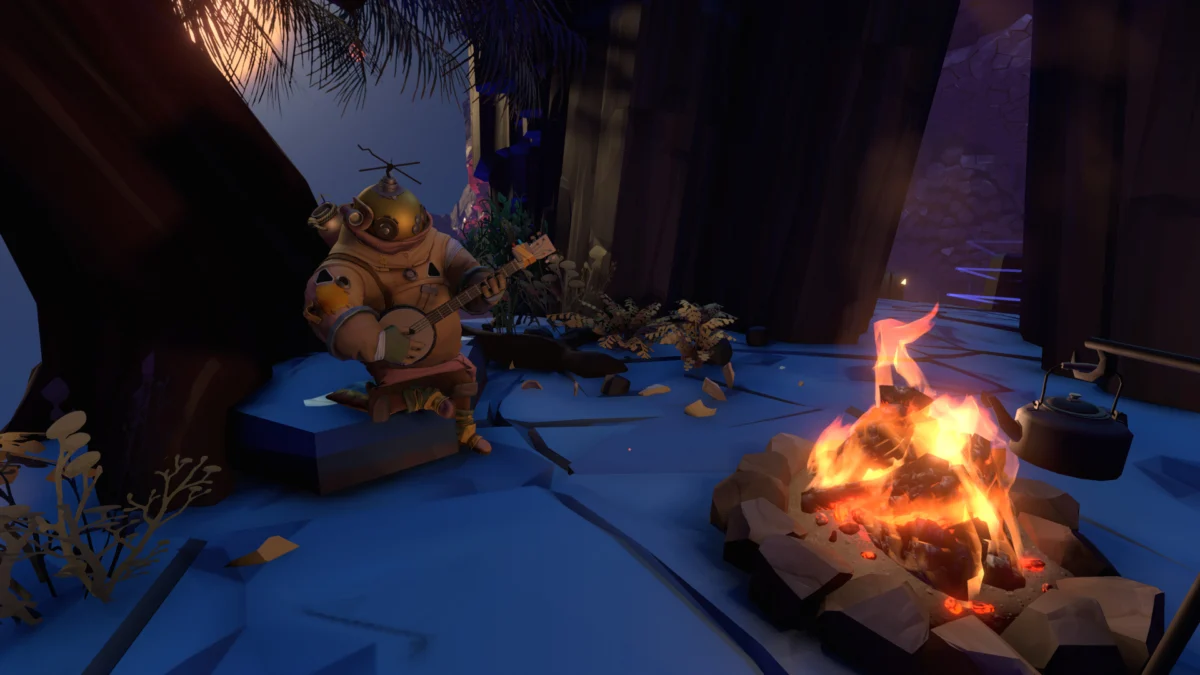
Since its debut in 2019, Mobius Digital’s Outer Wilds has ascended from a cult indie darling to a permanent fixture in the pantheon of essential video games. Often cited in the same breath as Portal or The Legend of Zelda: Breath of the Wild for its revolutionary approach to player agency and discovery, the game continues to captivate new audiences. As we look back from the vantage point of the present, it is clear that Outer Wilds is more than just a game; it is a profound exploration of curiosity, mortality, and the relentless march of time.
The Core Experience: What Is Outer Wilds?
At its heart, Outer Wilds is an open-world mystery game set within a hand-crafted solar system trapped in an endless 22-minute time loop. Players assume the role of an unnamed recruit for Outer Wilds Ventures, a fledgling space program tasked with exploring a series of bizarre, volatile planets to uncover the secrets of an extinct alien civilization known as the Nomai.
The game’s brilliance lies in its lack of traditional progression systems. There are no character levels, no weapon upgrades, and no experience points. Instead, the "progression" is entirely knowledge-based. The player learns how to navigate treacherous environments—such as the crumbling, hollow planet of Brittle Hollow or the sand-drowning twin worlds of Ember and Ash—by understanding the physics and history of the solar system itself. When the 22-minute timer concludes, the sun goes supernova, resetting the loop and forcing the player to start anew, armed only with the information they gathered in their previous run.
Chronology: A Trajectory of Discovery
The journey of Outer Wilds is a testament to the power of passion projects. The concept originated as a thesis project by Alex Beachum at the University of Southern California’s Interactive Media & Games Division. What began as a prototype exploring the "what if" of space travel and temporal mechanics eventually blossomed into a fully realized commercial title.
- 2012–2015: Development begins under the guidance of Mobius Digital, with the team focusing on the core concept of a solar system that evolves in real-time.
- 2015: A successful crowdfunding campaign on Fig garners significant attention, proving there is a hungry market for non-linear, narrative-driven exploration.
- May 2019: Outer Wilds launches on PC (via the Epic Games Store) and Xbox One. The reception is immediate and overwhelming, with critics praising its unique approach to game design.
- 2019–2020: The game receives numerous "Game of the Year" accolades, including the top prize at the 2020 BAFTA Games Awards.
- 2021: The release of the Echoes of the Eye expansion provides a masterclass in how to add depth to an already complete narrative, further cementing the game’s longevity.
Supporting Data: Why It Remains Essential
The sustained cultural relevance of Outer Wilds is backed by more than just critical acclaim. On platforms like Steam, the game maintains a "Overwhelmingly Positive" rating, a rare feat that speaks to the consistency of the player experience.
Data from community forums and retrospective analyses show that the game possesses a unique "viral" quality. Unlike games that rely on multiplayer mechanics to retain players, Outer Wilds thrives on a "spoiler-protected" recommendation model. Players are famously protective of the game’s secrets, urging others to go in completely blind. This organic, community-led advocacy has kept the game at the forefront of the indie conversation for years, long after its initial launch window.
Official Responses and Creative Vision
The development team at Mobius Digital has consistently maintained that Outer Wilds was designed to be the antithesis of the modern, checklist-heavy open-world game. In various interviews, Alex Beachum and creative director Kelsey Beachum have emphasized that the game was built to reward player agency above all else.
"We wanted to make a game where the only thing stopping you from reaching the end was your own understanding of the world," the team noted in post-launch retrospectives. By removing the "carrot-on-a-stick" reward structures common in contemporary RPGs, Mobius Digital forced players to engage with the environment as a scientist would: through observation, hypothesis, and experimentation.

Implications: A New Standard for Narrative Design
The success of Outer Wilds has significant implications for the industry. It proves that there is a massive appetite for games that respect the player’s intelligence. The "knowledge-gating" design philosophy—where barriers are removed by learning rather than by finding keys or gaining stats—is now being studied by designers as a gold standard for environmental storytelling.
Furthermore, the game serves as a poignant reminder of the power of the "time loop" mechanic. By stripping away the stakes of permanent death, the game encourages experimentation. Players are free to fly into the sun, drown in the depths of Giant’s Deep, or be crushed by falling debris, all without the frustration of losing progress. This creates a "failing forward" loop that is arguably one of the most satisfying feedback systems in gaming history.
Addressing the Barriers to Entry
It would be remiss not to acknowledge why some players might find Outer Wilds daunting. The game demands patience. It is, at times, frustratingly difficult to navigate, and the lack of explicit guidance can feel alienating to those accustomed to modern, waypoint-heavy titles.
However, this friction is intentional. The game does not hold your hand because the point of the game is to learn to walk on your own. For those willing to invest the time—and to accept that "dying" is not a failure, but a piece of the puzzle—the payoff is an emotional and intellectual journey that few other mediums can provide. It is a rare experience that manages to be both deeply terrifying and profoundly comforting.
Conclusion: A Timeless Legacy
As we reflect on the years since its release, Outer Wilds stands as a titan of game design. It is a game about the universe’s indifference to our existence, yet it manages to be a deeply human story about the beauty of exploration and the importance of finding meaning in a fleeting world.
Whether you are a seasoned gamer looking for something to challenge your perceptions or a newcomer curious about the "hype," Outer Wilds is an essential experience. It is not merely a game to be played; it is a mystery to be unraveled. If you haven’t yet stepped into the cockpit of your wooden ship and blasted off into the unknown, you are missing out on one of the greatest adventures ever committed to digital code.
The universe is waiting. The question is: are you ready to learn what it has to say?

