

Introduction: Redefining Compact Power
In the rapidly evolving landscape of embedded and industrial computing, the perpetual engineering challenge has always been the delicate balancing act between thermal dissipation, processing power, and physical footprint. As enterprise applications demand higher computational throughput at the edge—ranging from advanced machine vision and autonomous robotics to high-density Internet of Things (IoT) gateways—hardware manufacturers face a bottleneck. Traditional active cooling solutions, reliant on bulky copper heatsinks and mechanical cooling fans, introduce mechanical points of failure, acoustic noise, and excessive bulk.
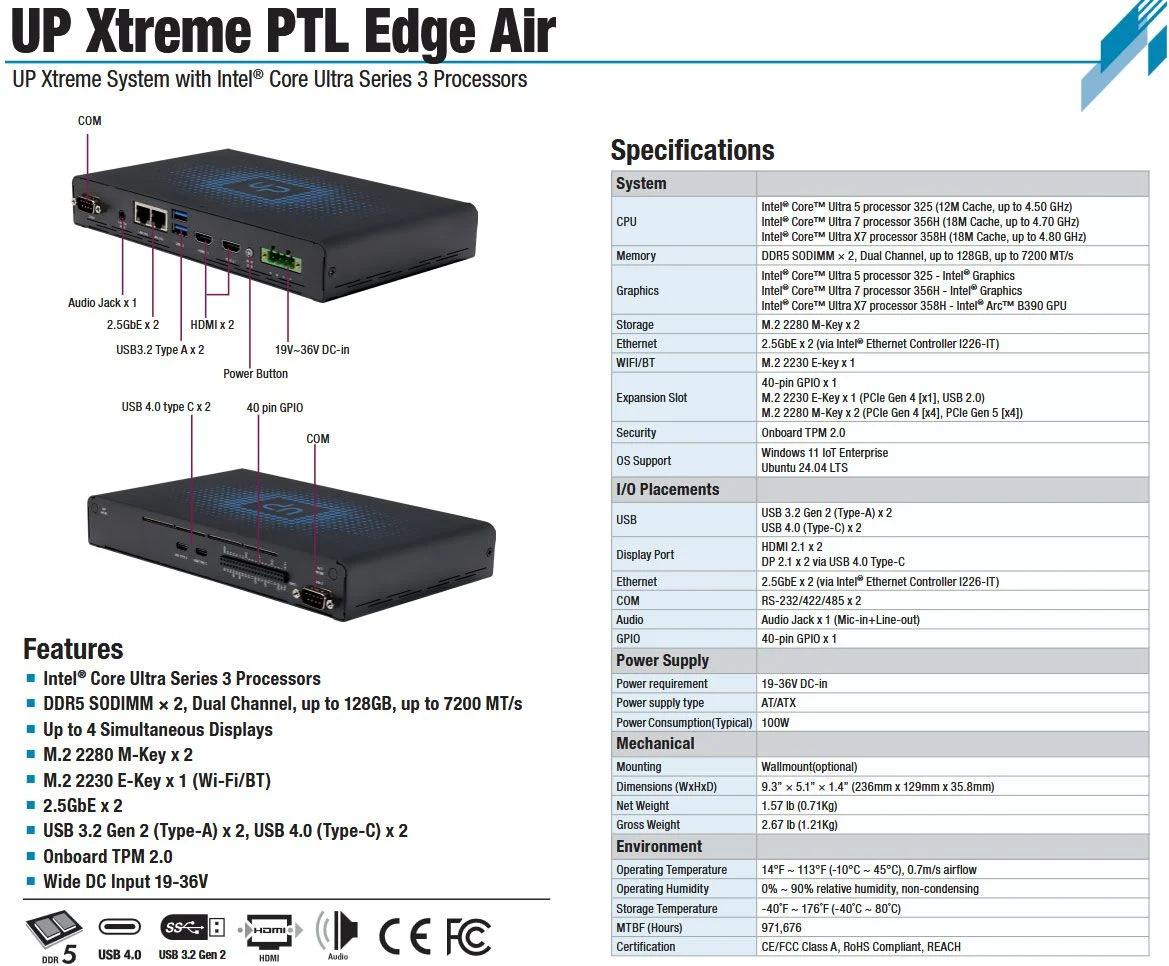
Enter Aaeon, a recognized leader in embedded and industrial computing solutions, which has fundamentally reshaped the paradigm with its latest release. The company has officially launched the Up Xtreme PTL Edge Air, a next-generation fanless mini PC that bridges the gap between high-performance desktop processing and ultra-compact, silent industrial deployment. Powered by up to an advanced Intel Core Ultra processor (featuring configurations scaling up to the Intel Core Ultra X7 358H and leveraging cutting-edge architectures), this compact machine represents a masterclass in modern hardware integration.
What sets the Up Xtreme PTL Edge Air apart from the crowded field of industrial mini PCs is not merely its impressive silicon under the hood, but how Aaeon manages its thermal envelope. By integrating Frore Systems’ revolutionary AirJet solid-state active cooling technology—which utilizes ultrasonic membranes rather than spinning fan blades—Aaeon has achieved a feat of mechanical engineering. The result is a device that is whisper-quiet, remarkably thin, exceptionally light, and capable of sustaining heavy computational loads without throttling.
This comprehensive report explores the main facts surrounding the launch, the chronological evolution of this technology, supporting data and architectural breakdowns, official responses from industry stakeholders, and the profound broader implications this device holds for the future of edge computing.
Main Facts: What is the Up Xtreme PTL Edge Air?
At its core, the Aaeon Up Xtreme PTL Edge Air is designed for deployment in mission-critical, space-constrained environments where reliability, acoustic discretion, and high processing density are paramount.
Key Specifications & Features:
- Processor Architecture: Driven by Intel’s latest silicon innovations, the unit supports up to an Intel Core Ultra X7 358H processor (incorporating advanced Xe-LPG or Xe3 graphics cores depending on the exact platform iteration, alongside robust dedicated NPU capabilities for AI acceleration).
- Cooling Technology: Utilizes Frore Systems AirJet ultrasonic membrane solid-state cooling chips.
- Acoustic Profile: Operates at an ultra-low noise level of under 21 dBA, making it virtually silent to the human ear in standard office or cleanroom environments.
- Form Factor Reductions: Thanks to the elimination of traditional bulky heatsinks and rotary fans, Aaeon’s design team successfully engineered a chassis that is 35% thinner and 43% lighter than comparable systems utilizing conventional active cooling assemblies.
- Target Markets: Industrial automation, smart retail, medical imaging devices, digital signage, edge AI processing, and embedded robotics.
The integration of Intel’s Panther Lake-class and Core Ultra architectures equips the Up Xtreme PTL Edge Air with exceptional multi-threaded performance, robust integrated graphics, and dedicated hardware blocks for artificial intelligence tasks. However, packaging such high-Thermal Design Power (TDP) silicon into a diminutive industrial chassis has historically required aggressive fan curves or massive external heatsink fins. Aaeon’s adoption of AirJet technology completely sidesteps this limitation.
Chronology: The Road to Solid-State Thermal Management
To fully appreciate the significance of the Up Xtreme PTL Edge Air, it is essential to trace the historical timeline of thermal engineering in computing and how this specific product came to fruition.
The Era of Rotary Fans and Passive Heatsinks (1990s–2020)
For decades, personal computers and industrial systems relied on the exact same fundamental mechanism to remove heat from central processing units: the centrifugal or axial fan. While effective at moving air, mechanical fans have inherent flaws. They ingest dust and moisture—a fatal flaw in industrial settings—they degrade over time due to bearing wear, and they create acoustic noise and vibration.
For harsh environments, engineers turned to passive cooling (heatsinks relying on natural convection). While reliable due to a complete lack of moving parts, passive systems are severely limited by surface area and ambient airflow, forcing manufacturers to cap processor performance or build massive, heavy metallic chassis.
The Rise of Solid-State Active Cooling (2021–2023)
Recognizing the physical limitations of mechanical fans, startup Frore Systems emerged from stealth mode to introduce the AirJet technology. Utilizing the principles of ultrasonic resonance, AirJet chips contain vibrating membranes inside a microscopic chamber that generate high-velocity jets of air. These synthetic jet pulses can effectively force heat away from concentrated hotspots with zero mechanical bearings, zero dust ingestion risk, and a thickness profile measured in millimeters.
The Convergence: Aaeon and Intel Panther Lake (2024–Present)
Aaeon, known for its "UP Board" series that often integrates maker-friendly layouts with industrial-grade reliability, began exploring how to scale solid-state cooling beyond thin-and-light laptops into rugged industrial enclosures.
Concurrently, Intel’s development of the Core Ultra and subsequent Panther Lake architectures pushed performance-per-watt metrics to new heights, featuring specialized Xe-class graphics and powerful Neural Processing Units (NPUs) for local AI workloads. Aaeon recognized that combining Intel’s high-efficiency compute engines with Frore’s scalable AirJet modules would unlock a new category of mini PC. The Up Xtreme PTL Edge Air is the direct result of this engineering convergence—moving from conceptual prototypes to a fully realized commercial product ready for global enterprise deployment.
Supporting Data: Metrics, Performance, and Thermal Efficiency
Engineering whitepapers and technical disclosures surrounding the Up Xtreme PTL Edge Air provide compelling data points that highlight the advantages of solid-state active cooling over traditional methodologies.
Physical Footprint and Weight Reductions
- Thickness Reduction: 35% thinner profile compared to standard active-fan systems of equivalent compute tier.
- Weight Reduction: 43% lighter, significantly reducing structural load constraints when mounting the mini PC onto robotic arms, vehicle bulkheads, or behind industrial display panels.
Thermal and Acoustic Performance
- Noise Output: <21 dBA. To put this into perspective, 20 dBA is roughly equivalent to the sound of rustling leaves or a quiet whispering library. Traditional industrial blowers often operate in the 40 to 60 dBA range under load, creating noticeable acoustic fatigue in enclosed workspaces.
- Dust and Particle Resistance: Because AirJet modules utilize high-speed air pulses through microscopic nozzles, they maintain a high backpressure that prevents dust ingress, allowing Aaeon to design enclosures with superior Ingress Protection (IP) ratings compared to traditional fan-cooled chassis.
Compute and AI Benchmarking Potential
Equipped with up to the Intel Core Ultra X7 358H, the Up Xtreme PTL Edge Air is positioned to handle intensive multitasking and localized AI inference. Modern Intel Core Ultra architectures feature:
- Advanced CPU Cores: A hybrid architecture combining Performance-cores (P-cores) and Efficient-cores (E-cores) to optimize both burst workloads and background tasks.
- Integrated Graphics: High-execution-unit GPU architectures capable of driving multiple high-resolution 4K or 8K displays simultaneously.
- Dedicated NPU: Offloading artificial intelligence calculations from the CPU and GPU to an integrated Neural Processing Unit, enabling real-time computer vision, predictive maintenance analysis, and natural language processing at the edge without relying on cloud connectivity.
Official Responses and Industry Reactions
The announcement of the Up Xtreme PTL Edge Air has generated considerable buzz across both the embedded computing sector and mainstream technology media.
Industry analysts have pointed out that Aaeon’s willingness to embrace non-traditional cooling mechanisms signals a broader industry shift. In official corporate statements accompanying the launch, Aaeon representatives emphasized that customer demand for high-performance edge computing was running headfirst into physical workspace limitations.
"Our enterprise and industrial clients no longer want to compromise," noted an Aaeon product development spokesperson during the initial product briefing. "They demand the absolute highest tier of processing power—particularly for edge AI and machine vision applications—yet they must fit this hardware into enclosures that are increasingly compact, sealed, and silent. By partnering with innovators like Frore Systems and leveraging Intel’s exceptional power-efficient silicon, the Up Xtreme PTL Edge Air solves this paradox entirely."
Frore Systems has similarly highlighted the partnership as a validation of AirJet technology’s scalability. While initial commercial implementations of AirJet were primarily focused on ultra-thin consumer laptops, the integration into an Aaeon industrial mini PC proves that solid-state active cooling is robust enough, thermally capable enough, and versatile enough to handle demanding commercial environments.
Tech industry observers and hardware reviewers have praised the device for pushing the boundaries of what is possible in a fanless/semi-fanless ecosystem, noting that the sub-21 dBA acoustic rating makes it uniquely suited for medical operating rooms, financial trading floors, and smart-office automation hubs where background hums are strictly prohibited.
Implications: What the Up Xtreme PTL Edge Air Means for the Future
The launch of Aaeon’s new mini PC is not merely a single product release; it serves as a harbinger of broader trends in hardware design, industrial automation, and edge artificial intelligence.
1. The Death of the Traditional Cooling Fan in Compact Devices?
While traditional cooling fans will remain staple components in high-wattage desktop gaming towers and enterprise server racks for the foreseeable future, their days in compact form factors (mini PCs, laptops, and embedded industrial controllers) are numbered. As solid-state thermal technologies mature, decrease in cost, and increase in thermal dissipation capacity (measured in Watts removed per chip), mechanical fans will increasingly be viewed as obsolete points of mechanical failure.
2. Accelerated Edge AI Deployment
Artificial intelligence at the edge requires substantial computational horsepower. However, many edge environments—such as factory floors, remote weather stations, and transportation hubs—are dusty, vibrating, and thermally challenging. By combining Intel’s NPU-equipped Core Ultra processors with a dust-resistant, solid-state-cooled chassis, Aaeon has lowered the barrier to entry for deploying heavy AI models directly at the point of data collection. Enterprises can now run complex machine learning inference models locally without fearing thermal throttling or fan clogging.
3. Acoustic and Ergonomic Enhancements in Workspaces
In professional environments where compact mini PCs are mounted directly to the backs of monitors or tucked into tight desk spaces, acoustic pollution from micro-blowers has long been an annoyance. The sub-21 dBA threshold established by the Up Xtreme PTL Edge Air sets a new standard for acoustic stealth, proving that high performance no longer requires a noisy acoustic penalty.
4. A New Design Language for Industrial Hardware
The 35% thickness reduction and 43% weight reduction achieved by Aaeon will force competing industrial PC manufacturers to re-evaluate their mechanical engineering pipelines. Bulky, fin-heavy passive cases or loud, dust-vulnerable active-fan cases will struggle to compete against sleeker, lighter, and more thermally efficient solid-state alternatives.
Conclusion
The Aaeon Up Xtreme PTL Edge Air stands as a watershed moment for embedded and industrial computing. By harmonizing Intel’s powerful Core Ultra X7 358H processor architecture with Frore Systems’ groundbreaking AirJet solid-state cooling technology, Aaeon has successfully shattered long-standing engineering compromises.
No longer must industrial designers choose between high performance and silent, dust-resistant, compact operation. With a whisper-quiet acoustic profile under 21 dBA, a significantly reduced physical footprint (35% thinner and 43% lighter), and robust edge-AI capabilities, the Up Xtreme PTL Edge Air charts a clear course for the future of enterprise hardware. As this technology matures and proliferates across additional form factors, it promises to make industrial computing faster, quieter, smaller, and vastly more reliable than ever before.

