

By Global Tech & Defense Correspondent
Published: November 2024
Main Facts
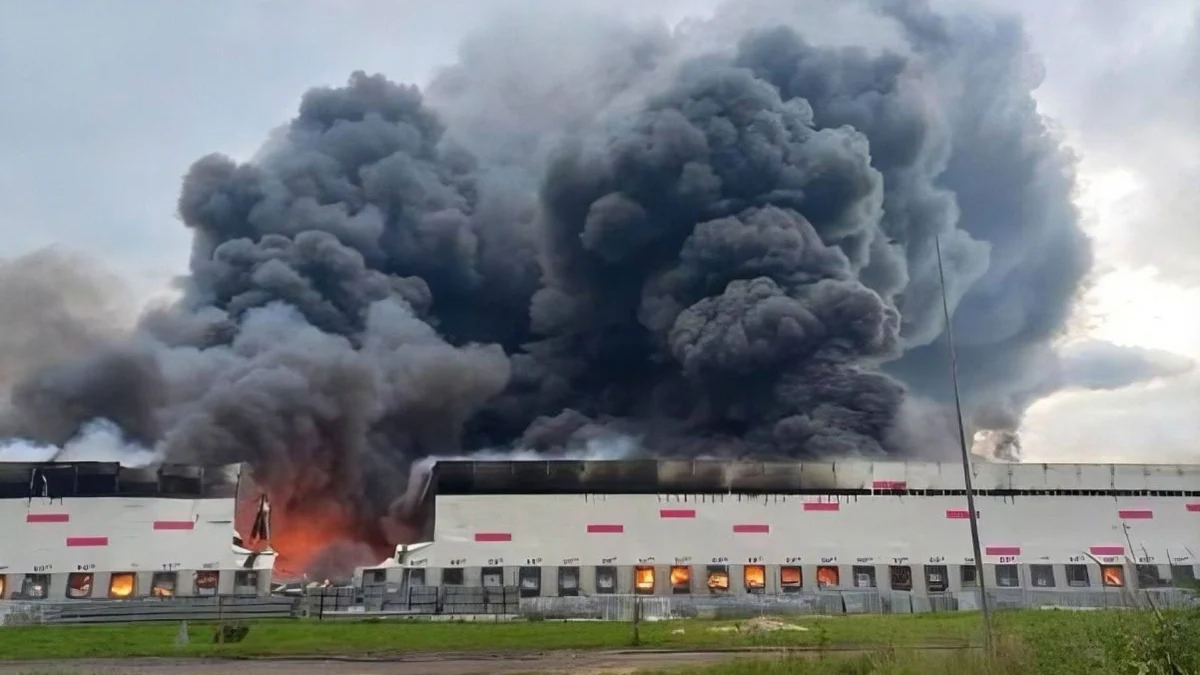
In a significant escalation of the cyber and physical dimensions of the ongoing war, a strategic Russian government data center located in the suburbs of Gorodets has been severely damaged by a targeted drone strike. Situated approximately 230 miles east of the Kremlin and more than 600 miles from the active frontlines, the facility represents a deep-interior vulnerability that Moscow had likely assumed was out of reach.
According to reports from Data Center Dynamics (DCD), the targeted facility is operated directly by the Russian Ministry of Finance. More critically, it serves as the digital bedrock for several vital state registries, most notably housing the primary database of the Federal Taxation Service (FZS).
Industry analysts and regional media outlets confirm that the facility was one of two critical, geo-distributed data processing nodes underpinning Russia’s federal tax apparatus. The loss or severe impairment of this site introduces massive operational risks to Russia’s centralized financial administration, threatening disruptions across various pillars of state information systems, civilian infrastructure management, and administrative services.
Chronology of the Digital War
The strike in Gorodets is not an isolated incident; rather, it marks a dangerous new chapter in a tit-for-tat infrastructure war that has increasingly targeted civilian-military tech architecture.
The Shift to Digital Target Sets (Early October)
For the first several years of the full-scale invasion, physical attacks on infrastructure were largely confined to energy grids, transport networks, and military installations. However, the dynamics shifted dramatically in October. Following a wave of Russian missile and drone strikes that targeted and bombed Ukrainian data centers—resulting in widespread connectivity losses for over 100,000 households and forcing domestic firms to frantically migrate critical data to foreign cloud servers—Kyiv pivoted toward a retaliatory counter-offensive in the digital realm.
The Yandex Outages
Earlier in October, Ukrainian long-range drones struck major Yandex data center complexes inside Russia. Those facilities housed some of the country’s most powerful enterprise supercomputing hardware. The resulting kinetic damage caused catastrophic service outages, taking multiple hardware modules completely offline and paralyzing a wide swath of consumer-facing Russian apps and digital services.
The Gorodets Strike
Building upon the tactical playbook developed during the Yandex strikes, Ukrainian operators targeted the Gorodets facility. Flying hundreds of miles deep into Russian airspace, the drones bypassed air defense perimeters guarding Russia’s industrial and administrative heartland to deliver precision kinetic blows directly to the Ministry of Finance’s server halls.
Supporting Data and Infrastructure Vulnerabilities
To understand the severity of the Gorodets strike, one must examine the redundancy and architecture of Russia’s federal digital infrastructure.
- Geographic Spread: The Russian Ministry of Finance relies on a triad of primary data processing centers. These include the struck facility in Gorodets, the Federal Data Processing Center located in Dubna (Moscow Region), and a third site in Yerzovka (Volgograd Region).
- The Cost of Redundancy: While the ministry technically retains two operational nodes (Dubna and Yerzovka), losing the Gorodets facility instantly wipes out one-third of its primary heavy-duty data processing capacity.
- The Fragility of State Cloud Services: Russian state media and independent cyber analysts have frequently touted the resilience of the country’s localized "Runet" ecosystem. However, these recent attacks expose a profound systemic fragility. Geo-distributed tax and registry systems are designed to balance massive workloads. Shifting the heavy query loads of the Federal Taxation Service from two nodes to one risks creating catastrophic bottlenecks, system crashes, and processing delays for millions of citizens and corporate entities.
Ukrainian President Volodymyr Zelenskyy recently noted that as Russia continues to target ordinary life—bombing civilian data infrastructure to sow chaos and disrupt connectivity—the calculus of modern warfare has forced a mirror response. When ordinary life becomes a target, the infrastructure supporting bureaucratic and commercial operations naturally enters the crosshairs.
Official Responses and Media Blackouts
As is standard protocol during high-profile security breaches involving critical state infrastructure, official commentary from Moscow has been heavily managed or outright muted.
- Russian Authorities: Representatives from the Ministry of Finance and the Federal Taxation Service have downplayed the long-term impact, claiming that data backups and failover systems will prevent a total loss of tax records. However, government statements have notably avoided detailing the extent of the physical damage to server racks, cooling systems, and uninterrupted power supply (UPS) units.
- State Media Admisssions: While initial reports were suppressed, Russian regional media and tech channels have gradually acknowledged that "multiple modules" of the Gorodets complex were completely taken out of commission. Observers note that admitting to deep-interior vulnerabilities is politically sensitive for the Kremlin, which has consistently promised its populace that the war remains distant from the nation’s administrative core.
- Ukrainian Silence/Acquiescence: Kiev’s military intelligence and defense ministries have maintained a policy of strategic ambiguity regarding specific deep-strike operations, though officials have repeatedly emphasized that any infrastructure used to sustain Russia’s war machine—including bureaucratic, financial, and tax-gathering apparatuses—constitutes a legitimate military target.
Implications for the Future of the Conflict
The successful drone strike on the Gorodets data center carries profound implications for both the trajectory of the Russia-Ukraine war and the future of global infrastructure security:
1. The Normalization of Deep-Interior Tech Strikes
The capability of Ukrainian-designed drones to travel over 600 miles past the frontlines to strike a specific, nondescript government tech facility proves that geographical distance is no longer a guaranteed shield. Russian data centers, traditionally viewed as safe havens deep within the Federation, are now frontline assets.
2. Cascading Economic and Administrative Disruptions
The Federal Taxation Service is not merely a tool for collecting revenue; it is the digital spine of modern Russian commerce, handling corporate registration, property tracking, and individual income processing. Prolonged downtime or corrupted registries at the Gorodets site could freeze business registrations, complicate tax filings, and trigger bureaucratic gridlock across multiple federal subjects.
3. Accelerated "Digital Iron Curtain" and Cloud Migration
These attacks will likely accelerate Russia’s inward-looking technological policies. Moscow may enforce even stricter physical security protocols around remaining data centers, militarize their surroundings with localized electronic warfare (EW) and short-range air defense systems (like Pantsir-S1 batteries), and further isolate its domestic internet architecture from external dependencies.
4. A New Paradigm in Global Warfare
Ultimately, the Gorodets strike cements a grim new reality of 21st-century warfare: the blurring lines between physical battlefields and digital infrastructure. As long as state-backed digital networks are utilized to sustain military logistics, taxation, and administrative control, data centers will remain prime targets in the theatre of modern geopolitical conflict.

