

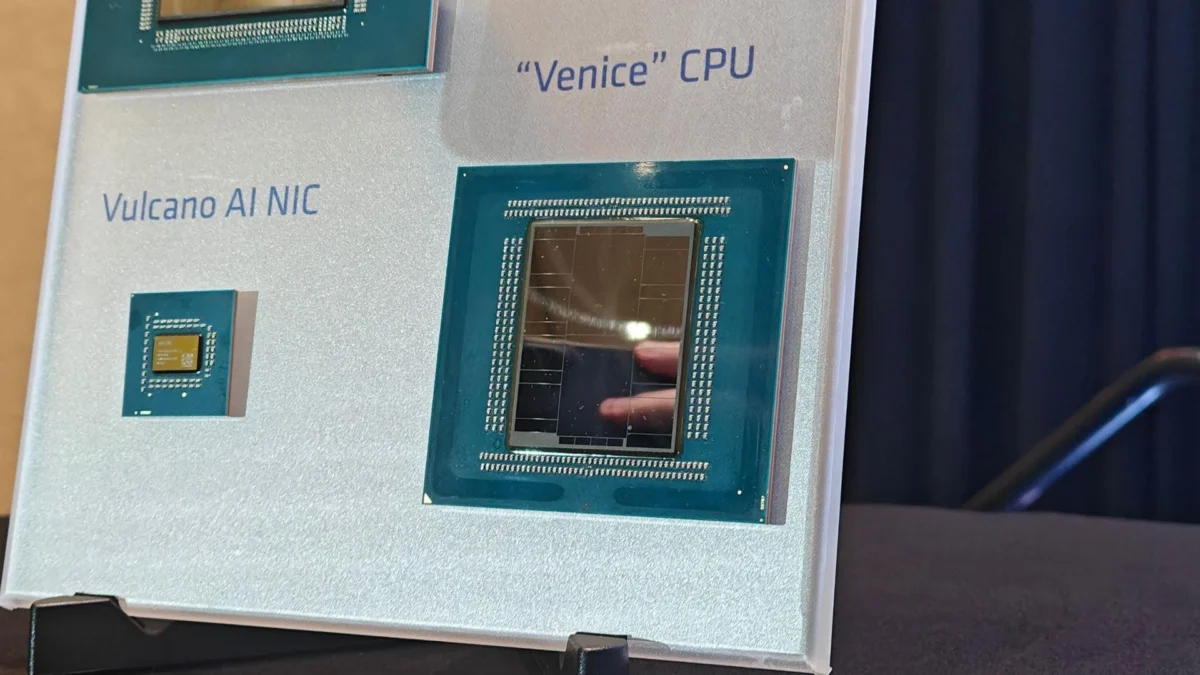
Following the initial launch window of AMD’s highly anticipated EPYC "Venice" CPUs in July, Advanced Micro Devices has stepped up its hardware marketing campaign. On Friday, the semiconductor giant released a comprehensive white paper detailing the architectural leadership and rigorous benchmarking metrics behind its upcoming Zen 6-based server chips.
While the headline-grabbing metrics remain largely consistent with previous disclosures—most notably that a high-frequency, 96-core Venice variant outperforms Nvidia’s 88-core Vera CPU by approximately 20% in the SPEC CPU 2026 Integer Rate benchmark—the newly published documentation offers an unprecedented look under the hood. AMD’s architectural deep dive outlines not only how Venice stacks up against fierce competition from Intel’s Xeon portfolio and Nvidia’s proprietary enterprise processors, but also highlights the sheer engineering scale of the Zen 6 platform, which supports configurations scaling up to a staggering 256 cores, 16-channel memory, and clock speeds reaching 5 GHz alongside a massive 1,024MB of L3 cache.
Main Facts
The latest disclosures surrounding the AMD EPYC "Venice" platform solidify the chipmaker’s aggressive stance in the high-performance computing (HPC) and enterprise data center markets. The core details shaping the narrative include:
- Zen 6 Architecture Breakthroughs: The upcoming EPYC 9006 series leverages the advanced Zen 6 microarchitecture, engineered to deliver massive leaps in instruction-per-clock (IPC) efficiency, raw core counts, and thermal-performance scaling.
- Core and Cache Scaling: At the absolute top end of the stack, the flagship EPYC 9996 "Venice" processor packs an astounding 256 cores. Furthermore, the platform supports up to 1,024MB (1GB) of L3 cache, mitigating latency bottlenecks for memory-bound enterprise workloads.
- Memory Subsystem Enhancements: Venice introduces robust 16-channel memory support, drastically increasing overall memory bandwidth compared to legacy platforms—a critical upgrade for massive artificial intelligence (AI) training pipelines, large language model (LLM) inference, and high-throughput database management.
- Clock Speeds: Despite packing unprecedented core densities into a single socket, high-frequency variants of the Venice lineup are capable of maintaining boost clock speeds up to 5 GHz.
- Competitive Benchmarking Claims: AMD’s newly released white paper explicitly asserts that a 96-core Venice processor outpaces Nvidia’s 88-core Vera CPU by roughly 20% in the industry-standard SPEC CPU 2026 Integer Rate test. Furthermore, broader system-level comparisons position top-tier Venice configurations as delivering up to a 3.4x performance multiplier over legacy or competing Intel Xeon architectures in select workloads.
Chronology of the EPYC ‘Venice’ Rollout
The trajectory of AMD’s server processor roadmap has moved at a breakneck pace, driven by relentless demand from hyperscalers, cloud service providers (CSPs), and enterprise AI operations.
Late 2024 to Early 2025: Rumors and Architectural Previews
As industry watchers tracked the sunsetting of Genoa and Bergamo (EPYC 4th generation) and the deployment of Turin (EPYC 5th generation based on Zen 5), whispers of Zen 6 began circulating within supply chain channels. Code-named "Venice," this prospective 6th-generation EPYC processor family was initially framed as AMD’s definitive answer to next-generation AI infrastructure and dense cloud compute requirements.
July: The Initial EPYC ‘Venice’ Reveal
AMD formally brought the EPYC ‘Venice’ CPUs into the public spotlight during a strategic product reveal. The industry was stunned by initial architectural disclosures, which pointed toward a radically overhauled I/O die, support for cutting-edge memory standards, and a flagship 256-core SKU (the EPYC 9996) designed to utterly redefine data center power-to-performance ratios. At this stage, high-level performance metrics were dropped, including the comparison against Nvidia’s Vera processor.
Friday: The Architectural White Paper Drop
Building directly upon the momentum of the July unveiling, AMD published an extensive architectural white paper titled "AMD EPYC 9006 Server CPUs: Architectural Leadership." This document marked a strategic pivot from high-level marketing claims to granular, reproducible testing methodologies, workload breakdowns, and deep technical disclosures regarding the Zen 6 core design, power delivery networks, and die-to-die interconnect fabrics.
Supporting Data & Architectural Deep Dive
To understand why AMD’s claims are sending ripples through the enterprise hardware ecosystem, one must examine the raw engineering specifications and benchmark data outlined in the white paper.
Core Density and Multi-Threading Dominance
The scaling of core counts in the server space has transformed modern data center economics. While early enterprise servers relied on dual-socket architectures to achieve 32 or 64 cores, AMD’s modular chiplet design has allowed the company to push single-socket density to unprecedented heights. The EPYC 9996’s 256-core layout ensures that hyperscale cloud environments can densely pack virtual machines (VMs) and containerized microservices without incurring the latency penalties of multi-node cluster communication.
Memory Bandwidth: The 16-Channel Advantage
One of the most persistent bottlenecks in high-core-count processors is memory starvation—a scenario where CPU cores sit idle waiting for data to fetch from system RAM. Venice addresses this head-on with a massive 16-channel memory subsystem. By doubling or significantly expanding channel counts compared to standard desktop platforms and improving upon previous enterprise generations, Venice ensures that all 256 cores remain fully saturated under heavy transactional loads, such as in-memory databases and real-time analytics.
L3 Cache Hierarchies
With up to 1,024MB of L3 cache integrated into the package, Venice minimizes trips to main system memory. Large caches are particularly vital for enterprise applications with sprawling working sets, such as scientific simulations, financial modeling, and complex database joins. By keeping frequently accessed data closer to the execution units, AMD significantly reduces instruction latency and overall power draw per transaction.
SPEC CPU 2026 Integer Rate Performance
The inclusion of SPEC CPU 2026 Integer Rate benchmarks in AMD’s latest white paper provides a standardized metric for enterprise compute throughput. According to AMD’s testing parameters, a 96-core high-frequency Venice processor secures a decisive 20% performance advantage over Nvidia’s 88-core Vera CPU. In broader compute scenarios, comparing the apex 256-core EPYC 9996 against competing Intel Xeon architectures yields performance multiples scaling up to 3.4x, depending on the specific multi-threaded vector or integer workload applied.
Official Responses and Industry Context
The release of AMD’s white paper has triggered intense discussion across the semiconductor industry, drawing reactions from competitors, enterprise customers, and independent analysts alike.
AMD’s enterprise division has framed the Venice platform not merely as a generational update, but as a paradigm shift in how data centers handle the convergence of traditional cloud computing and artificial intelligence workloads. Company representatives emphasize that as generative AI models mature, data centers require CPUs capable of efficiently managing pre-processing, data ingestion, and orchestration tasks alongside dedicated accelerators like GPUs.
Meanwhile, competitors are watching closely. Nvidia’s Vera platform—designed to operate in tight tandem with advanced Grace-class architectures and heavy-duty graphics processors—represents a formidable rival in tightly integrated AI supercomputing nodes. By directly benchmarking against Vera, AMD is signaling its intent to capture market share not just in general-purpose cloud hosting, but within elite AI infrastructure where Nvidia has historically held uncontested dominance.
Intel, actively pushing its latest generations of Xeon scalable processors, faces mounting pressure from AMD’s relentless core-count expansion and memory bandwidth leadership. Industry analysts note that while Intel continues to lean heavily on proprietary hardware accelerators (such as Advanced Matrix Extensions or AMX), AMD’s brute-force approach—combining high IPC, massive cache sizes, and raw core density—creates a deeply compelling value proposition for cost-conscious and performance-driven enterprise buyers alike.
Implications for the Enterprise and Cloud Ecosystems
The rollout of the EPYC ‘Venice’ architecture carries profound implications for the future of enterprise IT, cloud infrastructure, and the broader hardware supply chain.
1. Data Center Consolidation and Power Efficiency
Power density and thermal management have become the ultimate bottlenecks for modern data centers. Facility operators are increasingly constrained by megawatt limits rather than floor space. By delivering up to 3.4x the performance of legacy systems while optimizing power draw per core, Venice enables enterprises to drastically consolidate their server footprints. Fewer physical servers are required to handle the same computational workload, translating directly into massive savings on electricity, cooling infrastructure, and facility maintenance.
2. The Evolution of AI-Adjacent Infrastructure
While GPUs remain the undisputed workhorses for raw model training and inference execution, the surrounding infrastructure—the CPU nodes responsible for data cleaning, vector database indexing, tokenization, and pipeline orchestration—must scale in tandem. Venice’s 16-channel memory and massive L3 cache make it an ideal backbone for running high-throughput retrieval-augmented generation (RAG) pipelines and massive enterprise databases that feed AI models in real time.
3. Market Share Dynamics
AMD’s steady, calculated erosion of Intel’s historical enterprise dominance is poised to accelerate with the commercial deployment of Zen 6-based Venice chips. As hyperscalers—including Microsoft Azure, Amazon Web Services (AWS), and Google Cloud—evaluate their next-generation fleet architectures, AMD’s transparent documentation of benchmark performance and architectural leadership provides procurement teams with the hard data needed to justify massive hardware transitions.
As the industry awaits the full commercial availability of the EPYC 9006 series, AMD’s comprehensive white paper makes one thing abundantly clear: the battle for supremacy in the modern data center is entering its most aggressive, technologically sophisticated phase yet.

