

For decades, mobile PC gaming has operated under a strict set of compromises. Unlike their desktop counterparts, which enjoy sprawling multi-fan cooling solutions, massive heatsinks, and virtually unlimited wall power, gaming laptops are bound by the unforgiving laws of thermodynamics and battery chemistry. To prevent thermal throttling, component degradation, and catastrophic failure, manufacturers and hardware designers impose rigid power limits (Total Graphics Power, or TGP) on mobile graphics processing units.
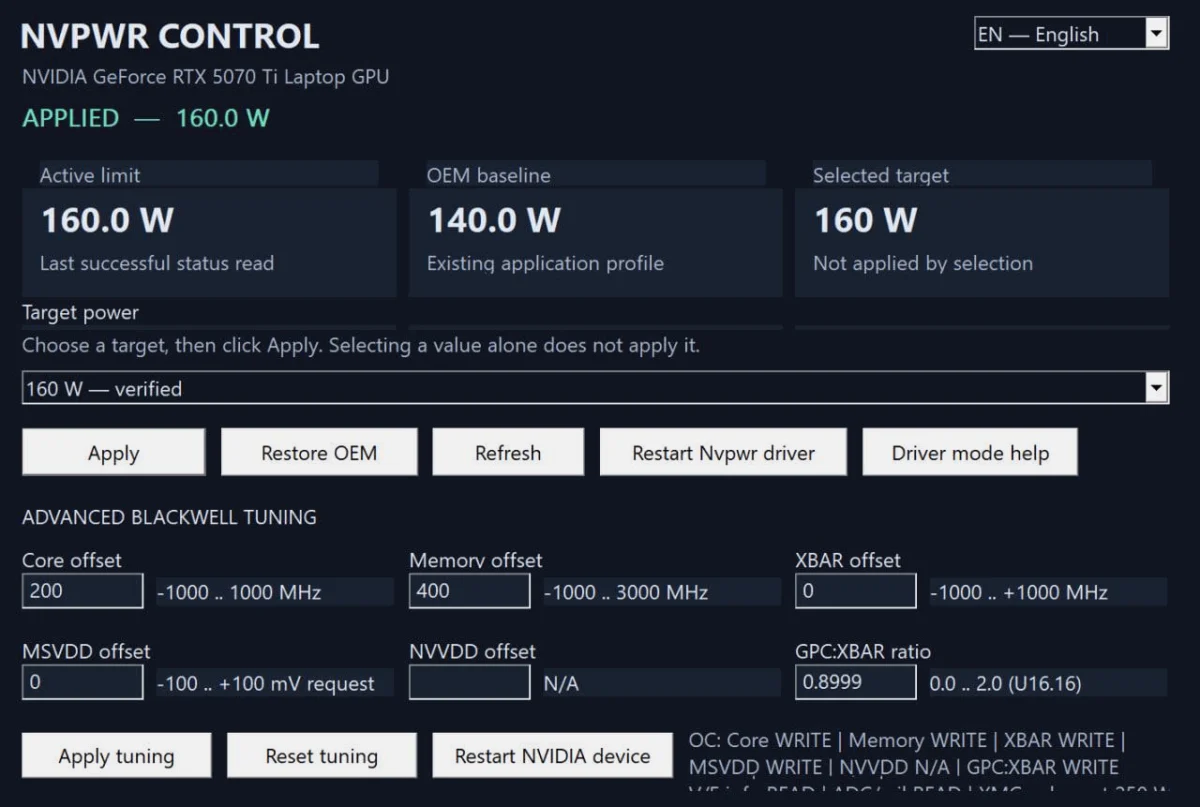
However, hardware enthusiasts and modders have never been entirely comfortable playing by the rules established by original equipment manufacturers (OEMs). Enter NvpwrControl, a newly surfaced open-source utility designed to bypass these factory safeguards. Spotted initially by industry hardware trackers at VideoCardz, this experimental software allows users with Nvidia-based gaming laptops to crank their mobile GPU power limits by as much as 40 watts.
While the prospect of unleashing desktop-class performance from a portable chassis is undeniably alluring, the tool comes with a massive caveat: it trades system longevity and hardware stability for raw, unbridled horsepower.
Main Facts
At its core, NvpwrControl is an advanced, highly specialized utility created by independent modder LevinAi-arch, currently hosted and distributed via GitHub. The software targets Nvidia’s mobile graphics architecture—specifically supporting high-end modern iterations—allowing users to forcefully override the maximum TGP boundaries established by laptop manufacturers.
Key highlights of the NvpwrControl utility include:
- Substantial Power Increases: Depending on the specific GPU model, the tool can elevate the power limit by up to 40 watts beyond official manufacturer specifications.
- Targeted Hardware: Early reports and developer documentation indicate compatibility with high-performance mobile silicon, including the mobile iterations of Nvidia’s RTX 50-series (such as the RTX 5070 Ti laptop GPU and the flagship RTX 5090 laptop GPU).
- Experimental Classification: The developer and technical community classify the software strictly as "experimental." It lacks the safety certifications, automated fail-safes, and validation testing inherent in official OEM software suites.
- Risk vs. Reward Dynamic: Utilizing the tool yields tangible performance gains in synthetic benchmarks and demanding video games, but it drastically increases thermal output, electrical draw, and mechanical stress on the laptop’s power delivery system (VRMs) and cooling apparatus.
Chronology: The Evolution of Mobile GPU Tweaking
The journey toward software-based TGP modification did not happen overnight. Understanding how the industry reached a point where end-users can safely—or at least functionally—inject an extra 40 watts into a laptop GPU requires looking back at the evolution of mobile graphics management.
The Era of Hard-Coded vBIOS Limits (Pre-2018)
In the early days of discrete mobile graphics, tweaking power limits was practically impossible for the average consumer. Laptop GPUs operated under strict, hard-coded Video BIOS (vBIOS) profiles. If a manufacturer designed a laptop with an 80W Max-Q variant of a GPU, that chip would rarely, if ever, cross that threshold. Enthusiasts who wanted more performance had to resort to risky, hardware-level flashing of custom, unverified vBIOS files sourced from forums like NotebookReview. This process often resulted in "bricked" GPUs, corrupted displays, and permanently dead motherboards.
The Rise of Dynamic Boost (2019–2022)
As thermal engineering improved with vapor chambers and liquid metal cooling, Nvidia introduced technologies like Dynamic Boost. This officially sanctioned feature allowed the system to dynamically shift power between the CPU and the GPU depending on the workload. While this gave users a taste of fluctuating performance envelopes, the ultimate ceiling was still strictly governed by the laptop vendor’s firmware design. Users remained locked out of absolute manual control.
The Modern Modding Frontier and NvpwrControl (Present Day)
As modern gaming laptops began pushing past the 150W and 175W TGP barriers, advanced modders began analyzing the low-level communication protocols between system management controllers and Nvidia drivers. Over the past year, community-driven projects have attempted to expose these hidden firmware registers.
The release of NvpwrControl represents the culmination of these reverse-engineering efforts. Moving away from dangerous, low-level vBIOS flashing—which risks permanent hardware corruption—NvpwrControl acts dynamically within the operating environment, communicating directly with power delivery interfaces to command higher wattage states on demand.
Supporting Data: Pushing the Limits of Mobile Silicon
To truly grasp the impact of NvpwrControl, one must examine the specific hardware figures involved. Mobile GPUs are precision-engineered silicon dies designed to operate within a very narrow window of voltage, current, and thermal dissipation (Thermal Design Power, or TDP).
According to early technical breakdowns and developer notes accompanying the GitHub release, the power scaling enabled by NvpwrControl yields significant numerical shifts across high-end configurations:
- Nvidia GeForce RTX 5070 Ti Laptop GPU: Traditionally capped by manufacturers around 140W to 150W to balance thermals in slim-and-light chassis, NvpwrControl can push this specific processor up to a staggering 180W. This represents roughly a 20% to 30% increase in baseline electrical allotment.
- Nvidia GeForce RTX 5090 Laptop GPU: As the undisputed crown jewel of mobile graphics, the mobile RTX 5090 typically operates near 175W. With the experimental tool engaged, power-hungry enthusiasts have forced the flagship silicon up to 225W.
The Electrical and Thermal Cost
While pushing an extra 40 watts through a mobile graphics processor sounds like a free performance upgrade, physics dictates that energy cannot be created or destroyed—it is only converted. That extra 40W of electrical current transforms almost entirely into heat.
[Standard Operation]
150W TGP ──> Moderate Heat ──> Standard Fan Curves ──> Stable Lifespan

[NvpwrControl Modded]
190W (+40W) ──> Extreme Heat ──> Maximum Fan RPM / Thermal Throttling ──> Accelerated Component Wear
Most gaming laptops are meticulously engineered to handle a specific maximum thermal load. For instance, a cooling assembly designed for a combined 230W system load (CPU + GPU) may suddenly find itself suffocating under a 270W load. This leads to immediate thermal saturation, forcing the system’s fans to spin at deafening maximum RPMs, and frequently resulting in secondary thermal throttling of the CPU as heat pipes become overwhelmed.
Official Responses and Industry Perspective
As of publication, major hardware manufacturers—including Nvidia, ASUS, MSI, Razer, and Lenovo—have not issued formal statements specifically naming NvpwrControl. However, their overarching stance on unauthorized hardware modification remains uniform, strict, and uncompromising.
The OEM and Manufacturer Stance
Industry insiders and warranty policy administrators universally view software utilities that override factory power limits as a direct violation of terms of service.
- Warranty Voidance: Virtually every major PC manufacturer explicitly states that operating hardware outside of factory-specified parameters, or using third-party software to alter voltage, power limits, and clock frequencies beyond official developer tools (such as MSI Afterburner or proprietary vendor suites), voids the hardware warranty.
- Safety and Liability: Laptops are compact electronic ecosystems packed tightly with lithium-ion batteries, delicate circuit traces, and surface-mount voltage regulator modules (VRMs). When an end-user forces an unverified 40W increase through these channels, the risk of localized overheating, solder joint degradation, and component failure spikes dramatically. Manufacturers protect themselves by denying RMA (Return Merchandise Authorization) claims on devices showing evidence of power-limit modifications.
The Independent Developer and Community Perspective
Conversely, the underground modding community views tools like NvpwrControl through a lens of consumer rights and hardware freedom. Proponents argue that consumers purchase the physical hardware and should possess the absolute right to manage, configure, and push that hardware however they see fit—provided they accept the personal financial risk of damaging their own property.
Developers like LevinAi-arch emphasize caution, plastering disclaimers across GitHub repositories warning users that the software is strictly experimental and intended exclusively for advanced hobbyists who understand the inner workings of PC electrical engineering.
Implications: What This Means for the Future of Mobile Gaming
The emergence of NvpwrControl carries profound implications for the PC hardware ecosystem, influencing everything from laptop engineering choices to consumer purchasing behavior.
1. A Paradigm Shift in Laptop Selection
Historically, consumers purchasing gaming laptops scrutinized the "TGP rating" of a GPU above almost all else. A laptop featuring a "low-TGP" RTX 4080 at 105W was significantly slower than a "high-TGP" variant running at 175W, even though both chips shared the same name.
With tools like NvpwrControl entering the wild, savvy buyers might begin looking past factory power limits, recognizing that a cheaper, lower-TGP laptop chassis with decent cooling headroom could potentially be modded to match or exceed the performance of ultra-expensive flagship notebooks—albeit at their own peril.
2. Heightened Risks of Hardware Failure
The most immediate and practical implication is an uptick in fried components, degraded batteries, and failing motherboards among hobbyists. Laptop VRMs are not universally over-engineered; many mid-range chassis feature power delivery phases cut down to save costs. Forcing an extra 40 watts through a budget VRM array lacking adequate heatsinking can cause catastrophic component failure, turning an expensive gaming rig into an expensive paperweight in a matter of weeks.
3. Future Counter-Measures from Manufacturers
In response to utilities like NvpwrControl, it is highly likely that Nvidia and laptop OEMs will implement stricter firmware-level locks. Future vBIOS updates and security protocols may integrate hardware-handshake encryptions that render software-based power overrides impossible without physically rewriting locked flash memory chips. The arms race between hardware modders and corporate security compliance engineers continues to escalate.
Conclusion
NvpwrControl is a fascinating double-edged sword. For the bleeding-edge enthusiast willing to gamble thousands of dollars on silicon lottery and structural durability, it offers a tantalizing glimpse into unthrottled mobile performance, scaling laptop GPUs like the RTX 5070 Ti and RTX 5090 to dizzying new heights of 180W and 225W.
However, for the mainstream gamer seeking reliability, longevity, and peace of mind, the tool is best admired from afar. As the GitHub repository remains active and the community continues to experiment, users are reminded of the fundamental truth of PC hardware modification: power always comes with a price, and Mother Nature—and thermodynamics—always collects her due.

