

Main Facts: A Cooperative Phenomenon
Weeks after rolling credits on Big Walk, players and critics alike are still parsing through the lingering emotional resonance of what has quickly emerged as the standout video game of 2026. Developed by House House—the acclaimed Australian studio behind the global sensation Untitled Goose Game—Big Walk arrived with high expectations. Yet, rather than serving as a brief, lighthearted cooperative diversion, the title has unfurled into a deeply thoughtful, structurally innovative masterpiece.
At its core, Big Walk is a multiplayer puzzle and exploration game designed for groups of friends. However, its true brilliance lies not merely in its cooperative mechanics or its charming, minimalist character designs, but in its masterclass of audio design. Composed by the Australian duo aksfx, the game’s sparse, ethereal soundtrack and spatial audio implementation have redefined how environmental sound can dictate emotional pacing in an open-world sandbox.
Far from deploying a traditional, wall-to-wall orchestral score, Big Walk relies on strategic silence. Players can spend hours exploring vast, picturesque landscapes without hearing a single note of music. Yet, when the soundtrack finally breaks through the ambient quiet—via hidden world radio stations or player-transported boomboxes—it elevates the cooperative experience into something genuinely unforgettable.
Chronology: From Anticipation to Post-Credit Reflection
To understand the cultural and emotional footprint of Big Walk, one must trace the trajectory of a playthrough, which typically spans roughly ten hours of tightly coordinated exploration and puzzle-solving.

Phase One: The Lobby and the First Note
The journey begins the exact moment a player boots up the game. Before even stepping into the virtual lobby, they are greeted by the game’s main theme. Composed by aksfx, the track features distinct, pulsing electronic beats interwoven with playful, leaping vocal chops. To first-time players, these vocalizations evoke a strange, immediate sense of nostalgia—an auditory anchor that grounds the user before the adventure even begins.
Phase Two: The Great Silence and Accidental Discoveries
Once inside the world, the music recedes. House House deliberately paces the auditory landscape, forcing players to rely on the natural sounds of the environment: the crunch of footsteps, the whistling wind, and the chatter of teammates over voice comms. This stretches of silence make the eventual discovery of in-game elements all the more impactful. Players organically stumble across scattered radio stations seamlessly integrated into the terrain.
Phase Three: The Climax and Rolling Credits
As groups progress through increasingly intricate cooperative puzzles, these musical touchpoints become emotional anchors. By the time players reach the conclusion roughly ten hours later, returning to the main theme carries a profound weight. What initially felt like quirky background noise transforms into a deeply emotional motif capable of moving players to tears.
Supporting Data: The Anatomy of aksfx’s Soundscape
The technical execution of Big Walk’s audio is as deliberate as its artistic vision. The collaboration with Australian electronic duo aksfx encompasses nearly 30 distinct tracks, carefully engineered to balance electronic textures with organic warmth.

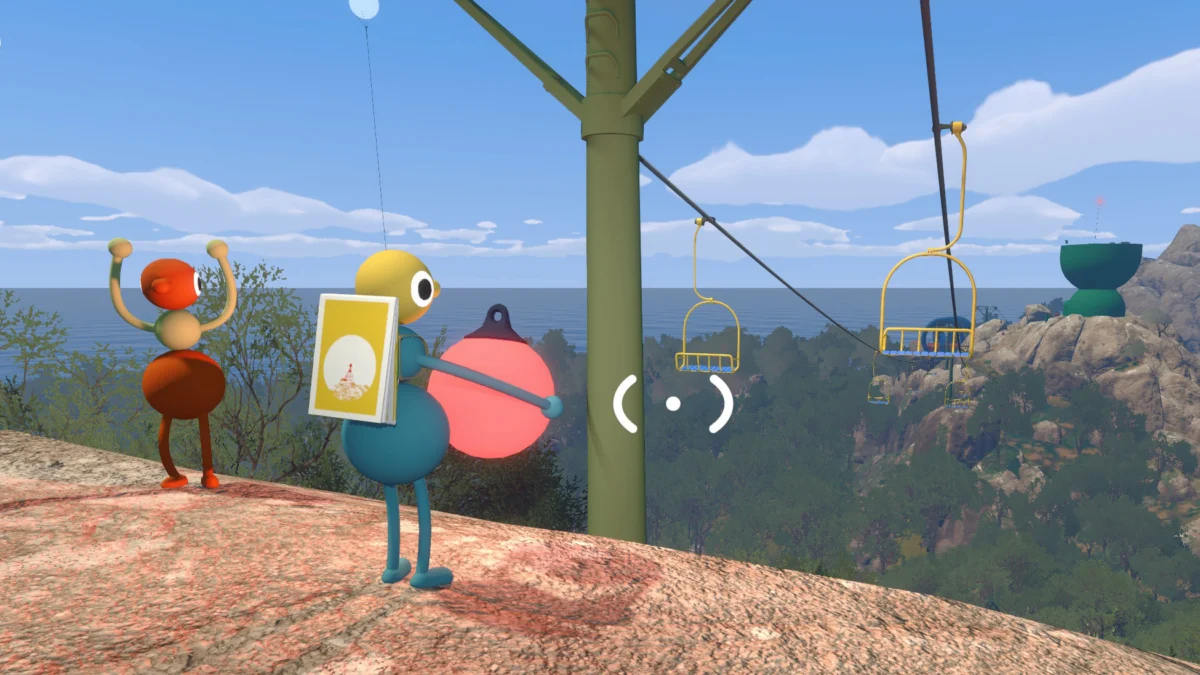
- Spatial Audio Integration: Radio stations found throughout the game map are not simple audio loops tied to the camera; they are physical objects. Surrounded by fully rendered, in-game speakers, these stations utilize advanced spatial audio mixing. Players can physically walk around the speakers, hearing individual components of the track pan across their headphones or surround-sound setups.
- The Backpack Mechanic: Demonstrating House House’s trademark ingenuity, the game allows players to detach these radios from their static environments and strap them directly onto a teammate’s backpack. This turns a stationary sound source into a walking, breathing boombox and audial beacon.
- Vocal Chops and Minimalism: Rather than relying on traditional lyrical singing or heavy orchestral arrangements, aksfx utilized unique vocal sampling ("jumping voices") that mimic human breath and playfulness. This minimalist approach prevents the music from overwhelming the gameplay while maintaining a distinct, ethereal identity.
Official Responses and Creative Intent
House House has historically maintained a meticulous approach to game design, prioritizing player autonomy, environmental storytelling, and tactile interactions over exposition. While the studio has kept post-launch interviews brief, the philosophy behind Big Walk’s soundscape speaks volumes about their creative evolution.
Industry analysts and audio directors have praised House House for subverting modern gaming conventions. In an era where AAA titles often bombard players with relentless, adaptive orchestral scores designed to dictate every emotional beat, Big Walk takes a courageous step backward. By trusting the player’s own pacing and the organic conversations happening between friends on voice chat, the developers created space for authentic, unscripted memories to form.
Aksfx’s contribution has similarly been lauded within the electronic music and game audio communities. Reviewers have noted that the music sounds mildly unsettling on paper—mixing pulsing electronic rhythms with jarring vocal clips—yet inside the game’s breezy, sun-drenched environments, it creates an atmosphere of pure, unadulterated freedom.
Implications: Redefining Cooperative Audio Design
The runaway success of Big Walk and its distinctive soundscape carries significant implications for the future of indie game development and cooperative multiplayer design.

1. The Value of Strategic Silence
For years, game developers operated under the assumption that continuous music is necessary to maintain player engagement during long exploration phases. Big Walk proves the exact opposite. By withholding music, developers can heighten the impact of musical cues when they finally arrive, turning a standard gameplay moment into a cinematic milestone.
2. Player-Driven Soundtracks
Allowing players to physically transport sound sources—such as strapping a radio to a friend’s backpack—blurs the line between non-diegetic background music and diegetic environmental interaction. This mechanics-first approach to music delivery encourages organic roleplay and deepens the bond between cooperative partners.
3. Emotional Longevity Through Audio
Video games are frequently judged by their visual fidelity or mechanical complexity, but Big Walk demonstrates that auditory memory is often what keeps players talking for weeks after the credits roll. The ability of a few vocal chops and a pulsing electronic beat to evoke genuine nostalgia highlights the unmatched power of thoughtful video game audio design.
As 2026 continues to unfold, Big Walk stands as a high-water mark for cooperative game design. It proves that simplicity, when executed with profound artistic intent, can outshine even the most lavishly funded productions—leaving an echo that lingers long after the walk is over.

