

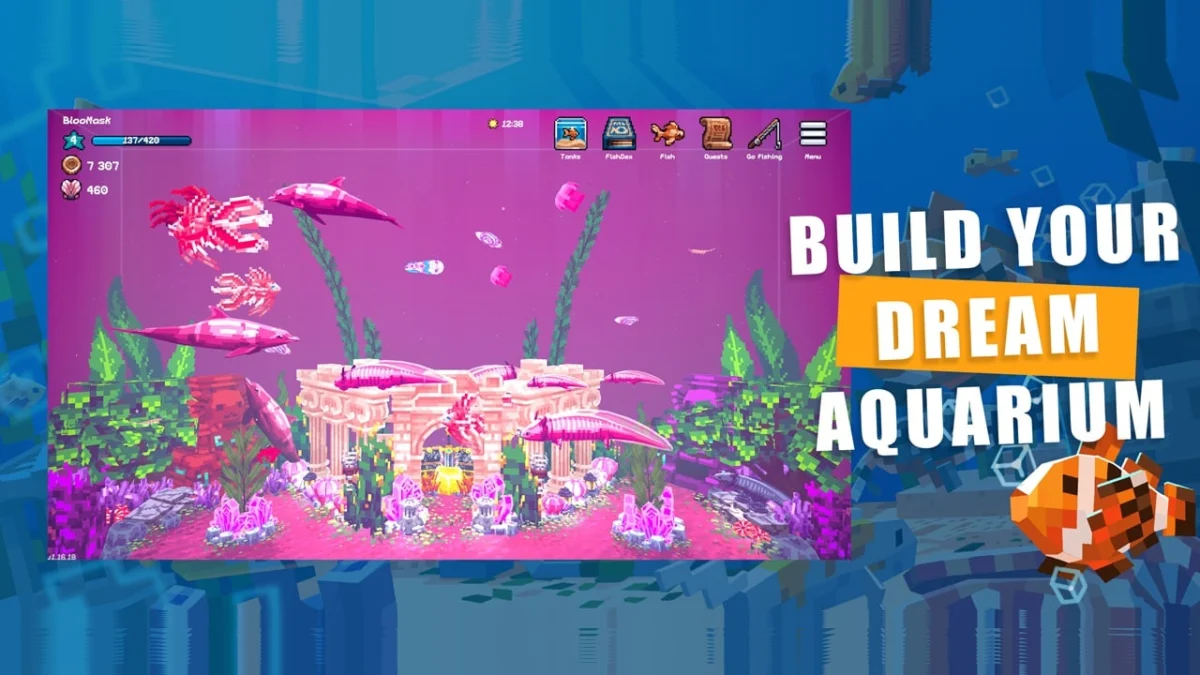
In the rapidly evolving landscape of mobile gaming, where high-octane battle royales and frenetic action RPGs often dominate the charts, a quiet revolution is taking place. Swiss developer Lunheim Studios has officially brought its meditative, low-stakes idle simulator, Tiny Aquarium, to mobile platforms. Following its successful debut on PC in June 2025, the title is now poised to transform how players engage with digital pets, offering a desktop-class experience that fits snugly in the palm of one’s hand—or, more uniquely, in the corner of one’s screen.
Main Facts: A Digital Oasis in Your Pocket
Tiny Aquarium is fundamentally an idle simulator designed for the modern, multitasking individual. At its core, the game challenges players to build, curate, and maintain a vibrant aquatic ecosystem. Unlike traditional simulators that demand constant active input, Tiny Aquarium thrives on passive progression. The game continues to simulate life, growth, and economy even while the player is offline or preoccupied with other tasks.
The game launches on the Google Play Store with a premium price point of $4.99, a choice that reflects its ad-free, "premium-first" design philosophy. Players begin their journey with nothing more than a solitary egg in an empty glass tank. Through patience and strategic management, this humble beginning evolves into a bustling, personalized aquarium containing a diverse array of over 120 unique fish species.
The gameplay loop is deceptively simple but possesses a deep layer of complexity for those willing to dive into its mechanics. Players can acquire new life forms through four primary methods:
- Natural Hatching: Watching life bloom from eggs over time.
- Breeding: Combining existing fish to create offspring with inherited traits.
- Fishing: A manual component that allows players to "catch" new additions to their tank.
- Trading: A social ecosystem allowing players to swap species with others to complete their collections.
Chronology: From PC Vision to Mobile Reality
The journey of Tiny Aquarium began in early 2025 with the team at Lunheim Studios identifying a gap in the market for "productive relaxation." While the PC version launched in June 2025, the developers spent the subsequent months refining the user interface to ensure that the transition to mobile touchscreens felt natural.
The PC iteration was initially praised for its innovative "Tiny Mode"—a feature that allowed the aquarium to hover as a persistent overlay on the desktop. When porting this to mobile, the studio had to overcome significant technical hurdles regarding screen real estate and operating system permissions. The mobile release, finalized in late 2025, represents the culmination of a six-month optimization cycle, ensuring that the background processing—which is vital for the game’s idle mechanics—remains stable and battery-efficient on Android devices.
Supporting Data: The Science and Strategy of the Tank
What sets Tiny Aquarium apart from standard "clicker" games is the depth of its simulation. Each of the 120+ species included in the game is assigned specific attributes that dictate its behavior, economic value, and utility in breeding programs.
Biological Realism Meets Creative Fantasy
Lunheim Studios has implemented a bifurcated species system. Some fish are meticulously modeled after real-world counterparts, while others are purely whimsical creations designed specifically for the game’s aesthetic. For the real-world species, the developers have integrated educational components, providing players with facts about the actual fish, including its native habitat and current conservation status.
The Trait System
Fish in Tiny Aquarium are not just visual assets; they are dynamic entities. Key attributes include:
- Swim Velocity: Determines how active the fish appears in the tank.
- Breeding Coefficient: A genetic value that influences the likelihood of passing down rare traits.
- Market Value: The currency generated by the fish, which can be reinvested into tank upgrades.
One of the most sought-after mechanics is the inclusion of rare genetic traits, such as albinism. These variants do not simply change the color palette of the fish; they significantly alter the "prestige" of a player’s tank and their standing in the trading community. Furthermore, the environmental simulation extends to non-fish life. Shrimp scuttle along the substrate, while snails traverse the glass, creating a layered, living environment that feels authentic to the hobbyist experience.
Official Responses and Developer Philosophy
In discussions surrounding the launch, the team at Lunheim Studios emphasized that Tiny Aquarium was never intended to be a "high-pressure" game. "We wanted to create a space that doesn’t demand your time, but rewards your presence," a spokesperson for the studio noted. "In an age of constant notifications and high-stress gaming, Tiny Aquarium is designed to be a digital fidget toy. It’s a way to decompress."
The decision to charge $4.99 was a deliberate move to foster a community free from the predatory monetization often found in free-to-play simulators. By removing energy timers and "pay-to-skip" mechanics, Lunheim Studios has prioritized the user’s peace of mind, ensuring that the progression feels earned rather than bought.
Implications: The Future of "Tiny Mode" and Passive Gaming
The most compelling aspect of Tiny Aquarium is its "Tiny Mode," a feature that holds significant implications for the future of mobile multitasking. In a world where mobile devices are increasingly used for professional and academic tasks, the ability to keep a low-intensity, visual, and rhythmic game running at the edge of the screen—without interrupting workflow—is a breakthrough in user experience design.
The Desktop-to-Mobile Paradigm
By allowing the aquarium to sit in the corner of a screen while the user browses the internet, studies, or manages professional emails, Lunheim Studios is tapping into the "body doubling" phenomenon—a productivity technique where having a secondary, low-focus presence nearby helps the user stay grounded and focused on their primary task.
This hybrid approach effectively turns the mobile phone into a "second monitor" for one’s digital well-being. Whether it is resting on a desk during a conference call or tucked into the corner of a tablet screen while drafting a document, the game provides a constant, calming visual feedback loop.
Competitive and Social Dynamics
While the game is inherently chill, the integration of a trading system adds a layer of competitive social interaction. Because different players will inevitably focus on different breeding paths—some aiming for rare albino variants, others for the most economically efficient species—a healthy, player-driven economy is expected to flourish. This social layer prevents the game from becoming a solitary, isolated experience, creating a global network of "aquarists" sharing resources and strategies.
Conclusion: A New Standard for Idle Simulators
Tiny Aquarium is more than just a game about fish; it is a meticulously crafted exercise in interface design and atmospheric storytelling. By combining the educational rigor of a real-world aquarium with the addictive, rewarding nature of an idle simulator, Lunheim Studios has created a unique space for relaxation.
As players continue to discover the intricacies of breeding and the joy of a perfectly curated tank, the mobile release is likely to cement the title as a staple for those seeking a reprieve from the noise of the digital world. At a time when games are becoming increasingly loud and demanding, Tiny Aquarium serves as a poignant reminder that sometimes, the best way to play is to simply watch life go by, one tiny, shimmering scale at a time.
For those interested in building their own underwater world, Tiny Aquarium is currently available for purchase on the Google Play Store. Whether you are a fan of simulation games or simply looking for a way to add a bit of zen to your daily digital routine, this Swiss-made title offers an experience that is as deep as it is tiny.

