

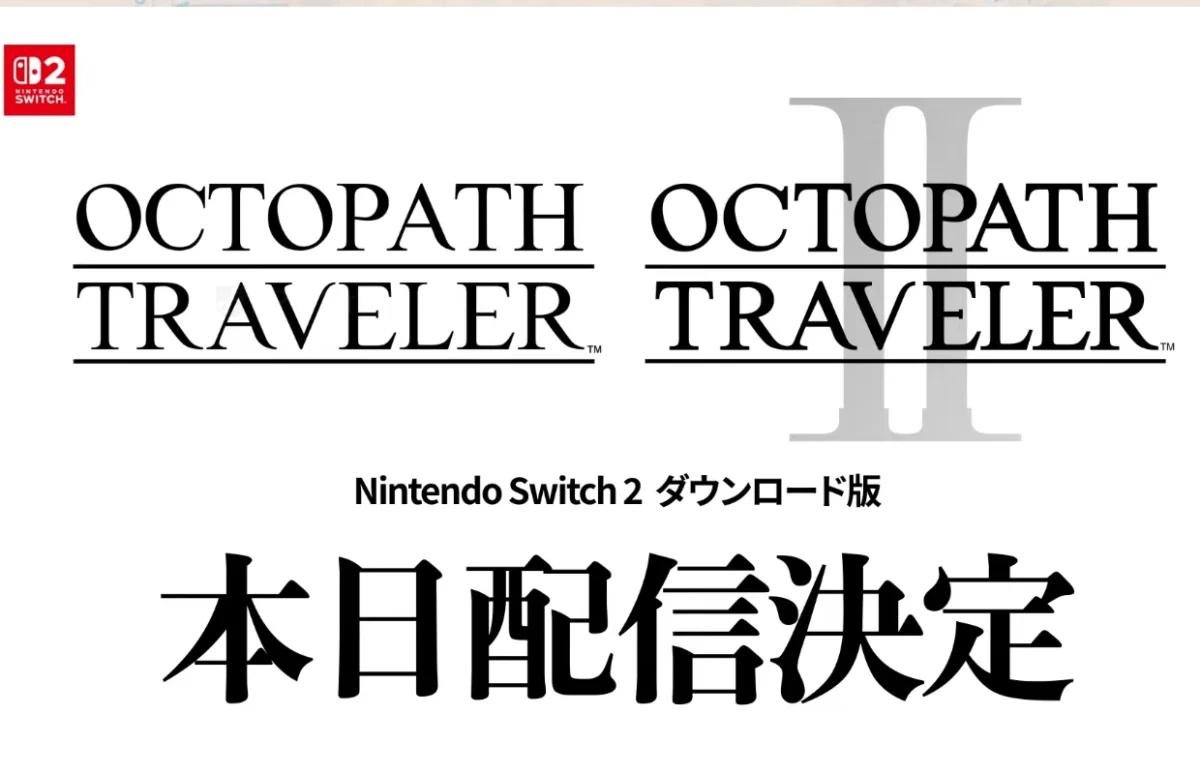
In a landmark development for the role-playing game (RPG) genre, Square Enix has officially confirmed that both Octopath Traveler and Octopath Traveler II are launching on the forthcoming Nintendo Switch 2. The announcement, delivered during a celebratory 8th-anniversary broadcast dedicated to the franchise, marks a significant milestone in the studio’s commitment to its most successful modern IP. By securing these titles for Nintendo’s next-generation hardware, Square Enix is positioning its acclaimed "HD-2D" aesthetic as a cornerstone of the upcoming console’s software library.
The Announcement: A Digital-First Strategy
During the livestream event, Square Enix representatives confirmed that both titles will be available for digital purchase on the Switch 2 storefront starting today. This "surprise drop" approach reflects a shift in modern marketing, favoring immediate player engagement over prolonged pre-order campaigns.
However, the announcement arrived with notable gaps in information. As of this writing, Square Enix has not disclosed whether existing owners of the original titles on the current Nintendo Switch will be eligible for a discounted upgrade path or a free "next-gen" enhancement. Furthermore, the company has remained silent on the prospect of save data transfers. For players who have poured hundreds of hours into their original playthroughs, the ability to migrate progress remains a primary concern. Industry analysts suggest that while cross-platform save transfers are notoriously complex, the lack of clarity here may stem from the technical architecture of the Nintendo Switch 2’s OS, which is currently shrouded in developer-only confidentiality.
A Chronological Odyssey: From Humble Roots to Global Success
To understand the significance of this expansion, one must look at the meteoric rise of the Octopath Traveler series.
The Birth of HD-2D (2018)
When the original Octopath Traveler launched on the Nintendo Switch in 2018, it was a risky experiment. Developed by Acquire and Square Enix, the game utilized a proprietary "HD-2D" visual style—a blend of 16-bit pixel art characters set against high-definition, depth-of-field-heavy 3D environments. Critics were skeptical, but the game became an immediate commercial success, proving that there was a massive, untapped appetite for retro-inspired JRPGs with modern production values.
Multi-Platform Proliferation (2019–2022)
Following its exclusive debut on the Switch, Octopath Traveler quickly expanded its reach. In 2019, it arrived on PC (Windows), followed by a surprise release on Xbox, and eventually PlayStation. This trajectory transformed the game from a niche Switch title into a global multi-platform franchise. The success of the first game solidified Square Enix’s confidence in the HD-2D engine, leading to the development of other titles such as Triangle Strategy and Live A Live.
The Refined Sequel (2023)
Octopath Traveler II launched in early 2023, refining every aspect of the original. It featured more interconnected character stories, expanded traversal mechanics (including the day/night cycle), and a more cohesive narrative structure. While it launched simultaneously on Switch, PS4, PS5, and PC, the Xbox version arrived later, cementing the series’ status as a ubiquitous staple across all major gaming ecosystems.
Supporting Data: Why the Switch 2 Matters
The decision to prioritize the Octopath Traveler series for the Switch 2 is not merely a nostalgia play; it is a calculated business maneuver.
Recent financial reports from Square Enix indicate that the "HD-2D" catalog consistently outperforms expectations in terms of long-term digital sales. Unlike AAA blockbusters that rely on massive initial sales spikes, Octopath Traveler maintains a "long tail" of profitability. By bringing these games to the Switch 2, Square Enix is ensuring that their titles are available on the hardware most closely associated with the franchise’s identity.
Furthermore, the technical capabilities of the Nintendo Switch 2—which, according to supply chain leaks, will offer significant improvements in thermal management and raw compute power—will likely allow the HD-2D engine to run at higher resolutions and more stable frame rates. While the art style is inherently stylized, the increased overhead on the Switch 2 will enable better post-processing effects, such as more sophisticated lighting, particle density, and dynamic shadow rendering, which are critical to the "depth" in HD-2D.
Official Responses and Developer Sentiment
In the wake of the announcement, the development team shared a brief statement expressing their excitement for the transition to the new hardware:

"Our journey began on the Nintendo Switch, and it feels only natural that our next chapter begins there as well. The HD-2D style is a love letter to the era of 90s RPGs, but we have always built it with an eye toward the future. The Nintendo Switch 2 offers us the canvas to present these stories with even greater clarity and immersion than ever before."
While the developers remained diplomatic about the lack of upgrade paths, community managers on social media platforms have acknowledged the player base’s inquiries. "We hear you regarding save data and upgrade paths," a representative posted on the official franchise X (formerly Twitter) account. "We appreciate your patience as we finalize the technical details of the transition to the new hardware."
Implications for the Industry and the Genre
The release of Octopath Traveler I and II on the Switch 2 has profound implications for the gaming landscape.
1. The Normalization of "Evergreen" Ports
We are entering an era where console generations are no longer hard resets. The seamless transition of the Octopath Traveler series suggests that Nintendo intends for the Switch 2 to be a platform where the library of the previous generation lives on, perhaps with iterative improvements. This is a massive win for consumer confidence, signaling that digital libraries are increasingly "portable."
2. The Resurgence of the Turn-Based RPG
For years, pundits claimed that the turn-based JRPG was dying, replaced by action-oriented titles like Final Fantasy XVI. The Octopath Traveler series proves that turn-based combat, when paired with high-end presentation and strategic depth, remains a viable and highly profitable model. By keeping these games at the forefront of the Switch 2’s launch window, Square Enix is sending a clear signal: the turn-based RPG is not just surviving; it is thriving.
3. Strengthening the Nintendo-Square Enix Partnership
The relationship between Nintendo and Square Enix has fluctuated over the decades. In the 90s, they were synonymous; in the 2000s, they drifted apart. The success of the Octopath series has effectively repaired this alliance. By choosing to highlight these games in a dedicated anniversary broadcast, both companies are signaling that their strategic partnership is stronger than it has been in two decades.
Future Outlook: What Lies Ahead?
As players begin downloading Octopath Traveler and its sequel on their new consoles, the question shifts from "what is coming?" to "what is next?"
With both titles now firmly established on the Switch 2, fans are already speculating about the possibility of a third entry in the series. Given the success of the HD-2D engine, it is highly probable that Octopath Traveler III—or an entirely new IP utilizing the same engine—is already in early development. The Switch 2 provides the perfect foundation for such a project to iterate upon the existing formula, perhaps introducing larger, more seamless open-world environments or even more ambitious multiplayer integration.
For now, the focus remains on the current announcement. The 8th anniversary of the franchise has served as a bridge between the past success of the Nintendo Switch and the future potential of the Switch 2. Whether you are a newcomer looking to experience the magic of Orsterra for the first time, or a veteran wanting to see how the games hold up on new hardware, the release of these titles marks the definitive way to play the Octopath saga.
As we await further clarification regarding save data and upgrade paths, the industry will be watching closely. If Square Enix handles the transition with player-friendly policies, it will set a gold standard for how publishers should manage the shift into the next generation of console gaming. Until then, the doors to Orsterra and Solistia are open, and the journey continues.

