

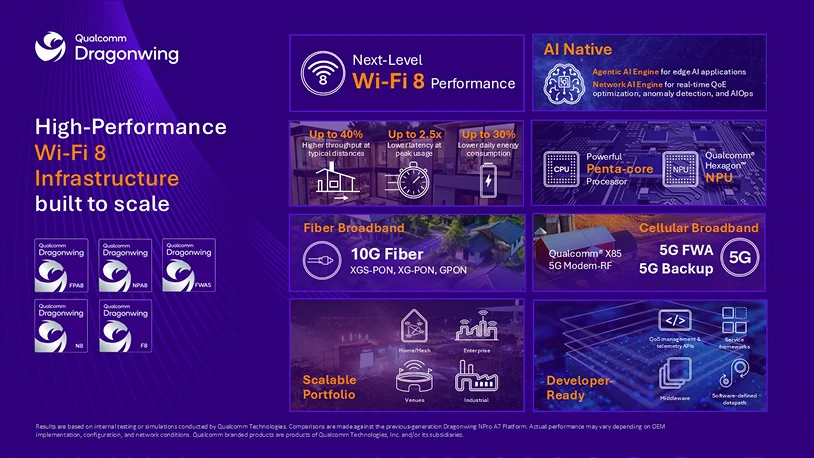
The wireless networking landscape is accelerating at a breakneck pace. Even though the Institute of Electrical and Electronics Engineers (IEEE) has yet to officially ratify the Wi-Fi 8 (802.11bn) specification, the hardware manufacturing and fiber-optic internet service provider (ISP) sectors are already sprinting toward the starting line.
In a surprising display of pre-emptive hardware deployment, networking giant TP-Link recently opened global preorders for its pioneering Wi-Fi 8 consumer router. Hot on those heels comes confirmation that GFiber—Alphabet’s high-speed fiber internet subsidiary—is preparing to roll out a proprietary Wi-Fi 8 Premium Gateway tailored specifically for its ultra-fast 20 Gbps fiber internet tier.
This aggressive push highlights a paradigm shift in the networking industry: rather than waiting for bureaucratic standardization to conclude, companies are betting heavily on early-adopter enthusiasm, surging bandwidth demands, and a corporate desire to future-proof home networks against the influx of heavy data consumers, augmented reality (AR) devices, and hyper-connected smart homes.
Main Facts
The race toward Wi-Fi 8 is no longer a distant theoretical roadmap; it is actively translating into physical consumer hardware.
- The Standard (802.11bn): Formally known as Ultra High Reliability (UHR), the Wi-Fi 8 specification prioritizes network stability, latency reduction, and massive congestion management over raw, headline-grabbing peak speed boosts (which were the primary focus of Wi-Fi 7).
- TP-Link’s Early Move: TP-Link made waves by opening global preorders for the world’s first consumer-facing Wi-Fi 8 router, signaling that consumer hardware production lines are already functional. However, regulatory hurdles—specifically a persistent FCC freeze—have kept the device out of the lucrative United States market for now.
- GFiber’s Enterprise-Grade Pivot: GFiber announced plans to introduce a custom-branded Wi-Fi 8 Premium Gateway. This hardware will serve as the wireless distribution backbone for the company’s elite 20 Gig internet plans, ensuring that subscribers can actually utilize multi-gigabit wireless throughput across their living spaces.
- The Regulatory Bottleneck: While international markets are seeing early rollouts and trial phases, manufacturers face significant bureaucratic friction in regions like the United States, where telecommunications regulators are moving cautiously regarding spectrum allocation and device certifications.
Chronology: How the Race to Wi-Fi 8 Unfolded
To understand how the industry reached a point where unratified standards are already powering consumer gateways, it is vital to look back at the rapid evolution of modern wireless networking.
1. The Wi-Fi 7 Era and Nascent Limitations (2023–2024)
As Wi-Fi 7 (802.11be) devices flooded the market with multi-link operation (MLO) and wider 320 MHz channels, internet service providers began offering multi-gigabit connections to residential homes. However, researchers and network architects quickly realized that while peak throughput had skyrocketed, real-world reliability in dense urban environments and congested smart homes still suffered from latency spikes and packet loss during heavy traffic loads.
2. The Conception of 802.11bn / Wi-Fi 8 (Late 2023–2024)
The IEEE task group working on the 802.11bn amendment—dubbed "Ultra High Reliability"—shifted the industry’s design philosophy. Instead of asking “How fast can we make a single connection?”, engineers asked “How stable and responsive can we keep 50 devices simultaneously?” TP-Link and other major chipset manufacturers began conducting closed-door trials, confirming successful early-stage data transmissions using pre-standard silicon.
3. TP-Link Shakes Up the Market (Late 2024)
In a move that caught many industry analysts off guard, TP-Link bypassed traditional product lifecycles by opening global preorders for its flagship Wi-Fi 8 router. The launch showcased the company’s confidence in the stability of the draft standard, though it immediately exposed geopolitical and regulatory complications as the U.S. market was left entirely off the initial distribution list.
4. GFiber Enters the Fray (Current Status)
Building upon the momentum generated by hardware manufacturers, fiber infrastructure providers recognized that selling 20 Gbps wired connections is pointless if the wireless router chokes the signal before it reaches a laptop or smartphone. GFiber’s announcement of its Wi-Fi 8 Premium Gateway marks the first major ISP integration of the next-generation standard, bridging ultra-fast fiber optics with ultra-reliable wireless distribution.
Supporting Data: Why Wi-Fi 8 Differs From Its Predecessors
Consumer skepticism regarding "pre-standard" hardware is entirely warranted; historically, buying draft-specification networking gear (such as early 802.11n routers) often resulted in compatibility nightmares once the final standard was officially ratified. However, manufacturers argue that modern software-defined architectures and iterative silicon designs mitigate these legacy risks.
Key Technical Focus Areas of Wi-Fi 8 (802.11bn)
| Feature | Wi-Fi 7 (802.11be) | Wi-Fi 8 (802.11bn) – Projected / Standardized Goals |
|---|---|---|
| Primary Design Goal | Maximum throughput and speed (up to 46 Gbps) | Ultra High Reliability (UHR) and latency reduction |
| Latency Management | Standard multi-link packet scheduling | Advanced coordinated spatial reuse and enhanced coordination across access points |
| Inter-Access Point Coordination | Limited / Basic mesh roaming | Dynamic multi-access point coordination to eliminate dead zones and co-channel interference |
| Target Audience | Early adopters looking for multi-gigabit wireless | Enterprise environments, dense smart homes, and multi-gigabit fiber subscribers (e.g., GFiber 20 Gig) |
While Wi-Fi 7 focused heavily on expanding channel bandwidth to 320 MHz and utilizing 4K QAM modulation to push raw numbers upward, Wi-Fi 8 addresses the quality of the connection. Features like Coordinated Beamforming and Enhanced Spatial Reuse mean that multiple routers or access points in a home or office can actively cooperate rather than competing for airtime. This is particularly vital for GFiber’s 20 Gig tier, where a single household might be running multiple 4K/8K video streams, competitive cloud gaming setups, and heavy data backups concurrently.
Official Responses and Industry Perspectives
The aggressive commercialization of unratified technology has sparked intense debate among industry insiders, standardization bodies, and consumer advocacy groups.
Manufacturer Perspective: Moving at the Speed of Demand
Speaking on condition of anonymity, product development leads at major networking firms argue that waiting for the IEEE to finalize a standard—a process that can notoriously take years of bureaucratic deliberation—leaves consumers stranded with outdated hardware while internet speeds at the wall continue to multiply.
"The infrastructure is moving faster than the paperwork," noted one senior hardware engineer. "When you are deploying 10-gigabit and 20-gigabit fiber connections to homes, the wireless router is no longer an accessory; it is the bottleneck. We cannot afford to wait for a rubber stamp to solve real-world latency and congestion issues that our customers are facing today."
The Regulatory Hurdle: The FCC Freeze
The enthusiasm surrounding early Wi-Fi 8 hardware has been heavily tempered by regulatory realities. TP-Link’s exclusion of the United States from its initial product launch highlights a growing friction between global hardware manufacturers and local regulatory bodies like the Federal Communications Commission (FCC).
U.S. regulators have maintained strict compliance guidelines regarding spectrum utilization, dynamic frequency selection (DFS), and the deployment of draft-standard wireless chips. Industry analysts point out that until the FCC thaws its cautious stance on pre-standard UHR hardware, American consumers will be forced to watch international markets test and adopt Wi-Fi 8 innovations from the sidelines.
ISP Strategy: GFiber’s Value Proposition
For GFiber, integrating a Wi-Fi 8 gateway into its elite 20 Gig packages is a calculated strategic move. By controlling both the physical fiber pipeline running into the home and the wireless gateway broadcasting the signal, GFiber aims to eliminate the friction points that typically frustrate ultra-high-tier subscribers.
An official GFiber spokesperson emphasized that providing a gateway designed to handle extreme multi-gigabit throughput wirelessly ensures that consumers paying for top-tier bandwidth can actually experience the performance they are billed for, without being bottlenecked by legacy Wi-Fi 6E or early Wi-Fi 7 router limitations.
Implications: What This Means for Consumers and the Market
The premature arrival of Wi-Fi 8 hardware carries profound implications for the consumer technology landscape over the next three to five years.
1. Fragmentation vs. Acceleration
The market now faces a period of fragmentation. International consumers in regions with relaxed or progressive regulatory environments will enjoy early access to ultra-reliable, coordinated wireless hardware. Conversely, consumers in the United States and heavily regulated territories may experience a prolonged delay before these devices clear compliance hurdles. This creates a two-tiered global market where "draft-spec" hardware becomes a battleground for early adopters.
2. The Death of the Wi-Fi Bottleneck
For years, the promise of fiber internet has outpaced the capabilities of home wireless routers. Even with gigabit fiber, users frequently noticed performance drops when moving away from the primary Ethernet connection. With ISPs like GFiber deploying custom Wi-Fi 8 gateways designed for 20 Gig pipes, the gap between wired and wireless performance will narrow dramatically. Network jitter will decrease, making cloud gaming, virtual reality, and real-time remote collaboration virtually indistinguishable from local machine processing.
3. Hardware Obsolescence Anxiety
Early adopters who rushed to purchase expensive Wi-Fi 7 routers over the past year may experience mild buyer’s remorse seeing manufacturers pivot toward Wi-Fi 8 enhancements. However, industry experts stress that Wi-Fi 8 is an evolutionary refinement of the underlying wireless architecture rather than a disruptive tear-down. Most Wi-Fi 8 hardware will maintain backward compatibility, ensuring that existing devices will still connect seamlessly, even if they cannot take advantage of the advanced UHR coordination features.
4. Looking Ahead to Official Ratification
As TP-Link fulfills its global preorders and GFiber begins rolling out its Wi-Fi 8 Premium Gateway, the IEEE is watching an unprecedented live-fire test of its draft specification. The real-world telemetry gathered from these early deployments will likely influence the final touches on the 802.11bn standard. If these early gateways prove stable and resilient under heavy consumer loads, it will validate a new era of hardware development—one where agile manufacturing outpaces traditional bureaucratic timelines to meet the insatiable human demand for faster, more reliable digital connectivity.

