

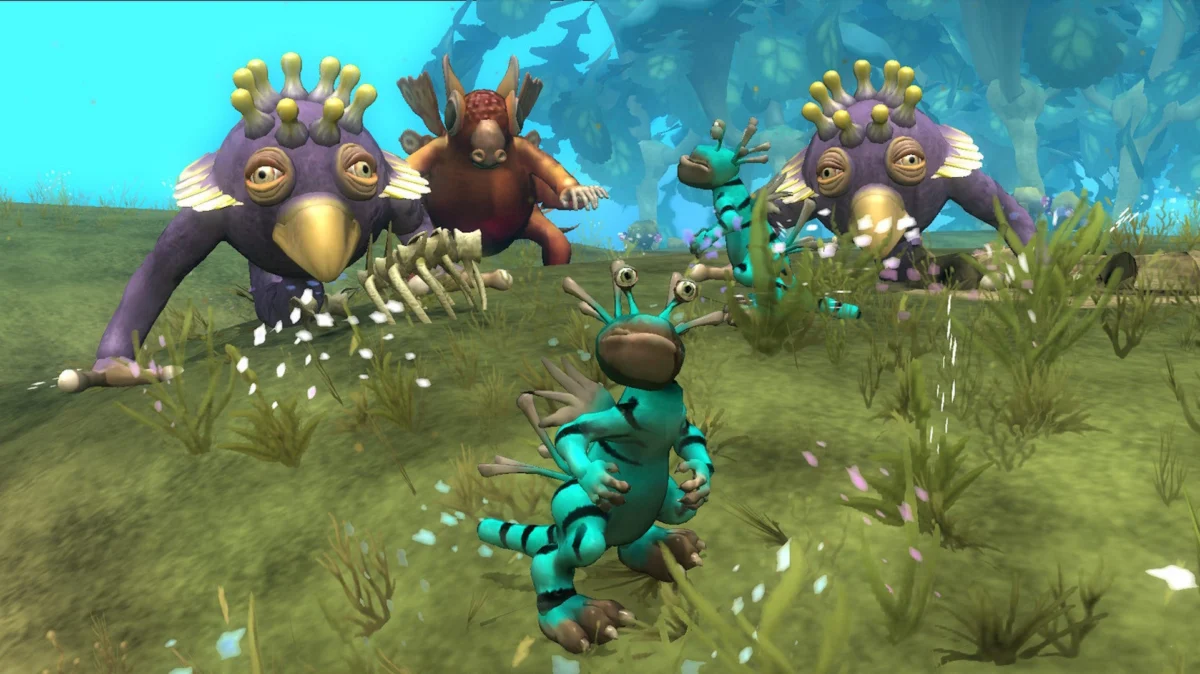
Sixteen years after its release, Spore remains one of the most polarizing artifacts in the history of interactive entertainment. To some, it was a profound disappointment—a title that promised the entire universe and delivered a fragmented collection of minigames. To others, it was an unparalleled creative sandbox that pushed the boundaries of procedural generation and player expression.
A sprawling new retrospective published by The Design Room has finally pulled back the curtain on the nine-year development cycle of the Maxis magnum opus. Through interviews with the game’s core architects, including founder Will Wright and art director Ocean Quigley, the industry has gained a candid look at how one of gaming’s most celebrated studios lost its way while chasing the infinite.
The Genesis of a Dream: A Chronology of Scope Creep
To understand Spore, one must understand the era of its conception. Following the meteoric, record-shattering success of The Sims, Will Wright enjoyed a level of creative latitude that was—and arguably remains—unprecedented in the corporate landscape of Electronic Arts (EA).
1999–2003: The Prototype Phase
The project began as an exploration of evolutionary biology and cosmic scale. Wright, fascinated by the concept of "everything," envisioned a game that would allow players to shepherd a species from a microscopic pond to the edges of the galaxy. During these early years, the team was lean, experimental, and driven by high-concept procedural generation. The technology was groundbreaking, but the mechanical glue required to hold the various phases together was absent.
2004–2006: The "Luminary" Management Gap
As the vision for Spore expanded, so did the studio. Maxis ballooned from a boutique team to a workforce of over 100 developers across two buildings. This period marked the beginning of the "operational crisis." Wright, occupied by his status as a gaming industry luminary, was frequently absent, leading to a vacuum in top-down decision-making. Lead gameplay designer Alex Hutchinson noted that the lack of a structured design process meant that the project lacked a central thesis to anchor the diverse mechanics of the cell, creature, tribe, civilization, and space stages.
2007–2008: The Final Push and Fragmentation
By the time the game neared its 2008 release, the "five games in a trench coat" reality became impossible to ignore. The team struggled to unify the disparate gameplay loops. As Ocean Quigley candidly remarked, "We wound up with these disconnected bits and pieces. And for that, I kind of have to blame Will. That was Will’s job." The game arrived on shelves with immense marketing hype, only to face a critical reception that mirrored the internal confusion of its developers.
The Operational Paradox: When Brilliance Fails to Cohere
The most striking revelation from the retrospective is the paradox of talent. Following EA’s acquisition of Maxis, the studio became a magnet for top-tier industry veterans. However, this assembly of "the smartest person in every room" created a unique management hurdle.
Chris Trottier, a gameplay designer on the project, highlighted the struggle: "How can I be brilliant in parallel with 100 other brilliant people and have it somehow cohere? That became the operational problem."
The Absence of Crisis
In the high-stakes world of AAA game development, a "sense of crisis" is often the catalyst for clarity. Deadlines, budget cuts, and publisher mandates act as guardrails that force designers to cut the "fat" and focus on core loops. Spore suffered from the inverse: it had too much freedom. Because Wright had generated a "bajillion dollars" for EA with The Sims, he was effectively insulated from the standard pressures of the industry.
"They gave us a ton of leash," recalled lead engineer Chris Hecker. "We never felt pressure." While this allowed for the creation of the game’s revolutionary procedural creature creator—a tool that still sees use in educational and hobbyist spaces today—it also allowed for the proliferation of "half-baked ideas." Without a crisis to force a narrowing of focus, the game remained a collection of disparate experiments rather than a unified experience.
Supporting Data: The Cost of "Going Crazy"
The financial implications of Spore are a testament to the "auteur theory" of game development. While exact figures are rarely disclosed with total transparency, the nine-year development cycle involving 100+ employees represents a massive capital investment.
- Development Cycle: ~9 years (1999–2008).
- Team Size: 100+ personnel.
- The "Leash" Factor: Due to The Sims revenue, EA provided a level of financial immunity that few projects ever enjoy.
- Technical Achievement: Despite the design failures, the game’s procedural animation and procedural audio systems remain benchmarks for technical innovation.
The lack of fiscal constraint, while lauded by the developers as an "honor," ultimately led to a product that was structurally unsound. The team effectively traded commercial and critical cohesion for the ability to explore "insane" concepts, a trade-off that both Wright and his team seem to view with a mix of pride and regret.
Official Responses and Reflections
The retrospective is defined by the honesty of its participants. There is no attempt to rebrand Spore as a misunderstood masterpiece; rather, there is an acceptance of its status as a noble, if flawed, failure.
"I think Spore was overall a failed game design," Will Wright admitted. His acceptance of this criticism is a rare moment of humility from a designer of his stature. However, he quickly pivots to the emotional core of the project: "but it had more magic in it than most games did."
This sentiment is echoed by Chris Hecker, who argues that the game’s legacy isn’t found in its disjointed gameplay stages, but in the specific, unrepeatable moments of joy experienced by the player. The ability to upload a creature, have it populate another player’s galaxy, and see it evolve through a procedural lens was a technical marvel that transcended the "gamey" aspects of the experience.
Implications for Modern Game Development
The story of Spore serves as a cautionary tale for modern AAA studios. In an era where "live service" models and strict publisher oversight often stifle creativity, Spore stands as the extreme opposite. It is the ultimate case study in what happens when "luminary" leadership is detached from day-to-day operations and when unlimited creative freedom lacks a steering mechanism.
Key Takeaways for the Industry:
- The Necessity of Conflict: Creative friction is often necessary to refine a vision. Without a "sense of crisis" or a clear editorial voice to say "no," projects suffer from feature creep.
- The Cohesion Problem: A game consisting of several excellent parts is not necessarily an excellent game. The connective tissue—the "repeating mechanic" that spans the entire experience—is the most vital component of design.
- The Longevity of Innovation: Despite its design failings, Spore continues to be discussed sixteen years later because it dared to innovate at the architectural level. Procedural generation has since become a cornerstone of the industry, and Spore was its most ambitious proving ground.
Conclusion: The Magic in the Failure
Ultimately, Spore occupies a unique space in the cultural canon of gaming. It is a "failed" design that succeeded in creating a sense of wonder that few polished, coherent titles ever achieve. The retrospective reveals a team of brilliant, exhausted individuals who were given the keys to the kingdom and used them to build a monument to their own ambition.
As the industry continues to grapple with the tension between corporate efficiency and artistic exploration, the story of Spore will remain a vital reference point. It reminds us that while the "magic" is what players remember, the "game design" is what makes that magic sustainable. For all its flaws, Spore stands as a testament to a time when developers were allowed to be grandiosely, beautifully, and catastrophically wrong.

