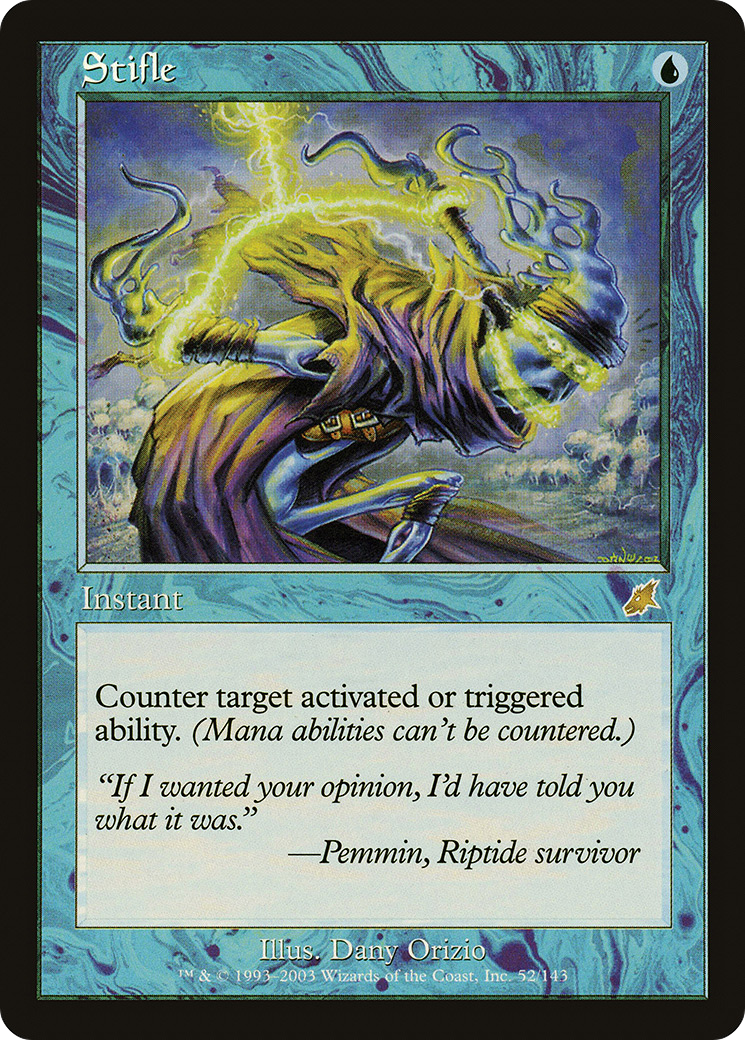
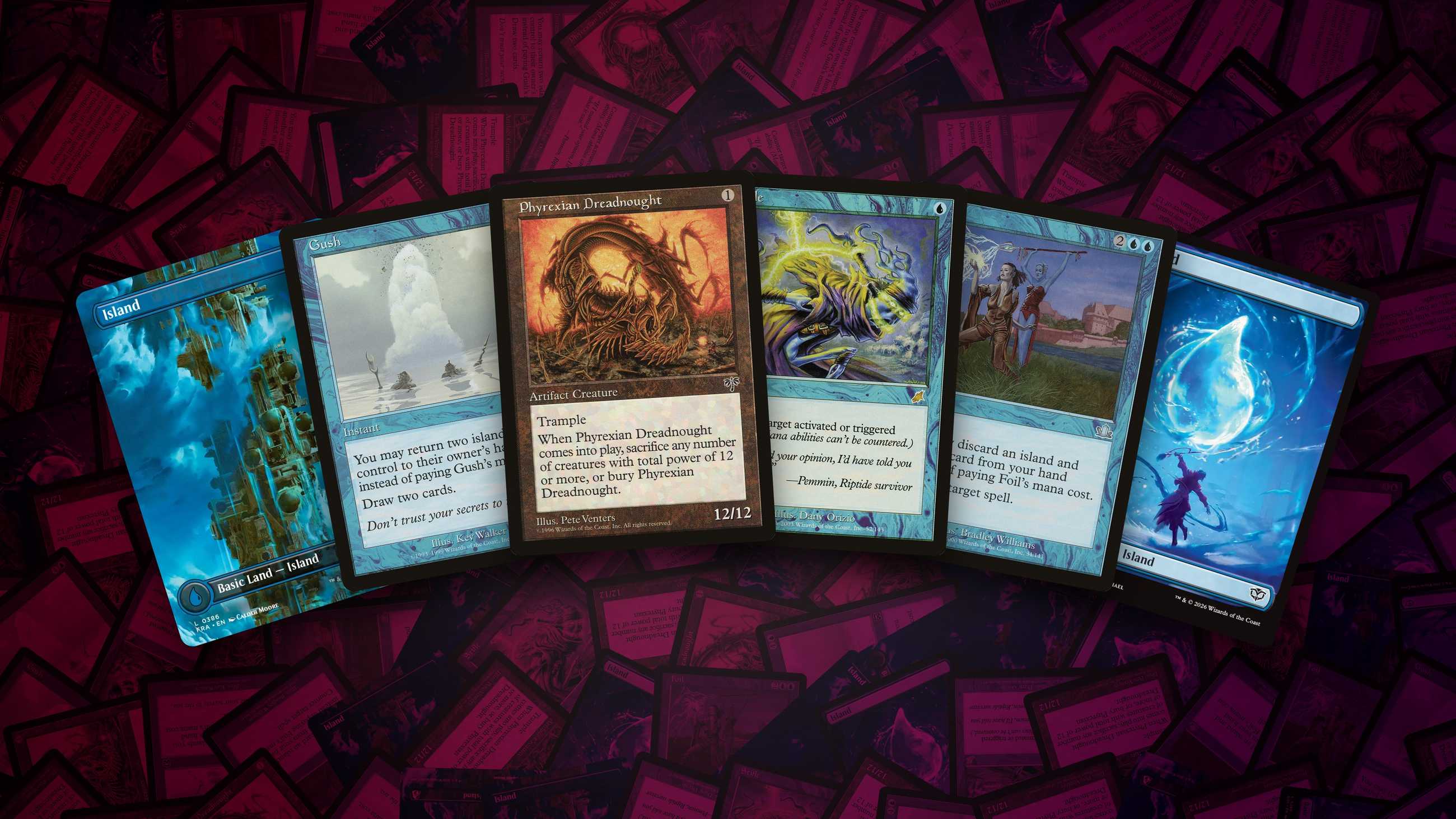
Spend enough time in Magic: The Gathering Online’s Premodern best-of-three queue and, sooner or later, you will encounter a chilling sequence: Your opponent plays a turn-one Island and passes. You think, "Control deck. Got it." You lead with a Forest and play a Birds of Paradise. Next turn comes, and there’s another Island on your foe’s side—followed instantly by Phyrexian Dreadnought and an immediate Stifle to counter the Dreadnought’s triggered ability. Boom: There’s a 12/12 trampler staring you down on turn two. Welcome to Premodern. You’ve just met Phyrexian Dreadnought and "Stiflenought," the powerhouse combo-control deck built around abusing one of the most ridiculous creatures in Magic history.
As Magic: The Gathering’s Mirage expansion marks its 30th anniversary, perhaps no card from the landmark set has enjoyed a stranger afterlife than Phyrexian Dreadnought. The one-mana 12/12 artifact creature has transitioned from an oddball relic of early Magic design into one of the defining threats of Premodern, the fan-created eternal format celebrating cards from the game’s first decade.
Main Facts: The Anatomy of a Modern-Day Monster
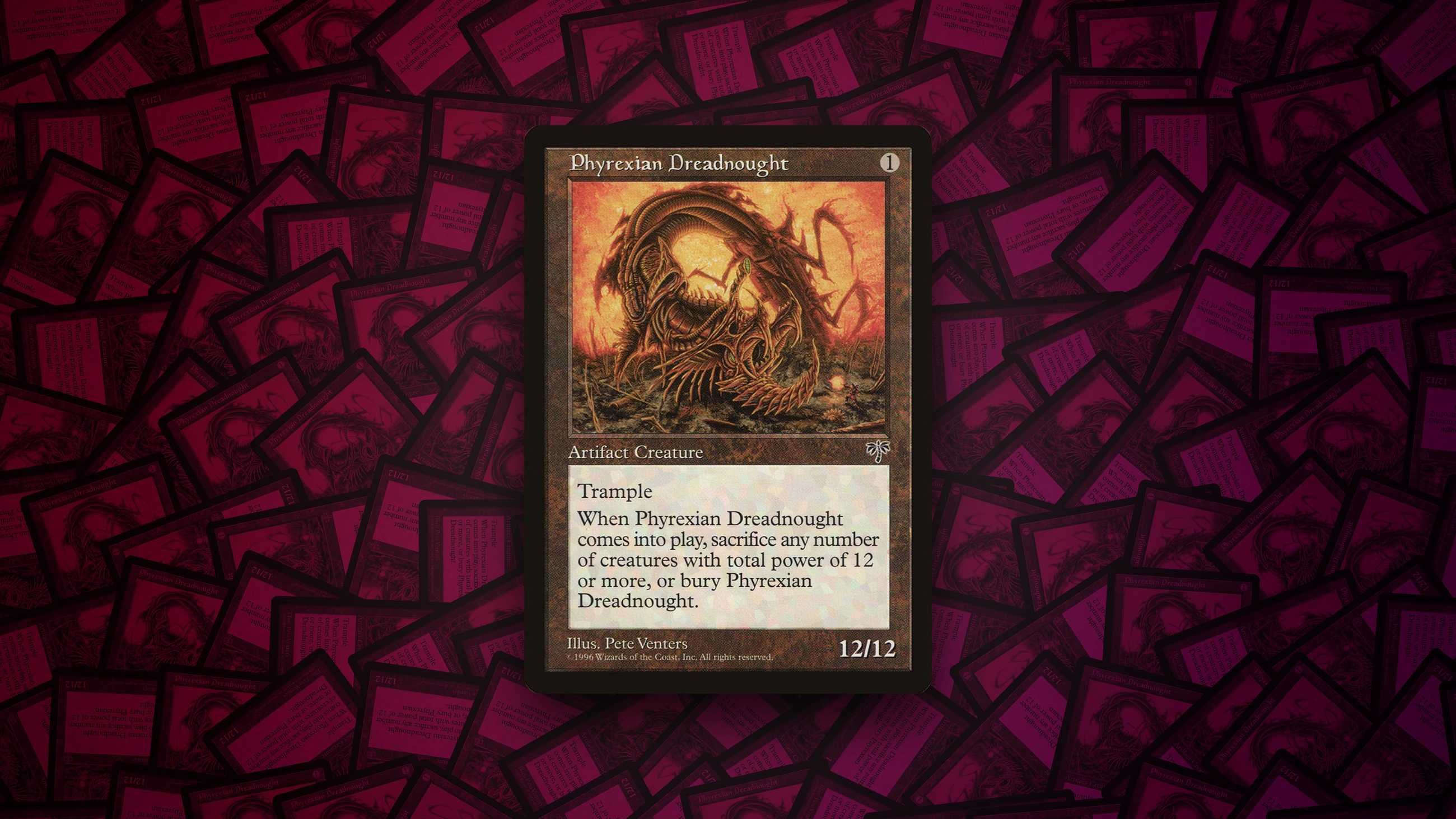
At its core, the "Stiflenought" archetype revolves around a breathtakingly cheap yet massive threat. Phyrexian Dreadnought costs just one generic mana to cast, but upon entering the battlefield, it demands a steep sacrifice: its controller must sacrifice creatures with a total power of 12 or greater, or else the Dreadnought itself goes to the graveyard.
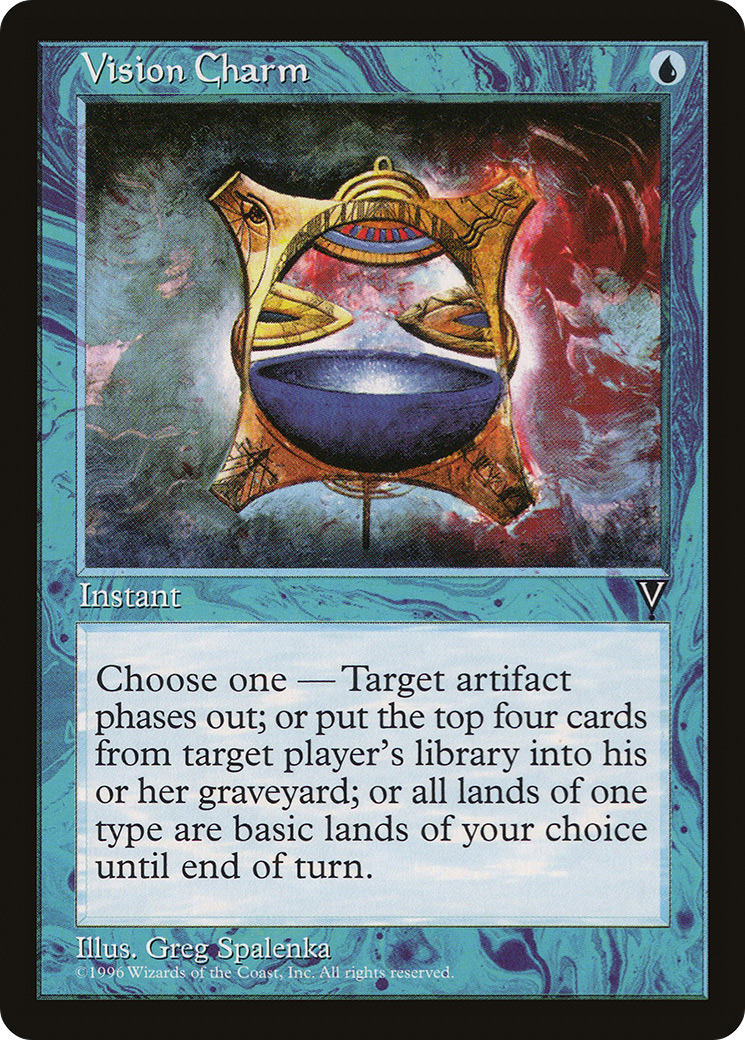
On paper, this was meant to be a devastating handicap. In practice, inventive players realized they could bypass the sacrifice restriction by using instant-speed interaction—specifically Stifle (to counter the triggered ability) or Vision Charm (to phase the artifact out before the trigger resolves).
Key Characteristics of the Stiflenought Strategy:
The Payoff: A 12/12 creature with trample for a total mana investment of typically one to two mana.
The Enablers: Stifle, Vision Charm, and heavy disruption suites.
The Format: Premodern, an officially unsupported yet widely popular fan format encompassing expansions from Fourth Edition (1995) through Scourge (2003).
The Community Moniker: Affectionately nicknamed the "Shrimp" by competitive players despite its towering lore and physical proportions.
Chronology: From 1996 Design Rooms to 2026 Competitive Metas
The journey of Phyrexian Dreadnought is a testament to how evolving rules, emergent playstyles, and unexpected synergies can rewrite a card’s destiny over three decades.
1996: The Birth of the 12/12
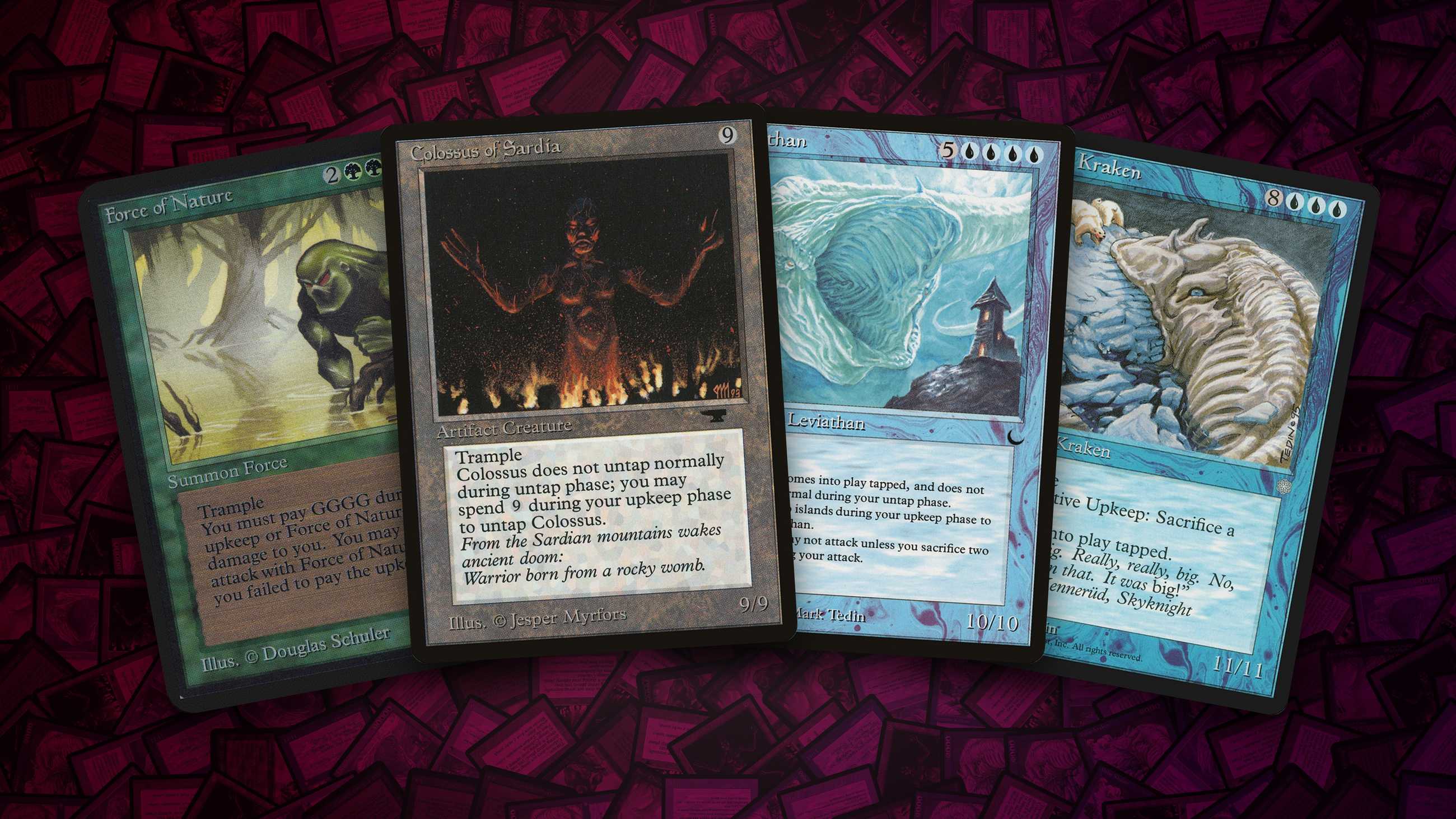
Phyrexian Dreadnought debuted in Mirage, Magic’s ninth expansion. Head designer Mark Rosewater has previously explained that the card grew out of a running arms race among early designers to continually one-up the largest creature ever printed. Alpha introduced the 8/8 Force of Nature, followed by Antiquities’ 9/9 Colossus of Sardia, The Dark’s 10/10 Leviathan, and Ice Age’s 11/11 Polar Kraken. When Rosewater pushed for a 12/12 in Mirage, lead designer Bill Rose demanded it be interesting. Rosewater’s response was an audacious 12/12 trampler for a single mana.
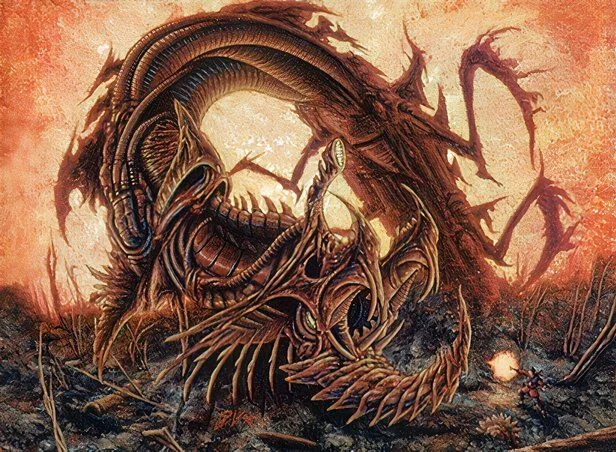
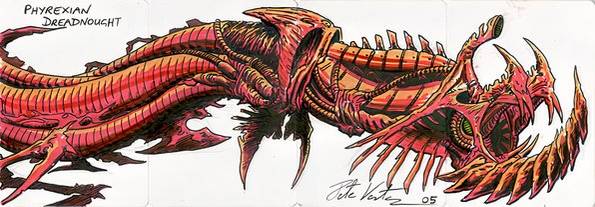
Simultaneously, legendary illustrator Pete Venters shaped the card’s visual identity. Having heard rumors of a 12/12 creature in the hallway from Rosewater, Venters campaigned to illustrate it. Influenced by H.R. Giger’s biomechanical aesthetics and Sandra Everingham’s Yawgmoth Demon, Venters sketched the sinuous wyrm. In a classic hidden detail, he placed a tiny early Planeswalker, Taysir, in the bottom-right corner to emphasize the monster’s colossal scale.
1999–2007: The Rules Overhauls
The card did not always function as it does today. Sweeping rule changes—most notably the introduction of the stack in Sixth Edition (1999)—fundamentally altered how timing and triggers worked. Wizards of the Coast initially issued power-level errata to prevent players from using tricks to cheat the Dreadnought’s cost. However, in 2007 with the Tenth Edition Oracle updates, Wizards rolled back power-level errata across the game.
This policy shift, paired with the printing of Scourge’s Stifle in 2003, finally unlocked the modern Stiflenought synergy. Players could now legally let the Dreadnought enter, place its sacrifice trigger on the stack, and counter it or phase the creature out.
Supporting Data and Strategic Depth: More Than Just a "Simple Combo"
While a turn-two 12/12 sounds like an automatic win, competitive specialists emphasize that Stiflenought is an exceptionally fragile and demanding archetype.
Andrea Piemonti (known in the community as PieGonti, author of prominent Stiflenought guides) highlights the inherent risks of the build:
"The complexity of Stiflenought comes from the fragility of the strategy — the two-for-one problem. When you’re building a Phyrexian Dreadnought, you’re always two-for-one-ing yourself."
Mathematical and Strategic Realities:
Opening Hand Probability: According to community calculations, players have roughly a 24.37% chance of opening both a Dreadnought and an enabler (Stifle or Vision Charm) in their starting seven cards.
Resource Management: Because the dream hand isn’t guaranteed, pilots must rely on cantrips like Gush, Flash of Insight, and heavy counterspell suites to navigate matches.
Advanced Sequencing: Skilled players routinely execute counterintuitive plays—such as bouncing their own lands with Gush to deny opponents free artifact-destruction targets like Mogg Salvage—proving that the deck demands deep tactical foresight.
PieGonti notes:
"An excellent Stiflenought player is like an encyclopedia of what can go wrong… When you lose with Stiflenought, it feels like losing in chess, where there’s a clearly best line you didn’t take."
Official Responses and Creator Reflections
The resurgence of early-era cards through formats like Premodern has caught many original creators by surprise. Pete Venters notes that while he is thrilled by the renewed interest, the sheer volume of old-school cards resurfacing has drastically impacted his convention schedule.
"Premodern has certainly turned that up to 11 for me, as the legal sets for the format are a snapshot of my most prolific time in Magic," Venters shared with interviewers. "It’s certainly made my signing events extra-busy."
Venters also reflected on how community culture shapes cards, expressing amusement at the affectionate "Shrimp" nickname given to his terrifying biomechanical creation:
"I’d heard the Dreadnought called ‘Shrimp’ — which I think is hilarious — but I wasn’t aware it was taking on full mascot status."
Implications: The Enduring Appeal of Retro Formats
The enduring popularity of Stiflenought and the Premodern format highlights a broader philosophical truth about trading card games: cards never truly die; their contexts simply shift.
While modern Magic: The Gathering prioritizes rotation, digital integration, and fast-paced sets, formats centered around fixed, older card pools prove that players relish historical depth. Rules changes, emergent deck-building, and nostalgic art transform forgotten cardboard into competitive centerpieces.
As PieGonti aptly summarizes:
"Some of us will play Dreadnought and try to win tournaments because it’s how we see Magic: blue, fun, hard, cantrips, and counters. And sometimes you win by slamming a 12/12 on turn two, something even my dog can accomplish."