

For most technology enthusiasts, building the ultimate custom PC involves balancing high-end components, liquid-cooling loops, and aesthetically pleasing RGB lighting within a reasonable budget. However, at the absolute apex of luxury hardware, normal rules of cost-to-performance do not apply.
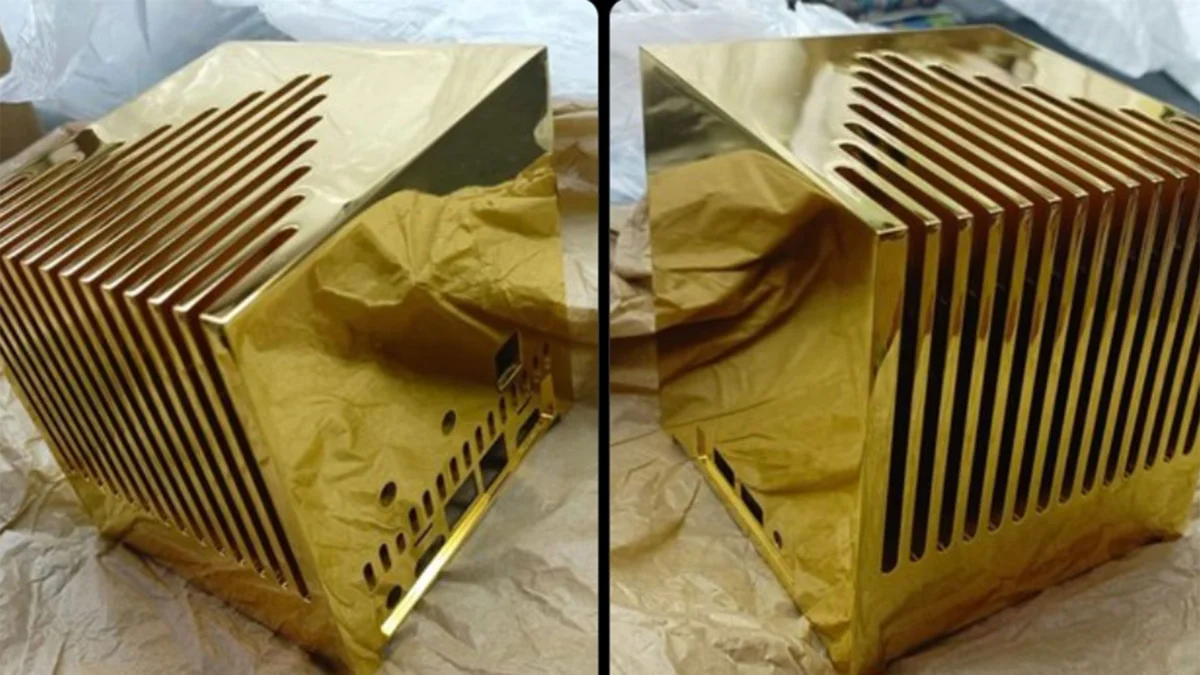
According to a recent report by Fanless Tech, a dedicated "chrysophile"—a lover of gold and golden objects—has commissioned a bespoke, one-of-a-kind mini PC housed in a pure 24-carat gold passive chassis. Based on the compact Kubb Fanless system, this ultra-opulent machine carries an eye-watering price tag of approximately $1.7 million.
While the computing world is no stranger to expensive hardware—often dominated by diamond-encrusted smartphones, gold-plated gaming consoles, and limited-edition components like ASUS’s gilded ROG Astral RTX 5090 Dhahab Edition—this custom mini PC takes materialism and functional engineering to an entirely new echelon. Beyond its staggering financial cost, the device offers a fascinating case study in material science, thermal conductivity, and the extreme limits of luxury PC modding.
Main Facts
At its core, the custom machine is an opulent evolution of the commercially available Kubb Fanless PC, a compact desktop known for its silent, convection-cooled design.
- The Chassis: The standard aluminum housing of the Kubb has been entirely replaced with a custom-milled chassis crafted from pure 24-carat gold.
- Dimensions: Despite its precious metal makeup, the machine retains the diminutive footprint of the original, measuring roughly 5 inches cubed (120 x 120 x 120 mm).
- Price Tag: The system is valued at approximately $1.7 million, with the vast majority of the cost driven by the sheer weight and spot price of the precious metal used in the build.
- Weight Gain: The transition from lightweight aluminum to heavy gold drastically impacts the machine’s physical heft. The standard model weighs a modest 4.6 pounds (2.1 kg), but the 24K gold variant tips the scales at a staggering 28.7 pounds (13 kg).
- Thermal Performance: While utterly impractical for the average consumer, gold possesses superior thermal conductivity compared to standard aluminum, aiding the passive, fanless cooling architecture.
Chronology: From Concept to Golden Reality
The journey of the $1.7 million Kubb Fanless PC highlights the intersection of bespoke jewelry crafting and high-end computer engineering. While exact details of the commissioning process remain private due to client confidentiality agreements, the project followed a meticulous timeline typical of ultra-high-end luxury goods.
Phase 1: The Brief and Feasibility Studies
The project began when an anonymous collector approached high-end boutique modders with a simple, albeit extreme, request: to build a fully functional, zero-noise workstation constructed entirely from pure gold. Standard PC chassis are typically made from aluminum, steel, or tempered glass because these materials offer structural rigidity at a manageable weight and cost. Gold, by contrast, is notoriously soft, malleable, and dense. Engineers had to determine whether a pure 24-carat gold chassis could structurally support internal computer components without sagging, warping, or failing under its own weight.
Phase 2: Material Sourcing and Precision Milling
Unlike gold plating or gold-anodized aluminum—common techniques used to give electronics a golden sheen without breaking the bank—this project required solid blocks of high-purity gold. Sourcing and verifying the bullion required strict security protocols. Once acquired, the gold was subjected to computer-numerical-control (CNC) milling to replicate the exact internal geometry, heat-dissipating fins, and structural mounts of the Kubb Fanless chassis.
Phase 3: Assembly and Thermal Tuning
Integrating the internal hardware into the gold chassis presented a unique engineering hurdle. Because gold is dense and heavy, every mounting point had to be reinforced to protect delicate PCBs, solid-state drives, and processors from vibration or structural stress. Once assembled, the system underwent rigorous thermal testing to ensure that the passive cooling capabilities matched—or exceeded—the baseline performance of the aluminum counterpart.
Phase 4: Public Disclosure
The existence of the ultra-luxury machine came to light when industry publication Fanless Tech detailed the build specifications in September 2026. The revelation quickly circulated through enthusiast communities, drawing comparisons to other exorbitantly priced hardware releases of the era.
Supporting Data: Engineering and Economic Breakdown
To understand the sheer absurdity and technical reality of the 24K Gold Kubb Fanless PC, it helps to examine the raw data comparing it to its standard consumer counterpart.
Specifications Comparison Table
| Feature | Standard Kubb Fanless PC | 24K Gold Custom Kubb PC |
|---|---|---|
| Chassis Material | Anodized Aluminum | Pure 24-Carat Gold |
| Dimensions | 120 x 120 x 120 mm (~5 inches) | 120 x 120 x 120 mm (~5 inches) |
| Weight | 4.6 lbs (2.1 kg) | 28.7 lbs (13 kg) |
| Cooling Method | Fanless / Passive Convection | Fanless / Passive Convection |
| Estimated Price | ~$1,000 – $2,500 (depending on specs) | ~$1,700,000 |
| Thermal Conductivity | ~205 W/m·K (Aluminum 6061) | ~310–318 W/m·K (Pure Gold) |
The Physics of Gold as a Heatsink
From a purely scientific perspective, gold is a fascinating material for thermal management. Thermal conductivity measures a material’s ability to conduct heat.
- Copper sits at the top of common practical heatsink materials with roughly 401 W/m·K.
- Gold follows closely behind, boasting a thermal conductivity of approximately 310 to 318 W/m·K.
- Aluminum, the industry standard for lightweight PC cases and basic CPU coolers, lags behind at around 205 W/m·K (depending on the specific alloy).
This means that pure gold transfers thermal energy more efficiently than aluminum. In a fanless PC—where silent operation relies entirely on the chassis acting as a massive heatsink to dissipate heat via convection and radiation—gold theoretically provides an exceptional thermal medium.
However, economics prevent gold from ever replacing aluminum or copper in mainstream computing. Copper is heavy and expensive; gold is exponentially heavier and astronomically more expensive. At current market prices, building a standard-sized full tower gaming chassis out of solid gold would push valuations into the tens of millions of dollars, rendering it structurally and financially unviable.
Official Responses and Industry Reactions
The announcement of a $1.7 million mini PC sent ripples through the tech community, eliciting a mixture of awe, amusement, and pragmatic skepticism from hardware reviewers, modders, and economists alike.
The Modding Community
Independent PC modders viewed the project as an extreme exercise in artisan craftsmanship. While modifying cases with custom paint, wood veneers, or carbon fiber is common, working with precious bullion requires specialized jewelry-making tools and metallurgical expertise.
"When you cross into the realm of precious metals, you aren’t just building a computer anymore; you’re creating a piece of fine art that happens to run an operating system," noted one prominent custom-loop designer in a forum discussion following the leak. "The thermal benefits are a neat scientific bonus, but let’s be honest—nobody is buying a gold PC for better thermals. They are buying it because they can."
The PC Enthusiast Reaction
On platforms like Reddit and Tom’s Hardware comment sections, reactions were heavily laced with internet humor. Many users pointed out the fundamental irony of housing rapidly depreciating technology inside a perpetually appreciating asset:
- “Imagine spending $1.7 million on a PC just for Windows to force an automatic update while you’re rendering a video.”
- “Specs are temporary, gold is forever. When this CPU becomes obsolete in five years, you can just melt the case down and buy a house.”
- “At nearly 29 pounds for a 5-inch cube, you don’t put this on your desk—you bolt it to the floor so nobody can run away with your desktop.”
Manufacturer Stance
Boutique builders who specialize in luxury technology often operate under strict discretion. Companies like Palm Silicon (the creators behind the Kubb line) and specialized luxury customizers have largely declined to comment on the identity of the buyer, maintaining the strict confidentiality expected by high-net-worth clientele who purchase multi-million-dollar custom tech.
Implications: What the $1.7M PC Means for the Future of Luxury Tech
While the 24K Gold Kubb Fanless PC is an extreme outlier that will never see mass production, it highlights several broader trends in the modern technology landscape.
1. The Ultra-Luxury Tech Niche is Expanding
As global wealth concentration grows, the market for hyper-exclusive, bespoke technology continues to expand. We have long seen gold-plated iPhones, diamond-encrusted smartwatches, and custom luxury automobiles. The migration of this trend into high-end computing—exemplified by products like the gilded ROG Astral RTX 5090 and now this pure gold mini PC—proves that technology is increasingly viewed as a status symbol on par with luxury watches and fine art.
2. Material Science vs. Practicality
The project serves as a physical demonstration of material limits. It proves that while exotic materials like gold can technically improve performance metrics (such as thermal conductivity), the law of diminishing returns makes it entirely impractical for consumer electronics. An aluminum or copper heatsink achieves 95% of the thermal performance at 0.01% of the cost.
3. The Absurdity of Obsolescence in Luxury Goods
Perhaps the most profound implication of the $1.7 million PC is the philosophical clash between computing hardware and luxury assets. Computers are inherently disposable; processors become obsolete, software requirements evolve, and hardware degrades over time. Conversely, gold is eternal.
By fusing the two, the buyer has created an object caught in a permanent identity crisis: a high-end workstation that will inevitably be outperformed by a $500 laptop in a few years, yet encased in a multi-million-dollar vault-worthy shell that will retain its intrinsic value indefinitely. Whether viewed as the ultimate expression of technological indulgence or the ultimate exercise in excess, the golden Kubb PC secures its place as one of the most eccentric hardware creations of the decade.

